A Short History: From Disaster to Icon
By the mid-1800s, the Lowveld had been very nearly emptied of its wildlife. Hunters operating without restriction had devastated populations that had existed for millennia. Ivory traders and skin merchants had taken the rest. An outbreak of rinderpest in 1896 then killed thousands more animals in a matter of months. The landscape was, by the end of the century, something close to a wasteland.
Into this situation stepped Paul Kruger, the president of the Transvaal Republic — a bearded, formidable Boer statesman who had spent his life on the African veld and understood, with the directness of someone who had watched it happening, what its destruction meant. In 1898, against significant opposition from landowners, hunters, and commercial interests who all saw the land as productive territory being locked away from them, Kruger persuaded the Transvaal parliament to proclaim the Sabie Game Reserve: a protected area between the Crocodile and Sabie Rivers where hunting would be prohibited. It was not a popular move. Many thought it foolish. History has judged otherwise.
After the Anglo-Boer War, in 1902, a Scottish army officer named James Stevenson-Hamilton was appointed as the first warden of the reserve. The local Shangaan people called him "Skukuza" — he who sweeps clean — a name that gives you a reasonable picture of his management style. He spent 44 years in the Kruger, banned hunting, pushed back poachers and farmers and mining interests with equal tenacity, extended the reserve's boundaries, and argued persistently to anyone who would listen that a protected wilderness sustained by tourism was a more valuable asset to the nation than anything that could be done with the land commercially. In 1926, the National Parks Act was passed, the Sabie and Shingwedzi reserves were merged with the farms between them, and the Kruger National Park was formally proclaimed. In 1927, tourists entered for the first time. Only three cars came through in that first year. By 1937, there were 3,600 kilometres of roads and dozens of rest camps. Today, over a million people visit annually. Stevenson-Hamilton's knife is still on display in the museum at Skukuza, alongside the preserved skin of the lion from which he famously prised it in 1904, after being dragged into the bush. It is worth seeing.
The Three Regions: Where to Go and Why
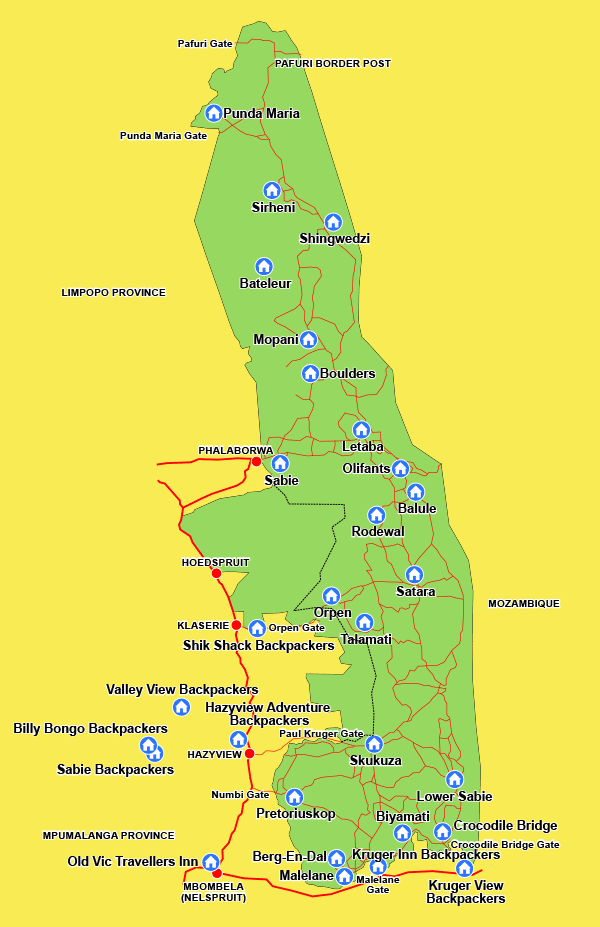
Kruger is big enough that driving from the southernmost gate (Crocodile Bridge) to the northernmost (Pafuri) takes the better part of a full day. For most first-timers, the sensible approach is to pick a region and explore it properly rather than trying to cover the entire park in a single visit. The three regions are very different from each other in landscape, wildlife concentration, and atmosphere.
Southern Kruger is where most backpackers go, and with good reason. The landscape is mixed bushveld — thorny thickets, granite outcrops, dry riverbeds, marula trees — and the concentration of wildlife is higher here than anywhere else in the park, partly because of the more reliable water supply and partly because the rivers in the south (the Sabie, the Crocodile, the Bume) attract game throughout the dry season. The south has the highest density of lions in the park; white rhinos are common in the grasslands around Crocodile Bridge and Berg-en-Dal; leopards are regularly seen in the riverine vegetation along the Sabie River. The main rest camps — Skukuza (the largest), Lower Sabie (arguably the best-located, on a bend of the Sabie River), Crocodile Bridge, and Berg-en-Dal — are all in this region, and the road network is the most developed. It is also the busiest section of the park, and in peak season (July–August, South African school holidays, Easter) it can feel like a traffic jam at popular sighting spots. Go in May or June, or early September, and it's considerably more spacious.
Central Kruger is the sweet spot for predator sightings in general and lions in particular. The open grasslands of the Satara area support one of the highest lion densities anywhere in Africa — a consequence of the enormous herds of zebra, wildebeest, and buffalo that graze the plains and provide reliable prey. Satara rest camp is the base for this region and is one of the better-loved camps in the park: well-maintained, with a good restaurant, a pool, and an atmosphere that is a notch more adventurous than the busier south. The H7 road between Satara and Orpen Gate, and the S100 road along the Timbavati River, are consistently good for sightings. Wild dogs are occasionally seen in the central region, usually in and around the Orpen and Timbavati areas — an always-extraordinary encounter with Africa's most endangered large predator.
Northern Kruger is the wild north: quieter, more remote, dominated by mopane woodland and massive baobab trees, with the landscape becoming more open and arid the further north you go. The wildlife concentration is lower than in the south, and the Big Five are harder to find in the dense mopane — but when you find them, you are often completely alone. Elephants are present in enormous numbers in the north; the Letaba Rest Camp, set on a bend of the Letaba River, sits in the middle of one of the best elephant-viewing corridors in the park, and the elephant hall at Letaba (displaying the skulls and tusks of the park's famous "Magnificent Seven" bull elephants) is one of the better free museum experiences in South Africa. The far north — the Pafuri area near the confluence of the Limpopo and Luvuvhu rivers — is a birding destination of international repute, with the fever tree forests along the Luvuvhu producing sightings of Pel's fishing owl, Narina trogon, and African broadbill. It is a long way from the south. It is worth the drive.
Practical Logistics: The Things You Need To Know Before You Arrive
You need a car. Kruger is not accessible by bus. The Baz Bus does not go there. The nearest large city is Johannesburg (about four to five hours by road to the southern gates), and the nearest town with car hire offices is Nelspruit/Mbombela (40 minutes from Malelane Gate) or Hazyview (30 minutes from Paul Kruger Gate). If you are flying in, the Kruger Mpumalanga International Airport near Nelspruit is the most convenient option; daily flights connect to Johannesburg. You can also fly to Hoedspruit Airport, which puts you closer to the central gates. Hire a small car — you do not need a 4x4 for the main park roads, which are either tarred or well-graded gravel. A Toyota Yaris or similar will cover 95% of Kruger's road network without difficulty.
Book your rest camp accommodation well in advance. SANParks (South African National Parks) opens bookings 11 months ahead, and the most popular camps — Lower Sabie, Satara, Skukuza — fill up months in advance for peak season (July–August) and Easter. Book through the SANParks website at sanparks.org. The booking system requires an account and payment by credit card. If you arrive without a booking and there is no space in the camp of your choice, you will need to drive to another camp or leave the park — neither of which is ideal at 5 PM when the gates are closing.
Gate and camp hours. Kruger's gates open and close with the sun. From April to September (winter), entrance gates open at 6:00 AM and close at 6:00 PM. From October to March (summer), gates open at 5:30 AM and close at 6:30 PM. Rest camp gates follow a similar schedule (camp gates typically open an hour earlier than park entrance gates in summer). This matters enormously, because you are not permitted to drive inside the park after the gates close. If you are out on a game drive at 5:45 PM and still thirty kilometres from camp, you are in trouble. Plan every day's driving with the closing time in mind, and add buffer. A broken-down car, a river crossing slower than expected, or an elephant simply refusing to move off the road for twenty minutes (this will happen) can eat your buffer very quickly.
Do not leave your vehicle. This sounds obvious and is worth saying anyway, because the temptation to get out for a better photograph, or to stretch your legs on a quiet dirt road, is real. Kruger is not a zoo. The animals are not managed. The grass on the side of the road conceals things. You may get out of your vehicle at designated get-out points (picnic sites and rest camps) and nowhere else. The rule exists because lions, leopards, and buffalo do not see a person-inside-a-car as a threat; they see a car as a large, non-threatening object that can be ignored. They see a person-standing-next-to-a-car as something completely different, and they react accordingly.
Speed limit and driving behaviour. The speed limit throughout the park is 50 km/h on tarred roads and 40 km/h on gravel. Drive slower than this. Much slower. Animals blend into the bush with extraordinary effectiveness, and most sightings happen because you were driving slowly enough to notice something moving, or to catch the flick of a tail, or to hear the alarm call of a bird. The person who drives through Kruger at 40 km/h constantly scanning the bush will see ten times more than the person who drives at the limit between known sighting spots. Slow down at waterholes and river crossings. Switch off your engine and wait. The waterhole at Lower Sabie, visible from the camp's restaurant terrace, regularly produces hippos, crocodiles, elephants, and lions at the water's edge over the course of a morning. You do not have to go anywhere.
Sightings boards. Every rest camp has a sightings board — a hand-drawn or printed map of the surrounding road network, on which rangers and visitors have marked recent animal sightings with coloured pins or marker: lions here, leopard here, wild dogs on this road two hours ago. This is an invaluable planning tool. Read it every morning before you leave camp and every afternoon when you return. Talk to other visitors at the camp braai areas in the evenings. The Kruger community of self-drivers is consistently generous with information, and someone who spent the morning on the H4-2 will tell you exactly what they saw and at what kilometre marker.
The Kruger Explorer app. Download it before you leave Johannesburg. It shows all the roads, camps, picnic spots, and waterholes, allows offline use, and has a sightings function where visitors log what they've seen and where. It is enormously useful and works without a data signal inside the park (download the relevant offline maps beforehand).
Frequently Asked Questions
What does it cost to enter Kruger?
International visitors pay a daily conservation fee of ZAR 602 per adult (approximately €29) as of 2025–2026. This is payable per person per day and is separate from accommodation costs. Keep your receipt — you need it to exit the park, and rangers at camp check-in will ask to see it. If you are visiting for three or more consecutive days, the fees add up: three days' entry for two people costs approximately €175. Factor this into your budget.
What does rest camp accommodation cost?
SANParks rest camps offer a range of accommodation from basic camping to chalets to larger family cottages. Prices vary by camp, season, and unit type. In broad terms for 2026: a camping pitch (you bring a tent) starts from around €23 per site per night. A basic hut (single room, shared kitchen and bathroom facilities) starts from around €26 per person. A self-catering chalet (private room with its own bathroom, kitchenette, and braai area) runs approximately €65–€120 per unit per night, depending on the camp and season. These prices make Kruger's rest camps extraordinarily good value — you are sleeping inside one of the world's great game reserves, with lions audible at night from your braai area. Most units are booked well ahead, particularly Satara and Lower Sabie chalets in peak season.
How many days do I need?
Three nights is the minimum to do the experience justice, and four or five is better. With three nights and two full days of driving, you can cover a meaningful section of either the southern or central region, do a morning guided walk, and attend one night drive. With five nights you can move between two camps, covering more of the park and allowing the rhythms of early starts and evening game drives to become properly enjoyable rather than rushed. One day as a drive-through day visitor is not worthless — you will almost certainly see elephants, giraffe, zebra, and impala, and you may get lucky with predators — but it does not do Kruger justice.
What is the best time of year to visit?
For game viewing, the dry winter months from May to September are optimal. The bush thins out as vegetation dies back, animals concentrate around the remaining water sources and rivers, and visibility is dramatically better than in summer. The days are warm (20–26°C), the nights cold (sometimes near zero in July), and the skies are reliably clear. Game viewing is particularly reliable in July and August, though these months also see the highest visitor numbers and some congestion at popular sightings.
Summer (October–March) brings green, lush vegetation, afternoon thunderstorms, migratory birds arriving from the north, and newborn animals — impala lambs appear from around October in extraordinary numbers, which draws predators, which makes for dramatic sightings. The trade-off is that dense vegetation makes the animals harder to see, and the heat (often 35–40°C in the Lowveld in January) makes mid-day driving unrewarding. If you're visiting in summer, focus your driving on the two hours after gate opening and the two hours before gate closing, and retire to the camp pool between noon and 3 PM.
Do I need malaria prophylaxis?
Yes. Kruger National Park is in a malaria zone. The risk varies by season — higher in summer (October–April) when rainfall creates standing water and mosquito populations peak, lower in winter — but the risk is present year-round. Consult your GP or a travel health clinic before departure. Standard prophylaxis options for the Lowveld include Malarone (atovaquone/proguanil), doxycycline, and Lariam (mefloquine), each with different side-effect profiles and costs. Use DEET-based insect repellent in the evenings, sleep with your bungalow windows and doors closed, and avoid being outside at dusk and dawn without repellent. Malaria is manageable, preventable, and treatable if caught early. It is not something to be casual about.
What should I bring?
Binoculars — the single most important piece of kit, and genuinely irreplaceable. A good pair (8x42 or 10x42 magnification) transforms distant brown smudges into identified animals and costs €50–€150 for a serviceable pair. A detailed road map of Kruger (available at the camp shops for about €8 and far better than phone GPS inside the park). Sunscreen and a hat — the Lowveld summer sun is ferocious. A good torch for camp use after dark. Groceries for self-catering if you are in a chalet with a kitchen — supermarkets in Hazyview, Nelspruit, or Phalaborwa (depending on your entry gate) are significantly cheaper than the camp shops inside the park. A portable power bank, since game drives start at 5:30 AM and your phone will run out. And a fleece for winter mornings in the open vehicle on a guided game drive — it is cold at 6 AM at 400 metres above sea level in July, and the wind chill on an open game vehicle makes it colder still.