Backpackers Bible Logo
BackpackersBible.com
The Drakensberg
The World In Your Pocket
× HOME FREE OFFLINE HOSTEL GUIDE
(PDF - 3mb)
WA
SHARE
We list ALL the hostels in South Africa! Click the icons for info.

Backpacking the Drakensberg

There is a wall running along the edge of southern Africa. It has been there for 180 million years. It stretches for more than a thousand kilometres along the spine of KwaZulu-Natal, separating the humid coastal lowlands from the high interior plateau of Lesotho, and in its highest section it rises to over 3,400 metres of sheer basalt cliff — dark, ancient, and absolute. The Zulu name for it is uKhahlamba: Barrier of Spears. The Afrikaner settlers who first looked up at it from below called it the Drakensberg, the Dragon Mountains. Both names are right. It looks exactly like something that should have a name involving spears, or dragons, or both.

People come to the Drakensberg to hike. But they stay — and return, sometimes for the rest of their lives — because of what it does to them. There is something about standing alone on a high ridge in these mountains, the plateau of Lesotho behind you, the green foothills of KwaZulu-Natal falling away below you to the coast, and nothing between you and the sky in any direction, that reorganises something in your head. It is very quiet. It is very large. It is one of those places that makes the scale of ordinary life feel, briefly but usefully, manageable.

Read More

What You Are Actually Looking At: The Geology

To understand the Drakensberg is to understand a very specific sequence of catastrophes. The story starts about 300 million years ago, when what is now southern Africa was part of the supercontinent Gondwana and the region was covered by an inland sea. That sea filled with sediment over tens of millions of years, layer after layer of sandstone and shale compressing under its own weight. Then the sea retreated. Then came desert. Then came something much more dramatic.

About 182 million years ago, as Gondwana began to tear itself apart into the continents we recognise today, the crust of southern Africa cracked open along enormous fissures. Basaltic lava poured out from these fissures for perhaps two million years, covering most of what is now KwaZulu-Natal, the Free State, and Lesotho under a layer of volcanic rock more than a kilometre thick. This was not a volcanic eruption in the Mount Vesuvius sense — no single explosion, no ash cloud, no one dramatic event. It was a slow, relentless outpouring that buried everything beneath a hardened black cap of flood basalt and killed off most of the life on the continent in the process. This event coincided with the great Triassic-Jurassic extinction, one of the five largest mass extinctions in Earth's history.

What you are looking at when you stand below the Drakensberg escarpment is the eroded remnant of that basalt cap. For 180 million years, rivers carved downward through it and rain stripped it back, centimetre by centimetre, retreating from the original coastline position inland to where it stands now. Beneath the black basalt, the older pale sandstone of the Clarens Formation is exposed in a creamy yellow band of cliff — soft, porous, easily carved by water and wind. This is the layer that forms the caves and overhangs of the Little Berg, the foothills zone below the main escarpment wall. Above the sandstone: the hard, dark basalt that resists erosion and forms the great flat-topped peaks and the sheer wall of the upper escarpment. Read the cliff face and you are reading 200 million years of geological time, displayed in stripes of gold and black.

The Drakensberg is still retreating. At roughly one centimetre per decade, water and frost are currently chiselling the escarpment wall back toward Lesotho. In perhaps another hundred million years, if anything is still here to observe it, the basalt cap will be gone entirely and the softer rock beneath will erode quickly to a flat plain. For now, the wall stands. It is not going anywhere you will notice in a lifetime.

The San: The People Who Were Here First, and the Art They Left

Before the Zulu kingdom, before the Dutch settlers, before any of the layers of history that most visitors bring as context to South Africa, the Drakensberg was home to the San — the hunter-gatherer people who inhabited southern Africa for tens of thousands of years and who are among the oldest continuous human cultures on the planet. They called the mountains home not as a geographical convenience but as a cosmological one: the sandstone cave walls of the Little Berg were, in their belief system, a membrane between this world and the spirit world, and painting on them was an act of penetrating that membrane.

There are approximately 40,000 individual rock paintings across 600 cave and overhang sites in the Drakensberg, concentrated in the foothills between Royal Natal in the north and Bushman's Neck in the south. This is the largest and most concentrated body of rock art anywhere in Africa. The paintings span thousands of years — some are perhaps 3,000 years old; the San were still painting in the Drakensberg into the late 19th century, long after European settlers had arrived. The most recent paintings sometimes show horses, wagons, and men with rifles: the San recording the arrival of the people who would eventually dispossess them entirely.

For most of the 20th century, the paintings were assumed to be straightforward depictions of daily life: hunting scenes, animal portraits, domestic activities. It was only in the 1970s that the South African archaeologist Professor David Lewis-Williams, working at the Game Pass Shelter in the Kamberg area, decoded what they actually represent, in what is now regarded as one of the most significant breakthroughs in the history of rock art research.

The key was the eland — the large antelope that appears in the paintings more than any other creature, depicted with extraordinary care and anatomical precision, often in dying postures, often accompanied by human figures who appear to be taking on the eland's physical characteristics: hooves where feet should be, hair standing erect, legs crossed in the same posture as the dying animal, blood trickling from the nose. Lewis-Williams identified these human-eland hybrids as therianthropes — figures combining human and animal attributes — and recognised them as shamans in trance.

The San trance dance was (and remains, among San communities in the Kalahari) their central religious ritual. Women sat and clapped; men danced in a circle for hours, sometimes days, without food or sleep, until certain individuals entered an altered state of consciousness that the San understood as dying — leaving this world and entering the spirit world. In this state, shamans experienced physical symptoms remarkably similar to those of a dying eland: trembling, sweating, bleeding from the nose, the sensation of the body elongating, of merging with animals, of flying. When they returned from trance, they painted what they had seen and felt. The rock face was not a canvas; it was a portal, and the act of painting was an act of pressing through it into the other side.

The eland mattered above all other animals because the San believed it held the most supernatural potency of any creature — a concentrated power that, when released at the eland's death, could be harnessed by a shaman to heal the sick, make rain, mediate disputes, and enter the spirit world. The paintings are not art in the Western aesthetic sense. They are simultaneously medical records, religious ritual, spiritual technology, and cosmological map. Standing in a cave looking at a 2,000-year-old painting of a shaman with eland hooves, nose bleeding, reaching into the rock face, you are looking at an extraordinarily sophisticated system of belief expressed in pigment mixed from iron oxides, charcoal, animal blood, and plant matter and applied with brushes of animal hair. It is, by any measure, one of the great cultural achievements of the human species on this continent.

The three main publicly accessible rock art sites are the Main Caves at Giant's Castle Game Reserve (guided tours; well-presented interpretive centre), Battle Cave at Injasuti (a dramatic 4-hour guided walk to a shelter with 750 individual paintings, including a battle scene between San and Nguni people), and the Game Pass Shelter at Kamberg (the site of Lewis-Williams' "Rosetta Stone" panel — the most important single panel of rock art in southern Africa, guided tours from the Kamberg Rock Art Centre). A custodian guide must accompany all visits. You cannot enter rock art sites alone and you should not try to. The paintings are irreplaceable and extremely fragile: touching them, even breathing close to them repeatedly, causes damage. Do not touch. Do not photograph with flash. Do not camp in a rock art shelter.

What Happened to the San

The San were systematically dispossessed and killed. This is the short version, and the honest one. From the 18th century, European settlers expanding northward from the Cape, and Nguni-speaking agricultural communities expanding southward and westward under the pressures of the Mfecane (the upheaval of Zulu kingdom expansion in the early 19th century), simultaneously enclosed the San's land, hunted out the game they depended on, and — in the case of the settlers — conducted organised killing campaigns against San communities who raided livestock in desperation. The last San communities in the Drakensberg were effectively eliminated by the late 19th century. The paintings they left behind are the primary record of their existence in these mountains.

The San who survive today — about 100,000 people, mostly in Botswana, Namibia, and South Africa — are genetically and culturally the descendants of the oldest continuous human population line on earth, confirmed by mitochondrial DNA studies as the basal branch from which all other human populations diverged. They were here long before anyone else. The Drakensberg rock art is their legacy, and it is worth more attention than most visitors give it.

Navigating the Berg: Three Zones

The section of the Drakensberg relevant to most backpackers runs for about 180 kilometres along the KwaZulu-Natal border with Lesotho, divided into three broad zones. Each has a distinct character and set of access points. Understanding the difference will save you a wasted journey.

The Northern Drakensberg: The Amphitheatre

This is where most first-timers go, and with good reason — the Northern Berg contains the single most dramatic piece of mountain scenery in South Africa. The Amphitheatre is a five-kilometre-wide, 1,200-metre-high curved basalt wall in the Royal Natal National Park, a geological formation so improbable it looks like a film set. The Tugela River pours off the top of it in a cascade of five distinct drops totalling 948 metres — making it either the second tallest or possibly the tallest waterfall in the world (measurements of both Tugela and Venezuela's Angel Falls are genuinely disputed, the margin between them smaller than the measurement uncertainties). In winter it freezes. In summer it flows with enough force to be heard from the valley floor.

The main access hub for the Northern Berg is the Bergville/Winterton area, about four hours' drive from Johannesburg and two and a half from Durban. Backpacker accommodation concentrates around here, with the best hostels offering guided hikes to the Amphitheatre via the Sentinel Peak chain ladder route — a full-day hike that takes you to the summit of the escarpment and to the top of Tugela Falls. This is the hike that people come back from unable to describe adequately to anyone who hasn't done it.

The Central Drakensberg: Peaks and Rock Art

The Central Berg is larger, wilder, and less crowded than the North. It encompasses the Cathedral Peak area, Champagne Valley, Monk's Cowl, Injasuti, and Giant's Castle — a landscape of high peaks exceeding 3,000 metres, deep gorges, excellent rock art sites, and the most extensive network of multi-day hiking trails in the mountains. Cathedral Peak itself (3,004 metres) is the most accessible of the major summits — a full-day climb requiring no technical equipment, just fitness and an early start. Giant's Castle (3,315 metres) is a harder proposition.

Champagne Valley is the commercial hub of the Central Berg, with plenty of mid-range and budget accommodation. Cathedral Peak is quieter and more atmospheric — accessed by a single road into its own valley, with limited accommodation options and that quality of remoteness that makes the Drakensberg feel genuinely wild rather than managed. For multi-day hiking, Injasuti is the preferred base for serious hikers: a camp with cave overnight routes into the high Berg and access to Battle Cave, one of the best rock art sites in the mountains.

The Southern Drakensberg: Sani Pass and Lesotho

The Southern Berg is defined by one thing above all others: the Sani Pass. This is the only road crossing of the Drakensberg escarpment in KwaZulu-Natal, connecting the South African lowlands to the Kingdom of Lesotho at an altitude of 2,876 metres. It is a gravel track of nine kilometres that climbs 1,332 vertical metres in gradients of up to one-in-three, through a series of hairpin bends with names like Devil's Corner and Suicide Bend, over ground that ranges from bone-dry loose gravel in good conditions to a river of boulders and ruts after rain. The full details are in the Things To Do section below. The base camp for the Sani Pass is the Underberg/Himeville area, about two and a half hours from Durban.

Drakensberg FAQs For Backpackers

When is the best time to go?

The Drakensberg has two distinct seasons and they are genuinely different experiences. Choosing the wrong one for what you want to do will significantly affect your trip.

Summer (November–March): Green, dramatic, dangerous. The mountains are at their most spectacular visually — the foothills are intensely green, the rivers run full, and the waterfalls are at their most powerful. But summer in the Drakensberg is also electrical storm season. Violent thunderstorms build over the escarpment every afternoon with clockwork regularity, typically from around 2:00 PM onwards. Lightning is not a minor risk here. The Drakensberg sits in the region of South Africa with the highest concentration of air-to-ground lightning strikes in the country — which has one of the highest lightning mortality rates in the world. Hikers have died on these mountains from lightning strikes. The rule is absolute: be below the ridgeline and under cover before 2:00 PM in summer. This means 5:00 AM starts for any serious day hike. It also means the multi-day escarpment hikes are significantly more committing in summer — you are on exposed high ground for multiple consecutive days, and the weather is unpredictable.

Winter (April–September): Cold, dry, clear. The electrical storms stop almost entirely. The skies are a blue that doesn't exist in summer. Visibility on the escarpment can extend for 200 kilometres. Snow settles on the high peaks and sometimes on the passes — the Amphitheatre under snow is extraordinary. The days are cold but manageable with proper clothing; nights on the escarpment can drop well below zero even in June and July. Rivers are lower, meaning stream crossings are safer. The rock art caves are at their best in dry conditions. This is the preferred season for multi-day hiking, the Sani Pass drive, and anyone who wants reliable weather.

The sweet spot: April–May and August–September. End of the wet season or end of the dry season — the mountains are still green from summer rain in April/May, the storms have eased, and the days are warm enough to be comfortable in a base layer. September brings wildflowers across the foothills. These shoulder months are when the Drakensberg is at its most balanced.

Do I need a car?

Yes, with one qualification. The Drakensberg is not served by any meaningful public transport, and the access roads into the different valleys — Northern, Central, and Southern — are not connected to each other along the escarpment. You drive in from the lowlands on a road that goes into a valley, and that valley is your base. Getting between the Northern and Central Drakensberg areas requires driving back out to the main N3 highway and re-entering via a different road, which adds 60–90 minutes. A car is not optional if you want to explore more than one zone.

The qualification: many hostels in the Bergville area (Northern Berg) offer shuttle pickups from the N3 and run their own guided hiking day trips, which means that a backpacker based at a single hostel without a car can experience the Amphitheatre hike and several other Northern Berg activities without needing to drive. If your sole destination is the Amphitheatre or the Sani Pass (where tour operators run day trips from Underberg), you can survive without a car by planning ahead and booking through your hostel. For everything else — Central Berg, Cathedral Peak, the rock art sites at Giant's Castle, any self-directed hiking — you need your own vehicle.

Most access roads are tarred to the park gates. Some valley roads beyond the gates are gravel but manageable in a standard sedan in dry conditions. The Sani Pass road is the one exception: the nine-kilometre section between the South African and Lesotho border posts is 4x4 only, mandatory and enforced. Details below.

What does it cost?

The Drakensberg is genuinely affordable. Dorm beds at backpacker hostels run from €10–€18 per night. Ezemvelo KZN Wildlife park entry fees are approximately €4–€7 per person per day, payable at the gates. Day hikes within the park are generally included in the entry fee. Guided hikes run through hostels — including the Amphitheatre chain ladder hike — typically cost €20–€40 per person inclusive of transport. Rock art guided tours at the major sites cost approximately €5–€10. The Sani Pass tour operators charge approximately €35–€50 per person for a guided day trip including transport. A daily budget of €35–€60 covers accommodation, food, park entry, and one paid activity. If you are camping rather than hostelling, drop that to €20–€40.

What should I actually pack?

This question matters more in the Drakensberg than in most places on the South Africa backpacker circuit, because the consequences of being underprepared here are not discomfort but genuine danger. The mountains change fast. A clear morning can become a violent electrical storm by early afternoon. A warm lowland day at the base of the escarpment can become sub-zero wind chill on the plateau within three hours of hiking. The following are non-negotiable regardless of season:

Waterproof jacket and trousers. Not water-resistant — waterproof. The storms here are serious. A €20 pacamac from a supermarket in Pietermaritzburg will fail on a Drakensberg escarpment in a July afternoon hailstorm. Bring something rated for genuine mountain weather.

Warm layers. Even in December, the plateau temperature at 3,000 metres can drop dramatically when cloud comes in. A fleece and a windproof layer are essential on any summit day. In winter, pack for below-zero overnight temperatures if you are doing any multi-day hiking with cave or tent camping.

Navigation tools. The Drakensberg has trails marked by cairns — small stacks of stones built by previous hikers. Some are accurate. Some lead nowhere. Some have been built by people who were also lost. In mist, which can descend in minutes on the escarpment, cairns become useless. Download the relevant Slingshot or Avenza hiking maps to your phone before you leave and keep your phone charged. Carry a paper backup. Tell the park office and your hostel your planned route and expected return time. If you don't come back, someone needs to know where to start looking.

Water and purification. Mountain streams in the Drakensberg are generally clean, particularly at altitude. A filter or iodine tablets allow you to refill from the rivers rather than carrying weight. In summer, the rivers run well. In winter, some streams on the plateau are reduced to trickles — carry more than you think you need.

Can I hike independently or do I need a guide?

Most day hikes within the park boundaries can be done independently with a map and the precautions described above. The Tugela Gorge walk to the base of Tugela Falls, the walks around Royal Natal's valleys, and most of the lower Cathedral Peak trails are well-used enough that you will encounter other hikers regularly. Sign the register at the park office before every hike — this is not optional, it is the system that triggers search and rescue if you don't return.

The Amphitheatre chain ladder hike (to the summit of the escarpment via Sentinel Peak) is technically independent-accessible but is significantly better done with a guide for your first time — the plateau navigation after the ladders requires map confidence, especially in summer when cloud can come in. Most hostels in the Northern Berg run this as a guided group trip, which solves the navigation problem and adds the social dimension of doing something serious alongside other people who are also having the experience of their lives.

Rock art sites: guides mandatory, as described above. Sani Pass on foot or with your own 4x4: no guide required, but read the logistics carefully below. Multi-day escarpment traverses and cave routes: experienced hikers can do these independently with the right preparation; beginners should hire a guide through Ezemvelo KZN Wildlife or one of the established local operators.

Safety In The Drakensberg

The Drakensberg is not dangerous in the way that some of South Africa's urban environments are dangerous. The risks here are natural, and they are manageable with preparation and respect. But they are real, and several of them are lethal.

Lightning: The Primary Killer

Lightning is the most serious hazard in the Drakensberg, and it is not close. The area receives the highest frequency of air-to-ground lightning strikes in the entire world. In summer, afternoon thunderstorms are a near-daily occurrence, and on exposed ridgelines and the upper escarpment, there is nowhere to shelter from them. Hikers have died here from lightning strikes. The safety protocol is simple and absolute: in summer, plan to be below the ridgeline and in shelter by 2:00 PM. This means early starts — 5:00 AM for serious summit hikes. Watch the western sky from mid-morning. If you see cloud building over the escarpment, do not ignore it and assume it will pass. Turn around.

If you are caught in a storm on exposed ground, the correct position is not lying flat (ground current from a nearby strike runs through your entire body), not sheltering under a tree (side-flash), and not huddling in a group (one strike can kill multiple people). The correct position is the lightning crouch: squat low, feet together, knees together, hands over ears. If your hair stands on end or you feel a tingling in your skin, you are in the charge shadow of an imminent strike — get into this position immediately. Spread out from the rest of your group so that one strike does not kill everyone. Spread out far enough that survivors can assist casualties. Caves are complicated: they can offer protection, but a cave at the base of a cliff during a strike on the cliff above can conduct lethal ground current. The Drakensberg hut system offers proper shelter; use it if you are multi-day hiking.

Flash Floods And River Crossings

After heavy summer rain, rivers in the Drakensberg can rise with terrifying speed — a gentle ankle-deep crossing in the morning can become an impassable torrent within an hour if there has been heavy rain on the plateau above, even if it is dry where you are standing. Never attempt to cross a flooded river. Wait. The water usually drops as fast as it rose. If it doesn't, make camp and wait again. Several hikers have drowned in the Drakensberg attempting crossings that seemed manageable. The Berg rivers, particularly in the central and northern zones, are bordered by narrow gorges in places where there is no alternative to crossing. Know your route, know the crossing points, and know what to do if they are impassable before you leave.

Hypothermia And Exposure

The Drakensberg plateau at 3,000 metres is a cold environment, and it can become a lethally cold one very quickly when wind and rain arrive simultaneously. Hypothermia — the dangerous lowering of core body temperature — does not require sub-zero temperatures. Wet, wind, and moderate cold (5–10°C) are sufficient to kill an underprepared person over several hours. Signs of serious hypothermia include slurred speech, confusion, lack of coordination, and paradoxical undressing (the person removes clothing because they mistakenly feel warm). If a member of your party shows these signs, this is a medical emergency. Get them dry and insulated immediately and activate the park's emergency response.

The escarpment caves marked on Drakensberg hiking maps serve as emergency shelters. They are not luxurious — most are shallow overhangs with a dirt floor — but they will protect you from wind and rain. Do not rely on them as your planned sleeping spot; always carry a tent on multi-day hikes. Never camp in a painted rock art shelter.

Snakes

There are over 25 species of snake in the Drakensberg region, of which four are dangerous: the Puff Adder, the Berg Adder, the Night Adder, and the Rinkhals (a spitting cobra). The Puff Adder is the most dangerous — slow-moving, well-camouflaged, and responsible for more snakebite fatalities in Africa than any other species. It favours rocky ground in exactly the terrain you will be hiking. The precautions are standard: wear proper hiking boots (not trail runners), watch where you put your feet and hands, do not sit down on rocks without checking first. In practice, snake encounters on Drakensberg trails are uncommon; most hikers never see one. But two or three hikers are bitten each year in the region, almost always by Puff Adders, and almost always because of inattention.

Getting Lost

People get lost in the Drakensberg. The plateau in mist, which can descend in minutes, looks the same in every direction. Cairns are unreliable. Paths across the basalt are often invisible. Always carry a downloaded offline map on your phone, carry a paper backup, sign the register at the park office, and leave your planned route with your hostel. If you become disoriented, stay calm, stay where you are, and use your whistle — six blasts in succession is the universal distress signal in these mountains. The park's emergency rescue service is efficient but the mountains are big and rescue by helicopter is expensive (€800–€1,500). Your travel insurance must cover mountain rescue and helicopter evacuation. If it doesn't, get different travel insurance before you go.


THE AMPHITHEATRE Photo: Wikimedia Commons

Things To Do In The Drakensberg

1. The Amphitheatre Chain Ladder Hike (Non-Negotiable)

If you do one thing in the Drakensberg, do this. The Amphitheatre chain ladder hike is the defining experience of the Northern Berg, and for many people the defining experience of South Africa. But it is also a hike that demands more respect than it sometimes gets — and this guide is going to give you the honest briefing that some tour operators won't.

The route starts at the Sentinel car park, reached by driving through the Free State side of the mountains via Phuthaditjhaba (about 90 minutes from the main Bergville backpacker hub). You hike from 2,200 metres to the top of the escarpment at 3,100 metres, skirting around the base of the Sentinel peak, with the full five-kilometre face of the Amphitheatre growing on your left as you ascend. The final section to the top is via two sections of chain ladder — heavy iron rungs bolted into the cliff face — each approximately 50 rungs high.

At the top, the world changes. You step onto the plateau of Lesotho — flat, grassy, wind-scoured, and vast — and walk to the lip of the Amphitheatre escarpment. Below you, 1,200 metres straight down, is the Royal Natal valley. The Tugela River begins its journey to the sea from a tiny basin near your feet, slides across the plateau, and then drops off the edge in five cascades totalling 948 metres. In winter it partially freezes. In full summer flow it is a wall of white noise that you can hear from the valley below. You are standing at the source of one of the great rivers of southern Africa, on top of a wall of basalt that has been here since before the dinosaurs, looking down at a country that looks, from this height, impossibly green and impossibly small. The hike takes 6–8 hours return.

Now, before you book anything: read this next section carefully.

Read More

⚠ Safety Warning: What Nobody Is Telling You About The Chain Ladders

The chain ladders are two vertical sections of iron rungs bolted to an open cliff face, each roughly 50 rungs high. Think about what that means in practical terms: the combined height is equivalent to climbing up the outside of a ten-storey building — in the open air, on exposed metalwork, with no safety harness, on a mountainside at over 3,000 metres above sea level. You would not do that on a building site without a harness. On a Drakensberg cliff face, some operators will tell you it's perfectly fine, that everyone does it, that a harness is unnecessary, that insisting on one makes you a sissy. This is, to put it bluntly, nonsense — and in a worst case it could kill you. The Backpacker's Bible has a firm position on this: insist on a safety harness for the chain ladder sections. Ignore any pressure to the contrary. Do not use any guide or operator who does not provide one. A guide who shames clients out of basic safety equipment is a guide who should not be guiding.

The condition of the ladders themselves. The chain ladders have been exposed to extreme mountain weather — snow, ice, lightning, gale-force winds, and freezing and thawing — for many decades. Recent maintenance has added steel safety cables alongside the rungs, which is a genuine improvement. However, the structural integrity of the cross-bar rungs themselves, after so many years of metal fatigue in those conditions, is harder to verify by eye. The addition of cables is welcome but is not a substitute for a proper structural assessment of the ironwork. Until there is a transparent, independently verified maintenance record for the ladders, treat them with the same caution you would apply to any ageing structure in a high-consequence environment: move deliberately, test each rung before committing your weight, and do not rush.

The weather. The Drakensberg escarpment generates its own weather systems, and they can change with very little warning. In summer (October–March), electrical storms build over the plateau most afternoons — and the escarpment, being the highest point for a very long way in any direction, is exactly where lightning strikes. Being on an exposed iron ladder bolted to a cliff face during an electrical storm is not a situation any guide should allow a client to be in. Check the forecast before you leave the car park. If there are anvil clouds building to the north or west, discuss with your guide whether continuing is wise. A good guide will already be watching them.

Fog is the less dramatic but equally serious hazard. The plateau at the top of the Amphitheatre can be in thick, visibility-down-to-a-metre fog while the valley below is in sunshine. The plateau edge — the lip of a 1,200-metre sheer drop — is not marked by a fence. It is simply where the grass ends and the air begins. Walking in zero-visibility conditions on a plateau where the edge drops without warning to a 1,200-metre cliff is not a hiking experience; it is a serious navigational emergency. A competent mountain guide with GPS coordinates, compass, and experience of the plateau in bad weather is not a luxury in these conditions. They are the difference between getting home and not.

Stone-throwing and intimidation. This is not something most booking agents mention, but it has happened often enough to be documented. There have been incidents — reported publicly and in detail by experienced guiding operations, including Vertical Endeavours — of local individuals positioned above the chain ladders throwing stones onto climbers below as an intimidation tactic to extort money. A stone dropped from height onto someone clinging to an iron ladder above a cliff face is an extremely serious danger. This is not a reason to not do the hike; it is a reason to do it with a guide who is known to the local area, who has established working relationships with the communities around the Sentinel car park, and who knows how to handle the situation if it arises. Going alone, or with an operator who has no local presence or reputation, significantly increases your exposure to this risk.

Our recommendation. This hike can technically be done independently — the route is well-worn, the car park is accessible, and thousands of people do it without a guide every year. We are not telling you that you must have a guide to enter the park gate. We are telling you that the combination of ageing infrastructure, unpredictable high-altitude weather, plateau navigation in poor visibility, and the documented stone-throwing incidents makes this a hike where the cost of cutting corners is potentially your life. Hire a highly-qualified mountain guide with documented experience on the Amphitheatre route, confirmed insurance, and a clear policy on safety harnesses for the ladders. Yes, this costs money. A professional UIMLA-qualified mountain guide for the Drakensberg will run approximately €40–€70 per person for the day. That is a meaningful line item on a backpacker budget. It is also, in the context of this specific hike, one of the best investments you will make in South Africa. Respect the mountain. It has been here for 180 million years. It will outlast your bravado.

All of that said: when you stand on the rim of the Amphitheatre with your lungs full of cold mountain air and the Tugela Falls dropping away below you into the valley — properly equipped, properly guided, in good weather — it is one of the most extraordinary things a human being can do on this continent. Book with a reputable operator. Ask specifically about safety harnesses and your guide's Drakensberg qualifications before you confirm.

Recommended Guides for the Tugela Falls Hike

We have said throughout this section that you should hire a highly-qualified guide for this hike. Here are three we specifically recommend — each verified, each qualified, and each with a strong record on the Amphitheatre route. Contact them directly to discuss dates, group size, safety harness provision, and pricing.

ZEE NDABA — DRAKENSBERG TREKS
Zee — short for Zimele, meaning "independent" in Zulu — is the first woman Zulu walking guide in South Africa, and one of the most respected figures in Drakensberg guiding. She holds a National Tourism and Guide Diploma in Mountaineering and Adventure from THETA (Tourism, Hospitality and Sport Education and Training Authority) and brings over 15 years of guiding experience in the Drakensberg and Lesotho to every hike she leads. Having spent four years working in the UK tourism industry before returning to her roots, she guides international clients with the fluency and cultural ease of someone who understands both worlds. Her tours of the Amphitheatre route are particularly valued for the depth of cultural and historical context she provides — the Basotho communities on the plateau, the history of the San, the Zulu heritage of the foothills. She is the guide of choice of internationally known figures, including Tom Cruise and BBC presenter Julia Bradbury, who described her as "a true adventurer, a warrior woman, and a joy to talk and walk with." Through her company Drakensberg Treks, Zee also involves local guides and porters from the mountain communities, meaning your booking directly supports the people who live alongside the mountains she guides in.

GAVIN RAUBENHEIMER — PEAK HIGH MOUNTAINEERING
If technical safety credentials are your primary criterion — and given the content of this page, they should be — Gavin Raubenheimer's qualifications are, quite simply, the most comprehensive of any guide operating in the Drakensberg. He holds a Mountaineering Instructor Award (MIA) from the Mountain Development Trust, a Mountaineering Guide qualification at NQF Level 8 (the highest level in the South African national qualifications framework), and a Cultural and Nature Guide qualification at NQF Level 4. He is a past President of the KwaZulu-Natal Section of the Mountain Club of South Africa, and since 2011 has served as Chairman of the Mountain Development Trust. He has been involved in mountain rescue since 1992, and since 2005 has been the Convener of Mountain Rescue for KwaZulu-Natal Province — the person who coordinates the rescue operation when things go wrong in these mountains. He has guided and climbed on rock, snow, and ice across South Africa and on four other continents. When you are standing on an iron ladder above a 3,000-metre cliff face and wondering whether the person responsible for your safety actually knows what they are doing, Gavin's answer is unambiguous.

IAN SHOOTER — DRAKENSBERG HIKER
Ian Shooter has been hiking the Drakensberg since he was ten years old, and the Drakensberg mountains are, in his own words, his spiritual home and his office. He is registered with the South African Mountaineering Development and Training Trust (SAMDET) as an Advanced Mountain Walk Leader — the formal qualification for multi-day wilderness hiking leadership in South Africa. His background is unusually practical: he worked as a paramedic after his national service, then spent a decade in Canada running an equestrian centre and gaining extensive experience in wilderness hiking, skiing, and ice climbing in the Canadian Rockies, before returning to South Africa to found Drakensberg Hiker. His particular strength is multi-day endurance trekking and logistics — he runs fully portered and catered hikes, meaning your pack weight is managed, your meals are cooked for you at the end of each day, and the expedition infrastructure is handled by an experienced team. He offers options from the single-day Amphitheatre hike to the full 12–16 day Drakensberg Grand Traverse, rated as one of the world's great long-distance mountain hikes. He also runs overland 4x4 tours of Lesotho and can arrange airport transfers from Durban or Pietermaritzburg — useful if you are combining the Tugela Falls hike with a wider itinerary.

Getting There: The Access Road, the Shuttle, and the Full Cost Breakdown

The Access Road Problem
The Sentinel Car Park — the starting point of the hike — is reached via a dirt road of approximately 8 kilometres from the point where it forks off the main road near Witsieshoek Mountain Lodge. This road crosses terrain that is rocky, eroded, and in some places severely rutted. In its current state it cannot be safely negotiated in a standard hire car or any 2WD vehicle. A genuine 4x4 with high ground clearance is required. Arrive in a standard sedan and you will not get through — and unlike the Sani Pass, where the border guards turn you back formally, here you will simply find yourself stuck, at altitude, with a flat tyre and nobody nearby. Significant road improvement works were reported as recently as 2024, but the condition of unpaved mountain roads in this region is highly variable and subject to rapid deterioration after rain. Verify the current road condition with your accommodation or guide before attempting it in any vehicle.

The Witsieshoek Shuttle
If you do not have a 4x4 hire car — which is the situation most backpackers find themselves in — the practical solution is the shuttle service run by Witsieshoek Mountain Lodge. The Lodge operates 4x4 shuttle transfers from its premises to the Sentinel Car Park (approximately 8 km, 25–30 minutes) for both guests and non-guests. Shuttles run on a schedule rather than on demand; as of early 2026 the reported schedule involves departures at set times in the morning, with a return shuttle in the afternoon. Past reviews have noted that the system can be inflexible — arriving a few minutes after a scheduled departure means waiting for the next slot — so confirm the current schedule and book in advance by contacting the Lodge directly.

Cost (as reported by hikers, April 2024): Approximately R375 per person for the return shuttle plus the Sentinel Park entry / hike access fee combined. This translates to roughly €18 per person at current exchange rates. Cash only — bring South African Rand in cash, as card payment machines in this area can have connectivity problems. The Lodge can be reached on WhatsApp at 082 609 8988, or by email at reservations@witsieshoek.co.za. Their website is witsieshoek.co.za. Non-guests may book transfers directly through the website.

Full Cost Breakdown for the Hike
Planning your budget for the Tugela Falls hike involves more components than most day hikes in South Africa. Here is the complete picture, with all prices in South African Rand (approximate Euro conversion at ~R20 = €1) as of 2025–2026 — note that SANParks fees change annually, so verify current rates at the time of your visit:

Road toll to access the Sentinel area: A toll gate on the R57 road through Phuthaditjhaba controls access to the Witsieshoek / Sentinel area. Bring cash as a backup in case card terminals are offline.

Sentinel Park entry / hiking access fee: Approximately R65 per adult (international visitors). This is payable at the Sentinel Car Park, not at the toll gate, and is included in the Witsieshoek shuttle package price quoted above. If you have your own 4x4, you pay this separately at the car park. Note: if you are staying at Witsieshoek Mountain Lodge, this fee is waived — confirm at booking.

Witsieshoek shuttle (non-4x4 hikers): Approximately R375 per person return, inclusive of the entry/hiking fee above (as of April 2024; confirm current price when booking). Cash only.

Professional guide fee: Approximately €40–€70 per person for a SAMDET or NQF-qualified mountain guide for the full day. This is the non-negotiable safety investment described in the section above. Prices vary by operator and group size — contact the guides listed above for current rates.

Total estimated cost per person (non-4x4 hiker, with guide): Roughly €60–€90 per person for the full hike — shuttle, entry, guide. Not cheap for a backpacker budget, but this is not an ordinary day hike, and the section above explains why.

Where to Stay: The Accommodation Situation (And What the Other Hostels Don't Tell You)

There is a piece of information that is conspicuously absent from the marketing material of several popular Northern Drakensberg backpacker hostels: the distance between where they are located and where this hike actually starts. The Sentinel Car Park is the trailhead. Everything else is measured from there.

Amphitheatre Backpackers is frequently mentioned as a base for this hike in online travel discussions and hostel listings. What is rarely mentioned in the same breath: the drive from Amphitheatre Backpackers to the Sentinel Car Park is over 150 kilometres by road, because the road route goes back through Bergville and around the long way through Phuthaditjhaba. From the hostel's location near Bergville on the KwaZulu-Natal side of the mountains, there is no direct road to Sentinel on the Free State side — you are effectively going around the mountain range. Allow two and a half to three hours' driving each way. For a hike that starts at dawn and aims to be off the escarpment by early afternoon, this makes an already long day significantly longer and more logistically complex.

The drive from Karma to the Sentinel Car Park is approximately 60 kilometres — significantly better than Amphitheatre, but still long.

Maluti Backpackers is the option that most online resources do not draw sufficient attention to — and it should be the first choice for anyone doing this hike as their primary purpose. Located in Phuthaditjhaba, directly on the approach route to Witsieshoek and the Sentinel Car Park, Maluti Backpackers sits approximately 25 kilometres from the hike trailhead — roughly 30 minutes' drive. This is the closest backpacker accommodation to the start of the hike. It also offers a free shuttle service (confirm current availability when booking), free Wi-Fi, mountain views, self-catering facilities, a minimarket on-site, and proximity to the Basotho Cultural Village — a worthwhile add-on that brings the history of the Basotho people (whom you will encounter on the plateau above the chain ladders) into context before you go up. For backpackers who want to minimise drive time, maximise time on the mountain, and keep their overall budget in order, Maluti is the practical choice.

MALUTI BACKPACKERS

ADDRESS: 3202 Nteo Street, Phuthaditjhaba-A, Phuthaditjhaba, 9870, Free State

PHONE / WHATSAPP: +27 76 193 4444

EMAIL: bookings@malutibackpackers.co.za

WEBSITE: malutibackpackers.co.za

DISTANCE TO SENTINEL CAR PARK: ~25 km / ~30 minutes

PRICE RANGE: From ~R850 per room per night.

The Bonus: Golden Gate Highlands National Park

If you are basing yourself in Phuthaditjhaba for the Tugela Falls hike — which this guide recommends — you are also sitting approximately 29 kilometres from Golden Gate Highlands National Park, one of the most underrated national parks in South Africa and one of the least-visited by international backpackers. It makes a perfect day before or after the Tugela hike, your legs and weather permitting, and the combination of the two constitutes one of the finest two-to-three-day hiking itineraries in the Free State.

Golden Gate takes its name from the way the sandstone cliffs of the Maluti Mountains catch the light — from gold and amber in the late afternoon to burnt orange and red at sunset, the rock faces shift through a colour range that has no equivalent in the Drakensberg's dark basalt. The park covers 340 square kilometres of rolling highveld grassland, sandstone gorges, and mountain plateau in the north-eastern Free State, bordering Lesotho. It contains one of the country's largest herds of black wildebeest, along with eland, blesbok, Burchell's zebra, springbok, and the full suite of highveld grassland birds including the globally endangered bald ibis, which breeds in the Cathedral Cave. The park is also a palaeontologist's dream — it holds some of the world's oldest fossilised dinosaur embryos, displayed at the Kgodumodumo Dinosaur Interpretive Centre inside the park.

The hiking is excellent, accessible, and completely different in character from the Drakensberg — lower altitude, gentler terrain, and focused on the extraordinary geology of the sandstone formations rather than the vertigo-inducing escarpment. The pick of the trails:

Wodehouse Peak Trail (10 km, moderate-challenging, 4.6/5 on AllTrails): The finest hike in the park. A loop that takes you to one of the highest points in Golden Gate, with constantly changing environments — grassland, rocky ridgelines, mountain plateau — and panoramic views of both the Golden Gate sandstone country and back towards the Drakensberg escarpment on clear days. Wildlife is frequently seen on the plateau section: wildebeest, zebra, and eland up close. No permit required beyond the park entry fee. Allow 4–5 hours.

Brandwag Buttress Trail (3 km, moderate): A shorter loop to the base of the Brandwag rock formation — the iconic golden sandstone buttress that is the park's signature image. Best at sunrise or sunset when the rock glows most intensely. 4.8/5 on AllTrails.

Cathedral Cave Trail (guided, 6 km return, ~R223 per person in 2025–2026): A guided walk to a massive sandstone overhang that creates a natural amphitheatre, with a waterfall into an upper pool accessible by chain ladder (a considerably less alarming version than the Drakensberg chain ladders). This trail must be booked in advance through SANParks — recommend at least three days ahead. The bald ibis breeds here; the trail is closed during the breeding season.

Park entry fees (2025–2026): International visitors ~R252 per person per day (approximately €12.50). SANParks accommodation inside the park (Glen Reenen Rest Camp) from approximately €20 per person for camping. The park is also accessible as a day trip from Phuthaditjhaba, 29 km away.

Golden Gate is genuinely one of those places that keeps not appearing on the standard backpacker radar despite being objectively extraordinary. The combination of Tugela Falls from the top and Golden Gate from the valley floor — two days, two completely different landscape experiences, both accessed from the same base — is one of this region's best-kept secrets. Take it.

2. The Sani Pass (Into Another Country)

The Sani Pass is the only road crossing of the Drakensberg escarpment in KwaZulu-Natal, connecting the South African lowlands to the Kingdom of Lesotho at 2,876 metres. It is nine kilometres long. It climbs 1,332 metres. It has gradients of up to one-in-three and a series of hairpin bends with names that reflect the experience of driving them. You cannot drive it in a standard car. You will be turned back at the South African border post at the bottom if your vehicle is not a genuine 4x4 — the border guards check, and they enforce. The wrecks of vehicles that did not make it are visible in the ravines on the descent side.

If you have a 4x4 hire car and the right permit (a letter of authority from the rental company allowing you to cross the border, which costs approximately €35 extra and must be arranged when you book the car), you can drive it yourself. The ascent takes about two hours in dry conditions. In wet conditions, longer, harder, and more committed. Do it dry. Both border posts open at 6:00 AM and close at 18:00; you must clear both within this window. If you get stuck in no-man's land between the two posts after 18:00, that is where you sleep.

If you don't have a 4x4, book a guided day trip from Underberg. Multiple operators run these; prices are approximately €35–€50 per person for a full-day tour in a proper 4x4 vehicle with a guide who knows the road. The tour typically includes the drive up, time at the Sani Mountain Lodge at the top (the highest pub in Africa, sitting at 2,874 metres with a view back down the pass that will make you want to stay until closing time, which you probably should not do on a mountain road), sometimes a short walk into Lesotho, and the drive back down.

The top of the pass is the start of the Lesotho Highlands, the high interior plateau of a small mountain kingdom that is entirely landlocked within South Africa. Lesotho is one of only three countries in the world entirely enclosed by another country. Its entire territory sits above 1,000 metres — it has the highest low point of any country on earth. The highland communities visible from the pass road are Basotho herders: men on horseback in blankets and conical grass hats, managing flocks on terrain that looks, in winter, like a high Himalayan valley transposed to Africa. If you spend more than an hour at the top, cross the border post and walk a short distance into Lesotho proper. It is a different country, a different culture, and a different visual world to the South Africa below the escarpment. A tourist levy of approximately €5 is payable at the Lesotho border post.

One urgent note: there are ongoing plans to tar the serious 4x4 section of the Sani Pass. Phase 2 of the road upgrade (below the South African border post) was completed in 2022. Phase 3 — the nine-kilometre 4x4 section itself — was in planning and expected to commence in 2025 or 2026. When that section is tarred, the Sani Pass becomes a standard road driveable in any vehicle, and the experience changes fundamentally. If you are reading this before that happens, go now. It is a finite thing.

3. The Rock Art Sites (Do This Even If You Don't Think You Care)

A common mistake is to treat the Drakensberg rock art as a side activity — something for the afternoon when the hiking energy has run out. It should be the opposite: a primary reason to come, given proper time and a guide who can explain what you are looking at. The difference between walking into Main Caves at Giant's Castle without context and walking in with a guide who explains the shamanic trance, the dying eland, the therianthropes, and the Lewis-Williams breakthrough is the difference between looking at a wall and reading a book. It is worth doing properly.

Game Pass Shelter, Kamberg (the most important): The shelter where Professor David Lewis-Williams identified the Rosetta Stone panel of San rock art in the 1970s — the breakthrough that decoded the entire symbolic system of the paintings across southern Africa. The Kamberg Rock Art Centre adjacent to the site has the best interpretive display of any rock art location in the Drakensberg. Guided tours run from the centre; book in advance, particularly in peak season. Approximately 2–3 hours including the walk to the shelter. Cost approximately €5–€8 per person.

Main Caves, Giant's Castle: The most visited site, with good reason — a substantial rock shelter containing several hundred paintings, well-preserved, well-explained on the guided tour, and situated in a spectacular valley with views of the Giant's Castle massif. The interpretive centre at the Giant's Castle camp is worth an hour before the cave walk. Half-day experience; tours twice daily.

Battle Cave, Injasuti: A four-hour round-trip guided hike to a shelter with 750 individual paintings, including one of the most striking battle scenes in all of southern African rock art — San and Nguni fighters depicted in a state of violent conflict, bleeding, falling, being restrained. It is viscerally different to the more contemplative shamanic imagery at Kamberg and Main Caves. The hike through the Injasuti valley to reach it is beautiful in its own right. Book at Injasuti Camp the day before.

4. Multi-Day Hiking: The Big Commitment

The Drakensberg has one of the finest networks of multi-day wilderness hiking routes in Africa, ranging from two-day valley walks to the full Grand Traverse — a 130-kilometre route along the full length of the KwaZulu-Natal escarpment that takes 10–15 days, involves summiting six peaks above 3,000 metres, and is regarded as one of the most demanding multi-day hikes in the southern hemisphere. The Grand Traverse is for experienced, well-equipped hikers only. It has claimed lives from falls, lightning strikes, and hypothermia.

For backpackers with moderate fitness and proper preparation, the more accessible multi-day options are:

Tugela Gorge to Tugela Falls base (2 days, Northern Berg): A moderate two-day route from the Royal Natal park gate up the Tugela Gorge — through indigenous forest, over boulders, alongside a river that is some shade of turquoise in good light — to a viewpoint at the base of Tugela Falls. Cave camping overnight. Permits required from Ezemvelo KZN Wildlife; book well in advance for weekends.

Cathedral Peak area circuits (2–3 days, Central Berg): A range of routes through the Cathedral Peak valleys using caves as overnight shelter, with options ranging from moderate to strenuous. The Orange Peel Gap route takes you up to the escarpment ridge with views into Lesotho. Rainbow Gorge is one of the most beautiful short sections of trail in the Central Berg. The Cathedral Peak Hotel can orient you on current conditions for any route in the area.

Injasuti multi-day routes (3–5 days, Central Berg): The Injasuti area has the most extensive network of cave routes in the Drakensberg, linking a series of mountain caves that serve as overnight shelters. These routes require map-reading competence and the willingness to be genuinely off-grid — no phone signal, no rescue within easy reach, no other hikers on many sections. They are extraordinary. Permits and route registration at Injasuti Camp; the camp staff are helpful and honest about current conditions.

5. Day Hikes for Non-Summiteers

Not every hike in the Drakensberg involves chain ladders and lightning risk. The Little Berg — the foothills zone of sandstone cliffs and grassland between the main escarpment and the valley floor — has a network of day walks that are spectacular in a quieter, more pastoral way. These are the hikes where you are likely to see eland (the same animal that dominates the rock art, now wild and alive and the size of a small horse, moving through the grassland with an unhurried dignity), black eagles hunting the cliff thermals, Cape vultures wheeling in large circles over the valleys, and the peculiar Drakensberg endemic plant life — aloes in red flower in winter, proteas in summer, the strange architectural shapes of Drakensberg cycads in the sub-alpine zone.

Tugela Gorge walk (Royal Natal, 7km return): The gentler approach to Tugela Falls, following the river through forest and boulders to a viewpoint at the fall base. No technical sections. Consistently beautiful. The best easy hike in the Northern Berg.

Cannibal Cave (Cathedral Peak area, half day): A walk through the Little Berg grassland to a sandstone overhang with rock paintings and a story: the cave is named for a period during the Mfecane upheaval of the early 19th century when desperate communities resorted to cannibalism in the surrounding area. The history of the Drakensberg is not only ancient.

Rainbow Gorge (Cathedral Peak area, 3–4 hours): A walk along a stream through a gorge of red and orange sandstone walls, with pools deep enough to swim in during summer. The colour of the rock in afternoon light justifies the name. Free with park entry.

Giant's Castle valley walks: Several signposted trails of 1–3 hours through the valley around Giant's Castle camp, all with views of the main escarpment wall and the high peaks. Good for wildlife — eland are commonly seen here, and the bearded vulture (lammergeyer) feeding station at the camp is active in winter, when rangers put out carcasses to attract these enormous and increasingly rare birds. Seeing a bearded vulture — a two-metre wingspan, rust-orange chest, bone-dropping behavioural speciality — from close range is one of the ornithological highlights of the subcontinent.

6. Free Activities

Swimming in the mountain rivers: The streams and rivers of the Drakensberg foothills are clean, cold, and often pool into swimmable depths in the sandstone gorges. Rainbow Gorge pools, the Tugela River pools in Royal Natal, the Marble Baths in Injasuti — clear water over rust-coloured rock, completely free, and the best remedy for the second day of a strenuous hike. In summer the water is merely cold. In winter it is genuinely icy.

Watching the bearded vultures: Even outside the formal Giant's Castle feeding station, lammergeyers are regularly visible from the foothills, riding the thermals along the cliff faces. They are identifiable by the enormous wingspan, the distinctive bone-coloured head, and the rusty orange underparts. They are globally endangered — the Drakensberg population is one of the most significant breeding populations in Africa. Watching one drop a bone from altitude onto a rock to shatter it and eat the marrow is wildlife behaviour that costs nothing to see.

Stargazing: The Drakensberg has almost no light pollution. On a clear winter night, from any of the foothills campsites, the Milky Way is visible as a solid white band across the sky — the kind of starscape that people who have grown up in cities have never seen. The Southern Cross is overhead. The Magellanic Clouds are visible to the naked eye. Bring a sleeping mat and lie on your back for an hour. This is free and it is something you will try to describe for years.

7. Horse Riding and Fly-Fishing

Several farms and lodges in the Champagne Valley and Cathedral Peak areas offer horse riding through the foothills — a route that covers terrain inaccessible on foot and gives you the surreal experience of moving through the Drakensberg grassland on horseback with the escarpment wall ahead of you. Costs run from approximately €15–€30 for a two-hour trail ride. The Drakensberg rivers — stocked with trout in the cooler streams of the upper foothills — are a fly-fishing destination of some renown; most accommodation in the Central and Southern Berg can arrange half-day or full-day fishing permits. Rods and instruction available for beginners.

Top-Rated Drakensberg Tours on GetYourGuide.com

Photo: GetYourGuide.com

Sani Pass Day Trip & Lesotho Village Visit

From ZAR1,478

Photo: GetYourGuide.com

From Durban: Drakensberg Full Day Hiking

From ZAR3,590

Photo: GetYourGuide.com

From Underberg: 2 Days / 1 Night Sani Pass & Lesotho

From ZAR5,365

Photo: GetYourGuide.com

From Himeville: Hodgson's Peaks & Hiking

From R1,680

Photo: GetYourGuide.com

From Pietermaritzburg: Sani Pass & Lesotho Day Trip

From ZAR3,690

Photo: GetYourGuide.com

Private Hike: Tugela Gorge & Waterfall

From ZAR6,800

GetYourGuide
Photo: Wikimedia Commons / -CC -BY -SA-3.0

Drakensberg Backpackers Hostels

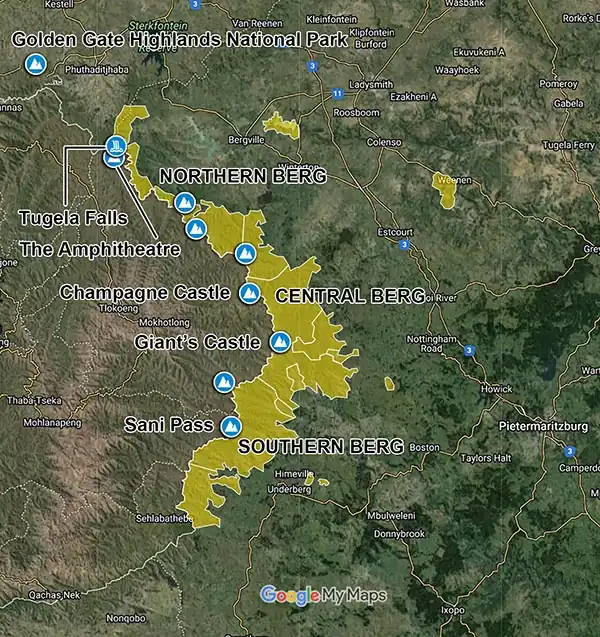
Map of the Drakensberg showing the SouthernBerg, Central Berg and Northern Berg, as well as the locations of Tugela Falls, The Amphitheatre and Sani Pass

Hostels listed on Booking.com and Hostelworld

ALL HOSTELS

Full contact details are included in case you want to book direct, plus useful info such as Safety Ratings and Value For Money, Solo Female Friendliness, and Digital Nomad scorecards.

Every listing below is independently researched and unsponsored. We review them all the same way - the hostels do not pay us for advertising.

Did we miss a hostel? Email us at and we'll add it.

A note on distances to the Tugela Falls trailhead: The Sentinel Car Park — start of the Tugela Falls / Amphitheatre hike — is accessed from the Free State side of the mountains via Phuthaditjhaba. It is not accessible directly from the KwaZulu-Natal side. Distances from each hostel to the Sentinel Car Park are noted in each listing.

KHOTSO LODGE & HORSE TRAILS

AREA: SOUTHERN BERG — Underberg

STREET ADDRESS: Drakensberg Gardens Road, Underberg, 3257

GOOGLE MAPS: -29.74596, 29.4264

PHONE: +27 82 412 5540

WHATSAPP: +27 82 412 5540

EMAIL: info@khotso.co.za

WEBSITE: khotso.co.za

SOCIAL: Facebook | Instagram

DISTANCE TO SENTINEL CAR PARK (Tugela Falls trailhead): ~175km / approximately 2.5 hours. Khotso is a Southern Berg base — Sani Pass and the Southern Berg hiking network are the primary draw, not the Tugela Falls hike.

ACCOMMODATION TYPE: Adventure Farm with Backpackers Lodge, Rondavels, and a large self-catering Log Cabin. Camping available.

PRICE RANGE: Budget to Mid-Range. Camping from R190 per person; Backpacker dorms from R360 per person; Private double/twin (shared bath) from R1,100 per room; En-suite rooms from R1,300; Self-catering rondavels from R1,600 (sleeps 2).

Read More

GOOGLE RATING: ~4.5 / 5

BOOKING.COM RATING: ~8.4 / 10 ("Very Good")

VALUE FOR MONEY RATING: 5 / 5. Khotso is exceptional value by any measure — not just for the price, but for the sheer depth of what is included. The horse trails through the Drakensberg foothills are Khotso's signature offering and represent one of the finest equestrian experiences in South Africa: multi-day trails into the mountains with Basotho guide ponies, overnight stays at remote campsites, and a perspective on the Southern Berg landscape that no hiking trail can replicate. Day rides run from approximately R600 per person; multi-day trail packages from R1,800 per person per day all-inclusive. On top of this, the farm setting itself — trout dams, indigenous forest walks, birdlife, and views of the Drakensberg escarpment — means you can spend a full day without spending a cent beyond your accommodation. One of the genuinely outstanding-value destinations in the entire Drakensberg.

VIBE-METER: 50% Adventure Farm Retreat / 30% Horseback Explorer / 20% Hiking Base. Khotso is not a social party hostel and makes no attempt to be one. The guest community that gathers here is united by a love of horses, mountains, and genuine outdoor experience. The atmosphere is warm, purposeful, and unhurried — conversations at dinner tend to be about tomorrow's trail rather than last night's bar. One of the most distinctive hostel experiences in South Africa.

DECIBEL LEVEL: 1 / 5. A working farm in the Drakensberg foothills. The loudest sounds are horses in the early morning and, occasionally, rain on a corrugated iron roof. One of the quietest sleep environments on the entire backpacker circuit.

KEY AMENITIES: Multi-day and day horse trails into the Drakensberg (Khotso's defining feature), trout fishing in the farm dams, mountain hiking directly from the property, birdwatching, swimming dam, braai facilities, self-catering kitchen, fire pits, stunning escarpment views, Sani Pass 4x4 tour arrangements (Underberg operators are 20 minutes away), communal lounge with fireplace.

NEARBY HIGHLIGHTS: Sani Pass 4x4 tours from Underberg (20 minutes), Drakensberg Gardens Golf Club, Bushman's Nek Border Post into Lesotho (45 minutes — the gentler, less dramatic alternative to Sani Pass, accessible by ordinary vehicle), Himeville Nature Reserve, Vergelegen Wetland, excellent trout fishing rivers throughout the Southern Berg.

SOLO FEMALE FRIENDLINESS: 4 / 5. The farm setting and warm management create an inherently safe, community-feel environment. The horse trail activities attract a strong female clientele — multiple reviews from solo women describe feeling genuinely welcomed and at ease. Accommodation units are spread across the farm rather than concentrated in a single building; private rondavels offer complete privacy. The absence of a bar scene and the purposeful outdoor focus make this one of the more comfortable Drakensberg options for solo women travellers.

DIGITAL NOMAD FRIENDLINESS: 1 / 5. This is not a work destination and should not be treated as one. Wi-Fi is available but connectivity in the Southern Berg foothills is patchy. The value of Khotso is in disconnecting completely, which it does with great conviction.

SAFETY RATING: GREEN. A managed farm property in a rural area with very low crime risk. The Underberg area is one of the safest rural environments in KwaZulu-Natal. The horse trails are led by experienced local guides; safety standards on the trails are well-regarded in reviews.

MANAGEMENT STYLE: Owner-managed with a long personal history of horse trail operation in the Southern Berg. The equestrian expertise and the quality of the trail programme reflect decades of accumulated knowledge. Management responsiveness in reviews is consistently praised.

EMPLOYMENT ETHICS: POSITIVE. Khotso operates a model that directly employs and supports the Basotho mountain community — the guides on the horse trails are local Basotho men with deep knowledge of the terrain, and the programme is built around their skills rather than importing external expertise. This is ethical employment in the most direct sense: the people with the knowledge get the work and the income.

THE BLURB: Khotso means "peace" in Sesotho, and the name is accurate. This is one of those South African backpacker experiences that doesn't fit neatly into any category — it's part farm stay, part adventure operation, part mountain retreat — but what it delivers consistently is a depth of Southern Berg experience that you simply cannot get from a standard dorm bed. The horse trails are the headline, and they genuinely deserve the billing: moving through Drakensberg foothills on a mountain pony, with a Basotho guide who has ridden these valleys his whole life, is a different order of experience from anything available to the standard self-drive tourist. Book the multi-day trail if you can. If not, even a single day ride from the farm will change how you understand this landscape.

FINAL VERDICT: The finest adventure farm experience in the Southern Drakensberg. Essential for horse riders; highly recommended for anyone who wants a genuinely immersive Southern Berg base. One of the best-value, most distinctive hostels in this guide.

SANI LODGE BACKPACKERS

AREA: SOUTHERN BERG

STREET ADDRESS: 10.5km along the Sani Pass Road, Mkhomazana Wilderness Area, Himeville, 3257

GOOGLE MAPS: -29.66232, 29.45614

PHONE: +27 83 987 3071

WHATSAPP: +27 83 987 3071

EMAIL: info@sanilodge.co.za

WEBSITE: sanilodge.co.za

SOCIAL: Facebook | Instagram

DISTANCE TO SENTINEL CAR PARK (Tugela Falls trailhead): ~165km / approximately 2.5 hours. Sani Lodge is a Southern Berg base — the Sani Pass is the primary draw.

ACCOMMODATION TYPE: Fair Trade Tourism Certified eco-lodge. Backpacker dorms, private rooms, rondavels (en-suite), and self-catering cottages. Set in indigenous riverine bush 10.5km along the Sani Pass road — mountain and river views from most units.

PRICE RANGE: Budget to Mid-Range. Backpacker dorms from R350–R400 per person; Private double/twin (shared bath) from R950 per room; Standard rondavels (en-suite) from R1,350; Self-catering cottages from R2,000 per night (sleeps 4).

Read More

GOOGLE RATING: ~4.4 / 5

BOOKING.COM RATING: ~7.9 / 10 ("Good")

VALUE FOR MONEY RATING: 5 / 5. Sani Lodge's Fair Trade Tourism certification is not marketing — it reflects a genuine, audited commitment to ethical business practices that directly benefits the surrounding community. The location itself is extraordinary value: 10.5km up the Sani Pass road, with the mountains pressing in on both sides and the Mkhomazana River running past the property. The rondavels and cottages offer a quality of mountain setting that comparable properties charge significantly more for. The guided Sani Pass hike (walking the pass rather than driving it — a completely different and largely unknown experience) is bookable through the lodge. Excellent value at every price point.

VIBE-METER: 40% Eco Wilderness Retreat / 35% Sani Pass Adventure Base / 25% Serious Hiking Base. Sani Lodge is the most ethically grounded hostel in the Drakensberg, and this is felt in the atmosphere — guests are here because they care about the mountains, the community, and the experience, rather than because it's the most famous name or the most socially active venue. The vibe is purposeful, warm, and genuinely connected to the landscape it sits in.

DECIBEL LEVEL: 1 / 5. You are 10.5km up a mountain pass road. The river runs past the property. The Drakensberg is behind you. This is one of the quietest sleep environments in South Africa.

KEY AMENITIES: Fair Trade Tourism certified (independently audited — not self-declared), guided Sani Pass hiking and 4x4 tours booked through the lodge, Mkhomazana River swimming and trout fishing, indigenous garden with mountain views, braai facilities, self-catering kitchen, birdwatching (bearded vulture/lammergeyer territory), guided Southern Berg day hikes, community cultural visits to nearby Basotho villages, communal fireplace lounge, free parking.

NEARBY HIGHLIGHTS: Sani Pass (starting 10.5km from the lodge — the most convenient base for the pass in the entire Southern Berg), Himeville Nature Reserve (30 minutes), Khotso Lodge horse trails (30 minutes), Cobham Nature Reserve and its hiking trails (45 minutes), Bushman's Nek border post into Lesotho (1 hour).

SOLO FEMALE FRIENDLINESS: 5 / 5. The Fair Trade certification includes specific standards around staff training, guest safety, and inclusive practice. The lodge's remote location — counterintuitively — makes it one of the safer environments in the Drakensberg: the road in is one track, the community is known, and the management is genuinely attentive. Multiple solo female reviewers specifically describe it as the highlight of their South Africa trip. The river valley setting and the quality of the rondavels provide privacy and comfort that a standard dorm cannot. One of our top solo female recommendations in the entire Drakensberg.

DIGITAL NOMAD FRIENDLINESS: 1 / 5. Not a work destination. There is a reason you came to the Sani Pass road. It is not to answer emails.

SAFETY RATING: GREEN. The Himeville and Underberg area is among the most rural and lowest-crime environments in KwaZulu-Natal. The lodge's position on the Sani Pass access road means that the only traffic is guests and locals who know each other. Fair Trade Tourism certification includes community safety standards. No adverse reports of any kind.

MANAGEMENT STYLE: Owner-managed with a deep personal commitment to Fair Trade principles. The certification — which requires independent annual audits across environmental, employment, and community standards — is the most concrete evidence of management values available for any hostel in this guide. Management responses to online reviews are prompt and thoughtful.

EMPLOYMENT ETHICS: OUTSTANDING. Fair Trade Tourism certification is the gold standard for ethical hospitality employment in South Africa. It requires living wages (not minimum wage), safe working conditions, equal opportunity hiring, community benefit programmes, and independent verification. Sani Lodge is one of a very small number of backpacker-category properties in South Africa to hold this certification. Staff are drawn from the surrounding Basotho and Zulu communities and include individuals with long-term tenure. The community cultural visit programme returns income directly to village households. This is not box-ticking; it is a business built around the principle that the people who live in these mountains should benefit from travellers coming to see them.

THE BLURB: Sani Lodge sits 10.5km up the Sani Pass access road in a river valley between mountains, and it is the most ethically serious hostel in the Drakensberg. Fair Trade Tourism certified, community-embedded, and set in a landscape that is quietly extraordinary — the bearded vultures ride the thermals above the property in the morning, the Mkhomazana River runs cold and clear past the rondavels, and the Sani Pass is visible from the terrace. The guided walking ascent of Sani Pass — which almost nobody knows you can do on foot — starts from the lodge's front gate. This is also the base from which to arrange a stay at the Sani Mountain Lodge at the top, where you can drink a beer at the highest pub in Africa and look back down the pass at the valley you walked up. If you are serious about the Southern Berg and you want to feel good about where your money goes, Sani Lodge is the answer.

FINAL VERDICT: The finest ethically-run hostel in the Drakensberg, and one of the most beautifully located. The definitive Southern Berg base for the Sani Pass, Fair Trade credentials, and genuine wilderness immersion. Highly recommended without reservation.

MOUNTAIN BASE BACKPACKERS

AREA: CENTRAL BERG

STREET ADDRESS: R600 Cathkin Road, Champagne Valley, Central Drakensberg (adjacent to Dragon Peaks Resort)

GOOGLE MAPS: -29.01608, 29.43671

PHONE: +27 36 468 1031

WHATSAPP: +27 81 479 8195

EMAIL: info@mountainbase.co.za

WEBSITE: mountainbase.co.za

SOCIAL: Facebook | Instagram

DISTANCE TO SENTINEL CAR PARK (Tugela Falls trailhead): ~120km / approximately 1.5 hours. Central Berg location — Cathedral Peak and Monk's Cowl hiking are the primary draw.

ACCOMMODATION TYPE: Adventure backpackers with dorms, private cabins, and en-suite rooms. Formerly part of an airfield operation; revamped as a dedicated backpacker and adventure base in the Champagne Valley.

PRICE RANGE: Very Budget-Friendly. Dorms from R165 (low season) to R220 (high season) per person; Private cabins (shared bath) from R225–R300 per person; En-suite rooms from R295–R400 per person.

Read More

GOOGLE RATING: ~4.1 / 5

BOOKING.COM RATING: ~7.6 / 10 ("Good")

VALUE FOR MONEY RATING: 4 / 5. The lowest dorm prices of any Drakensberg hostel on this list, in the Central Berg's most activity-rich valley. The Champagne Valley / Cathkin Park area has the highest concentration of outdoor activities per square kilometre in the Drakensberg — zip-lining, quad biking, golf, horse riding, white-water tubing, and direct access to Monk's Cowl and Cathedral Peak trails are all within a short drive. At these prices, Mountain Base is an outstanding budget base for the Central Berg.

VIBE-METER: 55% Budget Adventure Base / 30% Central Berg Hiking Hub / 15% Groups & Sports Tours. Mountain Base draws a younger, more active crowd than the Southern Berg properties — it has the energy of a place where people arrive in the morning having planned the day's activity and leave in the afternoon having done it. Not a social party hostel in the Long Street sense, but reliably active and sociable.

DECIBEL LEVEL: 2 / 5. The Champagne Valley is a valley, not a suburb. Road noise from the R600 is minimal. The property is large and spread out. Occasional group noise from sports tours; otherwise peaceful.

KEY AMENITIES: Direct access to Champagne Valley activity corridor (zip-lining, quad biking, horse riding, white-water tubing, golf — all bookable through the property), hiking access to Monk's Cowl Nature Reserve (30 minutes), Cathedral Peak hotel trails (45 minutes), braai facilities, self-catering kitchen, swimming, large outdoor areas, secure parking, group facilities for sports tours.

NEARBY HIGHLIGHTS: Monk's Cowl Nature Reserve and hiking (30 minutes), Cathedral Peak Hotel (45 minutes — day visitors welcome, excellent pool and bar), Champagne Castle summit (3,377m — one of the highest peaks in the Drakensberg, serious full-day hike), Didima San Art Centre at Cathedral Peak (45 minutes — the best rock art interpretive facility in the Drakensberg), Giant's Castle lammergeyer feeding station (1 hour in winter).

SOLO FEMALE FRIENDLINESS: 3 / 5. An active, outdoor-focused hostel with a good community atmosphere. The activity programme creates natural social groupings that are comfortable for solo travellers. Standard security; no specific female-focused facilities noted. Good for solo women who are confident in an activity-focused backpacker environment.

DIGITAL NOMAD FRIENDLINESS: 2 / 5. Wi-Fi available. The Champagne Valley is not a connectivity hub, and that is the point of being here.

SAFETY RATING: GREEN. The Cathkin Park / Champagne Valley area is a safe, tourism-focused rural environment. The property is managed and fenced. No adverse safety reports.

MANAGEMENT STYLE: Independent, staff-managed. The revamp from the old airfield operation suggests active reinvestment in the property. Review responses are present and professional.

EMPLOYMENT ETHICS: NEUTRAL. No adverse reports. Local employment apparent from staff interactions in reviews. No Workaway listings found.

THE BLURB: Mountain Base is the budget backpacker's best entry point into the Central Drakensberg — the lowest dorm prices on the list, in the valley that has the most to offer beyond the mountain itself. The Champagne Valley activity corridor running past the front gate covers everything from zip-lining to white-water tubing to golf, and the hiking access to Monk's Cowl and Cathedral Peak is genuinely excellent. It is not the most polished property in this guide, and it does not need to be. It is clean, affordable, well-located, and surrounded by the finest Central Berg landscape in the country. The lammergeyer vultures circle the ridge above the valley most mornings. Bring binoculars.

FINAL VERDICT: The best budget option in the Central Berg. Outstanding value for hikers and activity-seekers targeting the Champagne Valley and Cathedral Peak area.

BERG BACKPACKERS

AREA: NORTHERN BERG — Winterton

STREET ADDRESS: Glen Gray Farm, R600, Winterton, 3340

GOOGLE MAPS: -28.82754, 29.47028

PHONE: +27 82 400 3724

WHATSAPP: +27 82 400 3724

EMAIL: info@bergbackpackers.co.za

WEBSITE: drakensberg-hikes.co.za

SOCIAL: Facebook

DISTANCE TO SENTINEL CAR PARK (Tugela Falls trailhead): ~90km / approximately 1.5 hours via the R74. Better positioned for the hike than most Central Berg properties, though Maluti Backpackers in Phuthaditjhaba remains the closest and most convenient base.

ACCOMMODATION TYPE: Farm-stay backpackers. Private rooms only — no dormitories. Small, intimate property on a working Drakensberg farm.

PRICE RANGE: Budget. Private double/twin (shared bath) from R500 per room; Family rooms (private bath) from R900 per room.

Read More

GOOGLE RATING: ~4.3 / 5

BOOKING.COM RATING: ~7.4 / 10 ("Good")

VALUE FOR MONEY RATING: 4 / 5. Private rooms only at dorm-adjacent prices — at R500 for a double room, Berg Backpackers offers exceptional per-person value for couples or friends travelling together. The farm setting provides a level of quiet and space that no dorm hostel can match. No significant extras included, but the price point means they are not necessary.

VIBE-METER: 50% Quiet Farm Retreat / 30% Hiking Base / 20% Small Group Explorer. Berg Backpackers is a small, intimate property that draws independent travellers who want a peaceful base rather than a social hostel. The farm atmosphere — cows in the adjacent fields, mountain views across the valley, no bar scene — suits the self-directed hiker perfectly.

DECIBEL LEVEL: 1 / 5. A working farm outside Winterton. The quietest property in the Central Berg section of this list.

KEY AMENITIES: Farm setting with escarpment views, private room accommodation only (a genuine differentiator at this price), braai facilities, self-catering kitchen, hiking information and local trail maps, Drakensberg Hikes website integration (the owner is connected to the local hiking community and is a useful source of current trail conditions), parking.

NEARBY HIGHLIGHTS: The R74 to the Northern Berg and the Sentinel Car Park (90km), Spioenkop Dam Nature Reserve (40 minutes — significant Anglo-Boer War battlefield and good birding), Winterton Museum (local Zulu and settler history), access to both Central and Northern Berg hiking areas.

SOLO FEMALE FRIENDLINESS: 4 / 5. A small, quiet farm property with private rooms only — no mixed dorms, no bar scene, and an inherently safe rural environment. The intimate scale of the property means you know who else is staying. Good for solo women who prefer a guesthouse character over a hostel character.

DIGITAL NOMAD FRIENDLINESS: 2 / 5. Quiet enough to work; connectivity is limited in the Winterton farming area.

SAFETY RATING: GREEN. Rural Winterton farming area. Safe, quiet, no adverse reports.

MANAGEMENT STYLE: Small owner-managed farm property. The connection to the Drakensberg Hikes platform suggests an owner who is actively engaged with the hiking community and keeps current on trail conditions — useful practical knowledge for guests.

EMPLOYMENT ETHICS: NEUTRAL. Small local operation. No adverse reports.

THE BLURB: Berg Backpackers is the Drakensberg's quiet option for those who want a private room at backpacker prices in a genuine farm setting. It is not trying to be a social hub, and that is its strength. The views of the escarpment from the property are excellent, the owner knows the hiking network thoroughly, and the R74 north toward the Sentinel Car Park is within a reasonable morning's drive. A good choice for couples or pairs targeting both the Central and Northern Berg without wanting to pay guesthouse prices for the privilege of a room to themselves.

FINAL VERDICT: The best-value private room option in the Central Berg. Ideal for couples and pairs who want farm quiet, mountain access, and no dorm compromise.

AMPHITHEATRE BACKPACKERS LODGE

AREA: NORTHERN BERG — Bergville

STREET ADDRESS: R74, Northern Drakensberg, Bergville, 3350

GOOGLE MAPS: -28.64329, 29.15882

PHONE: +27 82 855 9767

WHATSAPP: +27 82 855 9767

EMAIL: bookings@amphibackpackers.co.za

WEBSITE: amphibackpackers.com

SOCIAL: Facebook | Instagram

DISTANCE TO SENTINEL CAR PARK (Tugela Falls trailhead): ~160km / approximately 2.5 hours each way. The Sentinel Car Park is accessed from the Free State side of the mountains via Phuthaditjhaba. From Amphitheatre Backpackers, the road route goes back through Bergville, north to Harrismith, and west through Phuthaditjhaba — there is no direct road across the mountain. This means a 320km round trip on the day of the hike, on top of the 6–8 hour hike itself. Factor this carefully into your planning.

ACCOMMODATION TYPE: Full-service adventure hostel with dormitories, private rooms (en-suite), safari tents, and camping. Pool, bar, restaurant.

PRICE RANGE: Mid-Range Budget. Camping from R135 per person; Dorms from R295 per person; Private double en-suite from R820–R1,080 per room.

Read More

GOOGLE RATING: ~4.1 / 5

BOOKING.COM RATING: ~6.3 / 10 ("Okay")

VALUE FOR MONEY RATING: 2 / 5. The Booking.com score of 6.3/10 — significantly below the average for this guide — reflects a consistent pattern in recent reviews: guests report that the tour and activity packages sold through the hostel are aggressively and repeatedly promoted from the moment of arrival, that the pricing of in-house tours is substantially above what comparable activities cost when booked independently, and that the overall atmosphere prioritises commercial transactions over guest experience. Several reviewers note that attempts to decline tours or ask questions about pricing were met with persistence rather than goodwill. At the price point, and given these consistent reports, the value for money is below what equivalent alternatives in the region offer.

VIBE-METER: 50% Commercially Driven Activity Hostel / 30% Social Party Atmosphere / 20% Northern Berg Base. Amphitheatre has a reputation as a lively, social property — the bar and pool area are active, and the hostel draws a party-inclined crowd alongside activity-focused travellers. The social energy is real. The commercial pressure attached to it is also real, and guests should arrive with clear expectations about both.

DECIBEL LEVEL: 4 / 5. An active bar, a pool, and a property designed around social and commercial activity. Not a quiet retreat. Evenings here are lively; this is a feature for some guests and a dealbreaker for others.

KEY AMENITIES: Swimming pool, bar and restaurant, tour desk (see note below), camping, safari tents, secure parking, Baz Bus stop (one of the very few Drakensberg Baz Bus stops — a genuine advantage for backpackers without a car).

IMPORTANT NOTE ON TOURS AND GUIDES: BackpackersBible.com recommends that all guests planning the Tugela Falls hike arrange a qualified, independent guide before arrival — regardless of any advice or offers received at any accommodation. The guides we recommend are listed on our Drakensberg activities page. Booking your guide independently ensures you are working with a qualified, properly insured professional whose primary loyalty is to your safety, not to a commercial arrangement with your accommodation.

NEARBY HIGHLIGHTS: The Royal Natal National Park and Tugela Gorge walks are within a reasonable drive. The Amphitheatre viewpoint (the view of the escarpment face from the valley floor — free, spectacular, no hiking required) is accessible from the R74 near the hostel. Cathedral Peak area is approximately 60km south.

SOLO FEMALE FRIENDLINESS: 3 / 5. The active bar and party atmosphere make this a less straightforward recommendation for solo women than the quieter Southern Berg properties. The property has standard security and a staffed reception. The social atmosphere can be a positive for solo travellers who want to meet people quickly; it requires the same situational awareness as any active bar environment after dark.

DIGITAL NOMAD FRIENDLINESS: 2 / 5. Wi-Fi available. The hostel's social character makes focused daytime work difficult. The Northern Berg area has limited connectivity.

SAFETY RATING: AMBER. The Northern Berg / Bergville area requires the standard rural KwaZulu-Natal awareness. The hostel itself is adequately secured. The Amber rating reflects the commercial pressure described in multiple reviews — specifically, the pattern of guests being guided toward high-margin in-house tour packages rather than receiving independent advice. This is not a physical safety concern but it is a financial one, and it is relevant to guests making decisions about guide hire for the Tugela Falls hike.

MANAGEMENT STYLE: Commercially managed, owner-driven revenue model with emphasis on in-house activity sales. The property is well-maintained physically. The management culture, as reflected in reviews, prioritises commercial performance over the kind of guest-first approach visible at Khotso, Sani Lodge, and Maluti.

EMPLOYMENT ETHICS: NEUTRAL. Standard local employment. No specific adverse or positive indicators identified beyond the general review pattern.

THE BLURB: Amphitheatre Backpackers is the best-known Northern Berg hostel name. The social atmosphere is lively, the setting in the Northern Berg foothills is good, the view of the Amphithatre fantastic, and the pool and bar work well for an active crowd. The consistent pattern in recent reviews — guests feeling commercially pressured around tour bookings from arrival — is documented, and guests should arrive knowing this and having arranged their own guide and activities independently. The 160km distance from the Sentinel Car Park is the other thing nobody tells you in advance: if the Tugela Falls hike is your primary reason for being in the Northern Berg, Maluti Backpackers in Phuthaditjhaba puts you 25km from the trailhead rather than 160km.

FINAL VERDICT: The Northern Berg's most social hostel. Arrive with your guide booked independently, your activity budget decided, and your expectations calibrated. For the Tugela Falls hike specifically, Maluti Backpackers is the more practical base.

KARMA BACKPACKERS

AREA: Maluti Mountains

STREET ADDRESS: 2 Piet Retief Street, Kestell, Free State, 9860

GOOGLE MAPS: -28.31098, 28.69908

PHONE / WHATSAPP: +27 83 442 3973

EMAIL: kestellkarma@gmail.com

WEBSITE: karmalodge.co.za

SOCIAL: Facebook

ACCOMMODATION TYPE: Small private guesthouse-style backpackers in the Northern Berg. Mixed dorm, private rooms

PRICE RANGE: Budget to mid-range. Dorms from ~R250, Rooms from ~R550.

Read More

GOOGLE RATING: ~4.3 / 5

VALUE FOR MONEY RATING: 4 / 5. Standard Northern Berg pricing. Free coffee, jam and vegetables from the hostel's garden (when available / in season).

VIBE-METER: 100% Quiet Small-town Retreat / 0% Party. The property presents as a small, quiet guesthouse-style accommodation aimed at hikers visiting the Amphitheatre area. The owners are elderly people who do not like noise.

DECIBEL LEVEL: 2 / 5. Small, quiet property in a rural Free State setting.

KEY AMENITIES: Standard backpacker facilities. Northern Berg location.

NEARBY HIGHLIGHTS: Royal Natal National Park and the Tugela Gorge walks. The Sentinel Car Park trailhead is approximately 60km away — better than Amphitheatre Backpackers but still a meaningful early morning drive before a full day's hiking.

IMPORTANT NOTE ON GUIDES: As with all Drakensberg accommodation, BackpackersBible.com recommends arranging your Tugela Falls guide independently before arrival. See the Drakensberg activities section for our recommended guides. Your guide's qualifications and safety equipment should be confirmed directly with them, not through any third party.

SOLO FEMALE FRIENDLINESS: 2 / 5. Small property in a rural setting.

DIGITAL NOMAD FRIENDLINESS: 1 / 5. Rural Free State. Not a work environment.

SAFETY RATING: AMBER. There have been some incidents of crime in Kestell and burglary of the property. Check whether they still leave their door unlocked at night.

THE BLURB: Karma occupies a middle ground in the Northern Berg — closer to the Sentinel Car Park than Amphitheatre Backpackers (60km versus 160km), smaller and quieter in character. For the Tugela Falls hike specifically, it is a more practical base than Amphitheatre if you are already committed to the Northern Berg side of the mountains. The clear recommendation for most hikers, however, remains Maluti Backpackers in Phuthaditjhaba — 25km from the trailhead, on the correct side of the mountain, with the Witsieshoek shuttle accessible from there if you do not have a 4x4.

FINAL VERDICT: A Free State option at roughly the midpoint between Amphitheatre and the trailhead. Adequate for the area, although there is little or nothing to do in the town of Kestell itself. The Backpacker's Bible experience is that the hostel's reputation for friendliness is more nuanced than reviews from passing travellers would suggest, with an abrasive attitude behind the scenes.

MALUTI BACKPACKERS ★

AREA: Phuthaditjhaba

STREET ADDRESS: 3232 Nteo Street, Phuthaditjhaba-A, Phuthaditjhaba, 9866, Free State

GOOGLE MAPS: -28.51372, 28.81858

PHONE: +27 76 193 4444

PHONE / WHATSAPP: +27 76 193 4444

EMAIL: bookings@malutibackpackers.co.za

WEBSITE: malutibackpackers.co.za

SOCIAL: Facebook

DISTANCE TO SENTINEL CAR PARK (Tugela Falls trailhead): ~25km / approximately 30 minutes. The closest accommodation of any kind to the start of the Tugela Falls hike.

DISTANCE TO GOLDEN GATE HIGHLANDS NATIONAL PARK: ~29km / approximately 30 minutes. Maluti is also the most convenient base for Golden Gate — see our note below.

ACCOMMODATION TYPE: Small, clean guesthouse-style backpackers — more B&B in character than a conventional party hostel, which suits the purpose of the location entirely. Private rooms (most with en-suite), self-catering facilities. On-site minimarket. Free shuttle to the Witsieshoek area (confirm availability when booking).

PRICE RANGE: Budget. Rooms from approximately R850 per room per night.

Read More

GOOGLE RATING: ~3.9 / 5

BOOKING.COM RATING: ~5.3 / 10 ("Fair")

VALUE FOR MONEY RATING: 4 / 5. The lower platform ratings require honest context. Maluti is not a polished tourist hostel — it is a clean, functional, affordable base in Phuthaditjhaba, a QwaQwa township that most tourists pass through at speed without stopping. Some negative reviews reflect cultural discomfort with the town environment rather than any failing of the property itself; others reflect straightforward infrastructure issues (load shedding, basic facilities) that are characteristic of the area. What Maluti offers in return is the single most important thing for anyone doing the Tugela Falls hike: proximity. At 25km from the Sentinel Car Park — compared to 60km from Karma, 90km from Berg Backpackers, 120km from Mountain Base, and 160km from Amphitheatre — Maluti allows you to start the hike at dawn without a punishing predawn drive. On a hike where early starts are essential for weather and lightning safety, this is not a minor advantage. It is potentially a lifesaving one.

VIBE-METER: 70% Practical Hiking Base / 20% Cultural Immersion (Phuthaditjhaba / QwaQwa township context) / 10% Budget Traveller Stopover. Maluti does not pretend to offer the social atmosphere of a party hostel or the wilderness romance of Sani Lodge. It offers a clean bed, a hot shower, a minimarket, and 25km between you and the start of the most significant hike in the Drakensberg. For the traveller whose primary purpose is the Tugela Falls hike or Golden Gate, this is exactly the right trade.

DECIBEL LEVEL: 2 / 5. An urban township environment — there is ambient town noise, which is different from mountain silence but perfectly manageable. Not a party hostel; the noise is external rather than internal.

KEY AMENITIES: Free shuttle service to the Witsieshoek Mountain Lodge area (confirm when booking — essential if you do not have a 4x4 for the Sentinel Car Park access road), on-site minimarket, free Wi-Fi, self-catering kitchen, mountain views toward the Maluti range, proximity to the Basotho Cultural Village (15 minutes — an excellent cultural add-on that provides context for the Basotho communities you will encounter on the Lesotho plateau above the chain ladders), secure parking.

NEARBY HIGHLIGHTS:

Tugela Falls / Sentinel Peak hike (25km, 30 minutes): The primary reason to stay here. The closest backpacker accommodation to the trailhead in South Africa.

Golden Gate Highlands National Park (29km, 30 minutes): One of South Africa's most underrated national parks, and a genuinely outstanding add-on to the Tugela Falls hike. Golden Gate's sandstone cliffs catch the afternoon light in shades of amber, orange, and red that give the park its name. The Wodehouse Peak Trail (10km, 4.6/5 on AllTrails) gives panoramic views of both the Golden Gate landscape and back toward the Drakensberg escarpment; the Brandwag Buttress walk is shorter and equally beautiful; the guided Cathedral Cave Trail (book ahead through SANParks) visits a spectacular rock arch with a chain ladder — considerably less alarming than the Tugela chain ladders, with a waterfall pool at the top. Entry approximately R252 per person per day (international). If you are staying at Maluti for the Tugela hike, staying an extra day for Golden Gate adds one of the finest national park experiences in the Free State at minimal additional cost and almost zero additional driving. It is a hidden gem, and Maluti is the obvious base for both.

Basotho Cultural Village (15 minutes): A living museum of Basotho culture — traditional architecture across five historical periods, craft demonstrations, and guides who explain the culture and history of the people whose plateau you will be walking on when you climb to the top of the Amphitheatre. Worth two to three hours before your hike day.

Witsieshoek Mountain Lodge (20 minutes): The lodge that runs the shuttle to the Sentinel Car Park. Even if you are not staying there, coordinate your shuttle booking with them the day before your hike.

SOLO FEMALE FRIENDLINESS: 3 / 5. A township environment requires standard urban awareness — the same approach you would apply in any South African town. Maluti itself is a managed, secure guesthouse property. The main practical note for solo women is that Phuthaditjhaba is not a tourist town, and navigating it for the first time after dark requires care. Arrive in daylight and orientate yourself. The on-site minimarket means you don't need to leave the property in the evening.

DIGITAL NOMAD FRIENDLINESS: 2 / 5. Free Wi-Fi available. Phuthaditjhaba has reasonable mobile connectivity. Not a work destination, but functional for a night or two.

SAFETY RATING: AMBER. Phuthaditjhaba is a busy QwaQwa township with the associated urban environment. The Amber rating reflects the town context rather than any specific incident at Maluti itself — the property is managed and secure. Standard South African urban precautions apply: keep your car locked and valuables out of sight, don't walk unfamiliar streets after dark, and ask the property staff for current local guidance on arrival. This is not a uniquely risky environment; it is a township, and townships require the same awareness as any South African urban area. The guests who report uncomfortable experiences at Maluti are almost always responding to the town rather than to the property.

MANAGEMENT STYLE: Small owner-managed guesthouse. The proprietors understand that their guests are primarily there for the Tugela Falls hike and organise accordingly — shuttle coordination, early breakfast options, and local knowledge about current road and weather conditions on the Sentinel access road are all part of what the property offers.

EMPLOYMENT ETHICS: POSITIVE. A locally-owned and locally-staffed property in a township community, with money staying in the community rather than flowing to outside operators. Supporting Maluti directly supports Phuthaditjhaba's small business economy. No adverse employment reports.

THE BLURB: Here is the thing that nobody tells you when they point you toward the Northern Berg hostels for the Tugela Falls hike: the hike starts on the other side of the mountain. The Sentinel Car Park is in the Free State, accessed via Phuthaditjhaba, and from the KwaZulu-Natal hostels the road route goes back around the mountain range — 160km from Amphitheatre, 60km from Karma. Maluti Backpackers is 25km from the trailhead. On a hike that requires a dawn start to be off the escarpment before the afternoon electrical storms, this difference is not trivial. It is the difference between leaving your accommodation at 4am versus 6am — and on this hike specifically, that hour could be the difference between a safe summit and a summit in a thunderstorm with an iron ladder under your hands. Maluti is basic. It is clean. It has a minimarket. The staff will help you sort your shuttle. It is 30 minutes from the start of the finest hike in South Africa. And it is 30 minutes from Golden Gate Highlands National Park, which is one of the great undiscovered parks in the country. Stay an extra day. Do both.

FINAL VERDICT: ★ BackpackersBible.com's recommended base for the Tugela Falls hike. The closest accommodation to the Sentinel Car Park trailhead; also the best base for Golden Gate Highlands National Park. Practical, honest, and community-supporting. The platform ratings do not capture what matters most here: the proximity.

Photo: Wikimedia Commons / -CC-BY-2.0

Welcome to our backpacking guide of South Africa!

Discover more