Backpackers Bible Logo
BackpackersBible.com
Cape Town
The World In Your Pocket
× HOME FREE OFFLINE HOSTEL GUIDE
(PDF - 3mb)
WA
SHARE
We list ALL the hostels in South Africa! Click the icons for info.

Backpacking Cape Town

You've probably seen photographs of Cape Town. You may even have thought: okay, looks impressive, I get it. You do not get it, not from a photograph. Not even close.

The thing about Cape Town that no image adequately conveys is the scale. This is a city built inside an amphitheatre. A flat-topped sandstone mountain — one thousand metres high, three kilometres wide — rises directly behind the city centre and simply dominates everything. From the sea, from the beaches, from every street corner, it is always there, turning slowly in its own cloud, watching. At night, it is lit from below and glows amber. In summer, a white cloud pours over its edge in a waterfall that never reaches the ground. From the summit, both the Indian and Atlantic oceans are visible at the same time.

Read More

This is your first morning: you wake up in a hostel on Kloof Street, you step outside, you look up, and there it is. That mountain. And in that moment, you understand that you are a very long way from home, on a continent you don't know yet, in a city unlike anything that exists in the northern hemisphere. That feeling — of complete disorientation and complete aliveness — is what Cape Town gives you on day one. Most people never quite recover from it. They keep coming back.

What Kind of Place Is This, Exactly?

Cape Town is the oldest city in South Africa and one of the most geographically extraordinary cities on earth. It occupies a narrow peninsula that stretches 75 kilometres south from the city centre into the convergence zone of the Atlantic and Indian Oceans — two entirely different bodies of water that crash into each other at the Cape of Good Hope. The Atlantic side is turquoise, freezing cold, and flanked by mountains; the Indian Ocean side is warmer, wilder, and flecked with penguin colonies and great white sharks. The city is wedged between the mountain and the sea, which means that no matter where you are in Cape Town, you are always within sight of something that will stop you mid-sentence.

It is also a deeply complex city. Beautiful in a way that can make you forget, for a moment, the weight of its history and the sharpness of its present-day inequalities. The most staggering wealth in sub-Saharan Africa exists here, ten minutes' drive from some of the most overcrowded informal settlements on the continent. You will feel this tension from the moment you arrive. The right response is not to look away from it. The right response is to pay attention, ask questions, and let the city's complexity be part of what you experience rather than something you manage around.

Cape Town will challenge you. It will also absolutely thrill you. Both things will be true at the same time, every single day. Welcome.

The City's Origin Story: It Started as a Salad

Long before any European set foot here, the Cape Peninsula was home to the Khoisan people — specifically the Goringhaicona clan, semi-nomadic hunter-gatherers and pastoralists who called this place Hui !Gaeb: "the place where clouds gather." They had been here for thousands of years. They watched the first Portuguese ships round the cape in 1488 under Bartolomeu Dias — who named it Cabo das Tormentas, the Cape of Storms, after nearly being wrecked — and they watched more ships come, year after year, for the next 164 years. They were not consulted on what happened next.

In 1652, the Dutch East India Company (VOC) sent Jan van Riebeeck to the Cape with one of the most prosaic mandates in colonial history: go grow vegetables. The sea route between Europe and the spice islands of the East Indies was a four-month, scurvy-ravaged nightmare. Sailors were dying of vitamin deficiency. The Cape, roughly halfway along the route, was the logical place to build a kitchen garden, a water station, and a repair depot. Van Riebeeck wasn't supposed to colonise Africa. He was supposed to grow lettuce.

What began as a cabbage patch became, within a generation, a full colony. Settlers spread beyond the fort's boundaries. The Khoisan, who had initially traded cattle with the Dutch, found their grazing lands enclosed and their herds taken. Enslaved people were imported from Madagascar, Mozambique, India, and the Dutch East Indies — a forced migration that would give Cape Town its extraordinarily diverse genetic and cultural makeup and, ultimately, its unique cuisine, its languages, and its hybrid identity. The Castle of Good Hope, completed in 1679 and the oldest surviving building in South Africa, was not built to defend against elephants. It was built to keep the enslaved population in and rival European navies out. Walk past it on the Grand Parade today and you are walking past the physical origin point of modern South Africa.

The Company's Garden — the vegetable patch that started it all — is still there, in the middle of the CBD, now a lush public park with ancient oak trees and famously fearless squirrels. It is four minutes' walk from the Long Street backpacker strip. The fact that this city's origin story sits directly alongside its party district is very Cape Town.

The Cape Malay, the Bo-Kaap, and the Language You'll Hear

One of the first things you'll notice in Cape Town is that the accent is unlike anything else in South Africa, and unlike anything else in the world. Cape Town has its own dialect of Afrikaans — and its own brand of English, heavily inflected by that Afrikaans — that reflects the city's layered history. Words like lekker (nice, good, delicious, enjoyable — a word that does everything), braai (barbecue), boet (bro), yoh (an all-purpose expression of surprise or appreciation), and eina (ouch, or "that hurts") will enter your vocabulary within 48 hours. The phrase you will hear most often, from everyone, is "shame" — which in Cape Town means approximately the opposite of what you think it means. "Ag shame" is an expression of sympathy and warmth. When a local says "shame, man" about a baby or a lost puppy, they mean something like "how sweet" or "poor thing." Do not be confused by this. It is one of the more charming linguistic features of the place.

The Bo-Kaap — the neighbourhood of steep, cobbled streets and neon-painted houses immediately above the CBD — is the historic heart of Cape Town's Cape Malay community, the descendants of the enslaved people and political prisoners brought here from the Dutch East Indies in the 17th and 18th centuries. The community maintained its Islamic faith through two centuries of colonial prohibition, developed its own dialect of Afrikaans (the oldest written form of the language), and created what is today called Cape Malay cuisine: the most distinctive and delicious cooking in South Africa, a fusion of Indonesian, Indian, African, and Dutch flavours. A bowl of Cape Malay curry — richly spiced with cinnamon, cardamom, and dried apricot; served over fragrant yellow rice with sambal and atchar — costs about €3 from the family-run restaurants on Wale Street and will rearrange your understanding of what a curry can be. Walk up from Long Street on a Sunday morning when the mosques are calling and the smell of koesisters (syrup-soaked twisted doughnuts) is drifting out of every other window. It is extraordinary.

Understanding the City: Five Zones, Five Worlds

Cape Town is not one city. It is a collection of sharply different neighbourhoods divided by mountains, motorways, and a history of forced racial geography. For a backpacker, understanding these zones is the difference between a good trip and a legendary one.
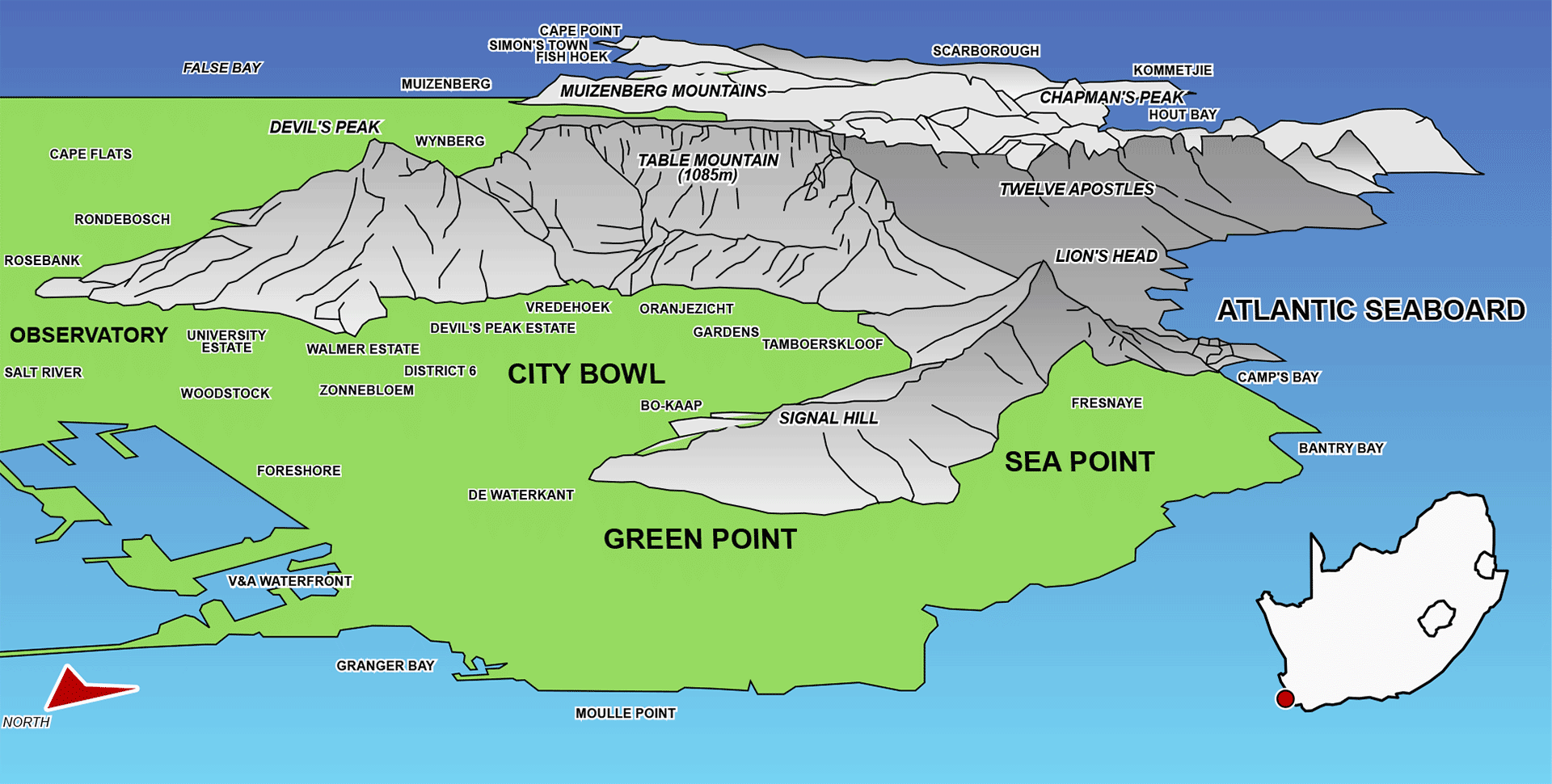
3-D map of Cape Town, showing the different suburbs relative to Table Mountain

The City Bowl: Where You'll Live

The City Bowl is the central valley cradled between Table Mountain, Devil's Peak, and Lion's Head. This is where the majority of backpacker accommodation sits, where the nightlife concentrates, and where you'll spend most of your time when you're not on a beach or a mountain. Long Street is the traditional backpacker artery — loud, colourful, sometimes sketchy after midnight, always alive. Kloof Street, running parallel up the slope of the mountain, is where you go for good coffee, better bars, and the feeling that Cape Town is a city that genuinely functions. Bree Street sits between them and has become the city's most interesting restaurant and craft beer strip in the last decade. The three streets form a triangle that contains more good food, good music, and good people-watching per square metre than almost anywhere else in Africa.

The Atlantic Seaboard: Where You'll Go for Sunsets

From the V&A Waterfront, the Atlantic Seaboard runs south along the base of the Twelve Apostles mountain range through Green Point, Sea Point, Bantry Bay, Clifton, and Camps Bay. This is the expensive, beautiful, slightly unreal side of Cape Town — all sundowner bars, white sand coves, and impractically attractive people. The water here is glacially cold (the Benguela Current comes directly from Antarctica), but nobody is swimming on the Atlantic Seaboard anyway; they're sitting on the rocks at Clifton with a cold beer, watching the sun go down over the ocean in colours that do not look like they belong to this planet. The Sea Point Promenade — 11km of oceanfront path — is free, endlessly social, and one of the great urban walks in the world at dusk.

Observatory ("Obs"): Where the Real City Lives

Observatory is the neighbourhood that Cape Town's creative class — musicians, artists, students, activists, people who make their own clothes and grow herbs on their windowsills — calls home. It sits on the southern slopes above the railway line, a 10-minute Uber from the City Bowl, and it looks completely different: peeling Victorian houses, independent record shops, a permanent smell of something cooking, bars with no signage and doors that open onto courtyards. The Armchair Theatre on Lower Main Road is the spiritual home of Cape Town's alternative music scene, with live bands on most nights, a firepit in the courtyard, pool tables, and a crowd that is roughly 50% local and 50% travellers who came for one drink and are still there at 1:00 AM. The Obs café strip is also the cheapest eating on the Cape Town social scene — bunny chow, biltong rolls, breakfast plates — in a neighbourhood that has not yet discovered what a flat white costs in the City Bowl.

The Northern Suburbs: Kite Country

Drive north from the city past the port and the industrial flatlands and you arrive at Bloubergstrand and Big Bay, on the western shore of Table Bay. This is where the Cape Doctor blows hardest — the fierce south-easterly wind that rakes the city from November to March — and it is, as a consequence, one of the premier kiteboarding destinations on the planet. Between December and February, the sky above Kite Beach is literally filled with hundreds of kites, the surfers below are foil-boarding at 40km/h, and the Table Mountain view across the bay is the most famous photograph in South Africa. There are beginner kite schools along the beachfront that will have you water-starting in three days. If that's not your thing, come at sunset for the view, which costs nothing.

The Southern Suburbs and False Bay: The Other Ocean

Over the mountain — through De Waal Drive or through the Southern Suburbs — lies a completely different coastline. False Bay faces east, is warmed by the Agulhas Current, and is the side of Cape Town that actually swims. Muizenberg is where South African surfing was born: a wide beach with a long, gentle right-hand break and a strip of Victorian beach huts painted in candy colours that have become one of the most reproduced images in the country. Beginners learn to surf here in the mornings. At the southern end of False Bay, Simon's Town is a Victorian naval town with a colony of 3,000 African penguins on the beach at Boulders, and Kalk Bay is a working fishing village with the best fish-and-chips in the southern hemisphere and an antique bookshop that will swallow your entire afternoon.

The Music: What's Actually Playing

You need to know this before you go out, because the music in Cape Town is not what you expect, and it is better than what you expect.

The dominant sound on Cape Town's dance floors right now is amapiano — a genre born in South African townships around 2014, built on a bed of deep log-drum bass lines, smooth piano riffs, and rolling percussion, with short, often repeated vocal hooks that sit on top like something between jazz and gospel. It is one of the most genuinely original musical forms to emerge anywhere in the world in the last decade, and it has now crossed into global mainstream consumption via streaming platforms and has been interpolated by artists from Drake to Beyoncé. But the version of amapiano that plays in Cape Town clubs — louder, harder, faster than the studio recordings — is something different again. When a Cape Town crowd is fully in it, the dance floor moves as a single organism. If you have never experienced it, prepare to be converted within approximately one song.

Alongside amapiano is gqom — Cape Town's own hard-edged adaptation of a form that originated in the Durban townships. Cape Town gqom is darker, more industrial than the Durban original, built on synths and strings layered over church hymn melodies, and has been dubbed "Emo Gqom" or "Gospel Gqom" by locals. The distinction between gqom and amapiano matters in the same way that the distinction between drum and bass and garage matters — they share a family tree, but they feel completely different on a dance floor. Coco on Loop Street is the home of the harder sound. Modular in Observatory is where the electronic and techno crowd goes. The Armchair is where anything can happen on a Friday night and usually does.

What makes Cape Town's music scene remarkable is that this is not imported culture. It came from the townships of Khayelitsha, Gugulethu, and Langa — from a generation of young Black South Africans who took the electronic music tools available to them and built something that is now genuinely influencing global pop. Hearing it live in the city where it was made, in a club that mixes backpackers and Capetonians from across the city's social divides, is one of those experiences that you will want to describe to people when you get home and will find you cannot adequately.

The Elephant in the Room: Inequality

Cape Town is the most unequal city in one of the most unequal countries in the world — and South Africa has the highest Gini coefficient (the standard measure of income inequality) of any country that keeps reliable records. You will feel this in ways that are difficult to prepare for. You will eat a beautiful breakfast in a garden café in Gardens and, twenty minutes later by Uber, be driving past informal settlements that stretch to the horizon. You will walk past people sleeping in doorways on streets that are otherwise some of the most photogenic in the world. You will go on a tour led by a person your own age who grew up in a township under conditions so different from your own as to seem fictional, and they will explain this calmly and with pride and you will not quite know what to do with that information.

There is no simple way to navigate this, and no guide can tell you how to feel about it. What we can say is this: the city is not asking for your guilt. It is asking for your attention and your respect. Spend money at local businesses. Tip well and directly — service workers in Cape Town earn wages that would be considered poverty pay in most of the countries our readers come from. Book your township tours with community-based operators rather than large commercial companies. Talk to people. Don't just photograph them. The inequality is real, it is structural, and it is the product of a very specific history. Understanding even a fraction of that history will make your time in Cape Town significantly richer than if you simply enjoy the view and move on. And the view is spectacular. Both things are true.

Cape Town FAQs for Backpackers

When is the best time to go?

Cape Town summers (December–March) are long, hot, and electric. Days are 14 hours of sunlight, evenings stay warm until midnight, and the energy in the hostels and bars is at its absolute peak. The Cape Doctor wind is also at its strongest in December and January — if it is blowing hard (and it can blow hard enough to close the cable car and make beach-sitting feel like a sand-blasting), head to Clifton 4th Beach or Llandudno, which are sheltered by the mountain. January and February are the best months for the kiteboarding and surfing scene at Blouberg.

The sweet spots for backpackers are October–November and March–April: warm, mostly dry, significantly less crowded, and with hostel rates that can be 30–40% cheaper than peak season. These shoulder months are when Cape Town feels most like itself rather than a city performing for tourists.

Winter (June–August) is cool, rainy, and — for the right traveller — deeply atmospheric. The mountain is regularly in cloud, the fynbos is in flower, the whale season starts in False Bay (June–November is the prime window for southern right whales), and the hostels are quiet enough that you get the place to yourself. If you are coming for surfing, hiking, or doing the Winelands without crowds, winter is underrated.

Where should I stay?

City Bowl / Kloof Street area

The default choice, and for good reason. You are at the foot of the mountain, walking distance to the best bars, restaurants, and coffee shops, and central to everything. This is where the majority of Cape Town's best backpacker accommodation sits. If you want nightlife, culture, and the social energy of people who are all going through the same disorienting first-week-in-Africa experience simultaneously, stay here.

Sea Point / Green Point

Better for active types who want to run the promenade in the morning and be near the Atlantic beaches. Slightly less central, more residential, and with a very different (calmer) energy. Some of Cape Town's best mid-range hostels are here.

Observatory

If you are staying for longer than two weeks and want to feel like you live in Cape Town rather than visit it, stay in Obs. Cheaper, more local, better music, and a bus ride from everything else. The Armchair is your living room.

Muizenberg

For surfers only. It is 45 minutes from the City Bowl without traffic and a different world entirely — small, community-focused, and built around the morning surf. If you are here to learn to surf and don't care about nightlife, this is your neighbourhood.

Blouberg / Northern Suburbs

For watersports. A great place to learn to kite surf, and with the iconic views of Table Mountain that you see in the brochures, but far from the main city action.

What does it cost to go out?

Cape Town is extraordinarily cheap by European and Australian standards. A craft beer at a Kloof Street bar: €1.50–€2.50. A cocktail at one of the nicer spots: €4–€6. Entry to most clubs: free or €2–€5. A full meal at a sit-down restaurant that would cost €25 in Amsterdam costs €8–€12 here. A Cape Malay curry from a Bo-Kaap family restaurant costs about €3. Uber across the city costs €2–€4. This gap between what you're used to paying and what things actually cost here is one of the genuinely transformative pleasures of being in Cape Town on a backpacker budget. You can afford to eat well, drink well, and experience the city properly in a way that would be impossible in London, Paris, or Sydney.

What is load shedding and will it ruin my trip?

Load shedding is South Africa's system of scheduled rolling power cuts — a consequence of decades of under-investment in Eskom, the state electricity provider. Good news: Cape Town has significantly reduced the frequency and duration of load shedding compared to the rest of the country, and in 2025 the city went through long periods of Stage 0 (no cuts) due to increased municipal renewable energy capacity. Bad news: it has not been fully eliminated, and when it does kick in, it typically runs for 2.5-hour blocks, twice a day. Download the EskomSePush app the moment you land — it will tell you exactly when and where the power will be off. Most decent hostels have inverters or generators that keep Wi-Fi and essential lighting running. It is an inconvenience, not a crisis, and most travellers barely notice it.

Getting around: Uber, bus, or hire car?

Uber and Bolt are the primary transport tools for backpackers in Cape Town, and they are ludicrously cheap. A 10-minute Uber across the City Bowl costs about €1.50. From the City Bowl to Camps Bay (a 15-minute drive with spectacular mountain views): about €3. Use Bolt to compare prices and get the better deal, especially at peak times.

MyCiTi buses are reliable, cheap, and good for the main routes along the Atlantic Seaboard and to Blouberg. They require a MyConnect card loaded with credit. Useful for getting to Camps Bay or Sea Point during the day without paying Uber surge pricing. Not useful for anything south of the CBD (Muizenberg, Simon's Town, Cape Point).

Metrorail trains: Avoid. They are unreliable, run to irregular schedules, and are not safe for tourists on most routes, particularly the Southern Line.

Hire car: Essential if you want to see the Peninsula properly — Chapman's Peak, Cape Point, the wine farms, the Boulders penguin colony, Hout Bay. Pick up at the airport (all major companies represented), drive on the left, and understand that the N2 to the airport is a road where smash-and-grab incidents happen at red lights. Keep windows up in slow traffic.

What is the Cape Doctor?

The Cape Doctor is the local name for the fierce south-easterly wind that blows through Cape Town from roughly November to March. It is named partly because it clears the city's air of pollution and partly because it is so powerful that it feels like an assault. In full force, it can throw you off your stride on the street, rip hats off heads, and make a beach afternoon miserable. But it also creates the famous "Tablecloth" — the white cloud that spills over the flat top of the mountain and cascades down the front face without ever reaching the ground, evaporating in the warmer air below. It is one of the most beautiful things you will see in Cape Town, and it happens because of the same wind that is spoiling your beach day. The Doctor can blow for three days straight or vanish overnight. Watch the mountain: if the Tablecloth is forming, head to a sheltered beach (Clifton, Llandudno) or up into the city.

Is cannabis legal?

In 2018, South Africa's Constitutional Court decriminalised the private use and personal cultivation of cannabis by adults — meaning you can legally use it in a private space such as a hostel room (if the hostel permits it). However, you cannot legally buy or sell it, and smoking in public — on the street, on the beach, in a park — remains a criminal offence. You will see pop-up "cannabis clubs" and unlicensed "dispensaries" around the City Bowl, particularly on Long Street. These operate in a legal grey area. A formal regulated retail market was still in the legislative pipeline as of early 2026. Use common sense: the law is clear on public consumption, whatever the vibe on the street suggests.

Is the tap water safe?

Yes. Cape Town's tap water is treated to a high standard and is safe to drink throughout the tourist areas of the city. You do not need to buy bottled water. That said, the city has been on recurring water-scarcity alert since the near-catastrophic "Day Zero" drought of 2017–2018, when the city came within weeks of running out of municipal water entirely. Conservation habits are embedded in local culture. Take short showers. Don't run the tap. The city will appreciate it and so will the Western Cape's increasingly stressed water catchments.

The penguins. Tell me about the penguins.

African penguins. Boulders Beach. Simon's Town. About 45 minutes' drive down the False Bay coast from the City Bowl. A colony of approximately 3,000 of them living on a public beach, completely unbothered by human presence, waddling between beach towels and nesting in the dune scrub. Yes, you can swim in the same water. Yes, they will swim alongside you and investigate your feet. No, they do not bite unless you provoke them (they do bite if you provoke them — they have a grip like a pair of pliers). The entry fee to the National Park section of the beach is small. The free section immediately adjacent to the park, reachable by walking past the navy base, gives you much the same experience without the boardwalk crowds.

While in Simon's Town: beware the baboons. The Cape Peninsula's baboon troops are legally protected, have learned that humans mean food, and have zero fear of people. If a baboon sees you carrying anything edible — or anything that looks like it might be edible, including a backpack or a shopping bag — it will take it. They are astonishingly fast and strong. Keep car windows up on the baboon-traffic sections of the road. This is not wildlife tourism; it is wildlife that has adapted completely to coexisting with tourism, which is a different and more complicated thing.

Are there sharks?

Yes, but the risk is managed and well below what the reputation suggests. The Atlantic side (Camps Bay, Clifton) is consistently too cold for sharks — the Benguela Current keeps the water at 12–16°C, which is outside the comfort zone of great whites. The False Bay side (Muizenberg, Fish Hoek) is warmer and does have great white activity; the Shark Spotters programme deploys observers on the mountain above the beach and uses a flag system visible from the water: green flag means all clear; white flag means a shark has been spotted — clear the water. In recent years, False Bay's great white population has dramatically declined — researchers believe the primary cause is a pair of orcas that moved into the area around 2017 and have since killed and eaten the livers of several great whites, causing the remaining sharks to relocate. The Cape whale watching cruises now regularly encounter these orcas. Conservation science is wild.

Safety In Cape Town

Cape Town requires a level of street awareness that most visitors from Western Europe, Scandinavia, or Australia are simply not used to. It is not a city where you switch off. That said, the majority of the tourists who pass through Cape Town every year — hundreds of thousands of them, many of them solo and in their twenties — have a completely trouble-free visit. The risks are real and manageable, not random and unavoidable. Here is what you actually need to know.

The Most Common Crime: Your Phone

Phone snatching is the number-one crime affecting tourists in Cape Town, and in 2025–2026 it has taken a new and more aggressive form: thieves on motorbikes who ride onto pavements and grab phones from hands at speed. This is happening in broad daylight in ostensibly safe areas, including Kloof Street, the V&A Waterfront vicinity, and along the Sea Point promenade. The rule is simple: keep your phone in your pocket when you are walking. Check your map before you leave, not while you walk. If you need to navigate, use your phone inside a café, a shop, or against a wall with your back protected. A moment's carelessness costs you everything — not just the phone, but the photos, the contacts, the banking apps. Use a crossbody bag with a zip, not a backpack with an external pocket.

Long Street After Midnight

Long Street is the engine of Cape Town's backpacker nightlife and it is worth every minute of it — but it is also a pickpocket corridor and a street where the "hugger mugger" technique (a stranger approaches with apparent friendliness, hugs you, and removes your wallet in the process) is common after midnight. Go, enjoy yourself, but keep your phone in a front pocket, carry only the cash you intend to spend, and — critically — do not walk the length of Long Street alone after 1:00 AM. Walk with people. Take an Uber from bar to bar after midnight rather than walking. The street is not dangerous in the way that some areas of the city are dangerous. It is pick-pocket dangerous, which is manageable with attention.

The Cape Flats: A Clear-Eyed View

The Cape Flats — the vast, flat terrain southeast of the city where the townships of Khayelitsha, Gugulethu, Nyanga, Mitchells Plain, and Manenberg are located — are where the majority of Cape Town's population lives, and where South Africa's gang violence is most concentrated. It is emphatically not a place for independent tourist wandering. That said, it is home to extraordinary community life, music, food, art, and people, and visiting it through a reputable community-based tour operator is not only safe but one of the most worthwhile things you can do in Cape Town. The distinction is critical: don't go alone, don't go spontaneously, and don't go with a large commercial bus tour either. Go with a small, locally run operator whose guides are from the community you're visiting. Your hostel can recommend them. Mzoli's Place in Gugulethu — a legendary township braai restaurant that draws a mixed crowd of locals and visitors on Sundays — is the exception: a specific, well-known venue that can be visited by taxi directly, without wandering.

Table Mountain Muggings: Real And Avoidable

Muggings on Table Mountain's lower trails — particularly the paths running from the lower cable car station toward the Platteklip Gorge entrance, and the trails near Rhodes Memorial — are an established and ongoing reality. The perpetrators work in groups and target solo hikers and pairs. The solution is straightforward: hike in groups of four or more, stick to the busy main trails (Platteklip Gorge is always populated), use the SafetyMountain tracking WhatsApp group (widely used by local hikers, ask at your hostel for the current number), and do not hike alone. The muggings almost exclusively happen on isolated sections. On a busy trail with other people around, you are very unlikely to have a problem.

GPS And The N2

When driving to or from Cape Town airport (or anywhere south of the city), Google Maps may suggest routes through townships to save a few minutes. It is not aware of which roads are safe for tourists to transit at night. Stick to the N1 and N2 highways, use the R300 or the N7 as directed, and if Google Maps suggests a shortcut through Crossroads or any informal settlement at night, ignore it. In slow traffic on the N2 particularly, keep windows up and do not leave bags visible on seats.


LION'S HEAD HIKE - Photo: Arthur Brognoli

Things To Do In Cape Town

1. The Mountain (Non-Negotiable)

You are going to climb Table Mountain. This is not a suggestion. It is a geographical inevitability. The only question is how.

Platteklip Gorge (the classic route, 2–3 hours up)

The most popular hiking route to the summit, and for good reason — it is well-marked, consistently busy (meaning safer), and the views that open behind you as you climb are increasingly absurd. At the top, you are standing on a plateau so flat that you can play cricket on it, looking down at a city that appears to have been designed by a set designer rather than built by humans. The cable car takes you back down for about €15. Or hike down the same way in half the time.

Lion's Head Sunset Hike (the social event)

Every clear evening, hundreds of people — locals, tourists, people of every age and background — make the 1.5-hour spiral hike to the summit of Lion's Head for sunset. The path involves chains and ladders near the top, which sounds alarming and is mildly exhilarating. The summit at sunset, with the Atlantic turning gold below you and the city lights beginning to flicker on across the bowl, is one of those collective experiences that Cape Town does better than any city I can think of. On a full moon, people do it at night with headlamps. The full moon hike is, by multiple accounts, even better.

Read More

Kasteelpoort (the quieter alternative)

If the Platteklip crowds are not your thing, Kasteelpoort approaches the summit from the Camps Bay side through a quieter, more atmospheric route with fewer other hikers and superior views of the Atlantic. It is harder — steeper and more technical in places — but the experience of emerging onto the summit plateau with nobody else around is worth the extra effort.

Abseiling the Front Face

This is the highest commercial abseil in the world, at 1,000 metres above sea level, stepping backwards off the top edge of the mountain and dropping 112 metres down the cliff face. Abseil Africa has operated this route for over 25 years with an impeccable safety record. You do not need prior experience; the guides manage everything. What you need is a willingness to lean back over a drop that your body is extremely reluctant to lean back over. The vertical perspective of the city from the cliff face — looking down between your feet at Cape Town laid out below you — is like nothing else. Cost approximately €65.

The Cable Car: The View Without the Legs.

The Table Mountain Aerial Cableway is not the lazy option. It is a completely different experience to hiking — and for good reasons, it is worth doing even if you have already climbed the mountain on foot. The car itself is a rotating cabin: as it rises the floor turns slowly through 360 degrees, so every passenger gets a full panoramic view of the city, both oceans, and the Peninsula stretching away to the south over the five-minute ascent. At the summit, the cable car drops you onto the plateau where you can walk freely across the top, look down the sheer front face, and spend as long as you like. There is a café at the top. The food is overpriced and the coffee is fine and the view from the café terrace is completely preposterous.

The practical information you actually need: the cable car does not run in high wind — and in Cape Town, high wind is a regular condition. The mountain can look perfectly clear from the city while a 60km/h south-easterly is running across the top, which means the cable car is closed for the day with no warning. Before you make the trip to the lower station, download the official Table Mountain Aerial Cableway app, which shows real-time queue length and operating status. This saves you significant frustration. Book tickets online rather than at the ticket office — the queue at the office in peak season can be two to three hours; booking online costs the same and you can go straight to the boarding area. Prices in 2026 run approximately €13–€16 return for an adult. The car closes for its annual maintenance shutdown every July/August for roughly one week; check the website for exact dates if you're visiting in that window. Finally: it is significantly colder on top of the mountain than in the city — even in midsummer, even on a cloudless day. Take a layer.

The best strategy for most backpackers: hike up via Platteklip Gorge and take the cable car down. You get the satisfaction and the views of the climb, your legs thank you on the descent, and you experience the rotating cabin. One-way down tickets are available. This is, by some margin, the most sensible approach to Table Mountain for people who are in reasonable shape but also have somewhere to be in the evening.

2. Adrenaline

Paragliding from Signal Hill

You launch from the slope of Signal Hill with a tandem pilot strapped to your back, catch the thermal rising off the mountain, and soar out over the Atlantic Seaboard — silently, at about 400 metres, with the full panorama of the Twelve Apostles on your left and the ocean on your right — before landing on the Sea Point Promenade in front of a crowd of genuinely appreciative onlookers. The flight lasts 10–20 minutes depending on conditions. It is the best way to see Cape Town from the air and is considerably less alarming than the skydive, though the skydive is also excellent (there is a drop zone up the West Coast at Langebaan where you can jump from 10,000 feet with the entire curve of the Peninsula visible below you on a clear day). Paragliding costs approximately €85 for a tandem flight; book through Fly Cape Town.

Kiteboarding at Blouberg (learn in 3 days)

The Cape Doctor makes Kite Beach at Bloubergstrand one of the most consistent kiteboarding training grounds in the world. Several IKO-certified schools operate along the beachfront and will take a complete beginner through the three-day course to water start and independent riding. Three days of lessons runs approximately €160–€200. It is one of the best investments you can make in Cape Town — you will leave with a skill that you can use on beaches across the world, and the experience of your first solo water start, with Table Mountain in the backdrop across the bay, is objectively one of the most euphoric things available in this city.

Shark Cage Diving at Gansbaai

A full-day excursion (about 2 hours from Cape Town) to Gansbaai on the Overberg coast, where you board a boat, cross to Dyer Island, and enter a suspended steel cage at water level while great white sharks investigate you from a distance of approximately one metre. The briefing makes it sound alarming. The reality is controlled, well-managed, and surreal in a way that is difficult to convey. You spend about 20 minutes in the cage over the course of the trip, interspersed with surface watching from the boat. Cost approximately €120–€140 inclusive of transport from Cape Town. Note the caveat from the sharks FAQ above: the great white population in False Bay has declined significantly since 2017, and the Gansbaai population has also been affected. The experience is still widely available, but check with your operator on recent sightings before booking.

Surfing at Muizenberg (learn in a morning)

The long, gentle, mushy right-hand wave at Muizenberg's Surfers' Corner is the most forgiving learning break in South Africa. A two-hour lesson with equipment rental runs about €25. By the end of it, you will have stood up on a wave — probably multiple times — and you will understand for the first time why surfing is a way of life for some people rather than a sport. The surf schools operate year-round. Winter (June–August) produces more consistent swell; summer is warmer and more crowded. The coloured Victorian beach huts provide the backdrop for the photograph your friends back home will assume was staged.

3. The Peninsula (The Day That Changes Everything)

Block out a full day. Get a hire car, or book the cycle-shuttle combo tour (more on this below), and do the whole thing: Cape Point, Boulders Beach, Chapman's Peak. This is the day that people talk about for years after their Cape Town trip.

The Cycle & Shuttle Tour

The definitive backpacker way to experience the Cape Peninsula. You'll probably see vehicles around the city with trailers loaded with mountain bikes — these are the Peninsula shuttle-cycle tours that a handful of operators run specifically for backpackers. The concept: they drive you over the steep and boring sections (including the brutal Suikerbossie hill) and drop you to cycle the scenic, manageable stretches — through the Cape of Good Hope Nature Reserve, past ostriches, baboons, and bontebok antelope, along clifftops with views that make you want to never go home. Most tours stop at Boulders Beach for the penguin colony, include a drive along Chapman's Peak (the cliffside road blasted into the mountainside above Hout Bay that is routinely listed among the most spectacular roads on earth), and cover the full southern tip from Simon's Town to Cape Point. A full day, roughly €40–€60 per person including bike hire. Book through your hostel.

Cape Point

The southernmost point of the Cape Peninsula is not, contrary to popular myth, the southernmost point of Africa (that is Cape Agulhas, about 160km to the east). But the distinction is irrelevant when you're standing on the cliff above the lighthouse at Cape Point, looking south into the Southern Ocean, with nothing but 4,000 kilometres of open water between you and Antarctica. It is a genuinely vertiginous feeling, and the landscape around it — fynbos, mountain, sea, and enormous boulders scoured by Atlantic swell — is wild in a way that the Garden Route is not. Entry to the Cape of Good Hope section of the Table Mountain National Park is approximately €12; this includes access to Cape Point.

Chapman's Peak Drive

Ten kilometres of road dynamited into the cliff face above Hout Bay in the 1920s, running between Noordhoek and Hout Bay at sea level on one side and a vertical rock face on the other. Drive it slowly, with the windows down, ideally at sunset heading south. There will be a toll (approximately €2). Pay it without complaint.

4. Free Cape Town (Zero Euros)

If your budget is tight, Cape Town is one of the best cities in the world to be broke in. Some of the finest experiences here cost nothing at all.

The Sea Point Promenade at Sunset

Eleven kilometres of paved oceanfront path along the Atlantic Seaboard. At dusk, it belongs to everyone: skateboarders, old men playing chess on fold-out chairs, families with pushchairs, runners, dog walkers, couples, and a general sociable throng of people who all seem to have silently agreed that the evening should be spent outside. The tidal pools along the promenade — wide, flat, filled by the Atlantic swell — are where local kids swim in summer. Grab a bag of braai chips from the petrol station on the corner and walk west until you run out of promenade. Free.

First Thursdays

On the first Thursday of every month, the galleries, studios, and creative spaces of the CBD and Woodstock stay open until 9:00 PM, and the streets — particularly Bree Street and the blocks around it — turn into a sprawling free street party. Food trucks, live music on the pavements, gallery openings with free wine, and an enormous, entirely mixed cross-section of Cape Town out in public together. It is one of the better social events in the country and it costs nothing to participate in.

The Company's Garden

The vegetable patch that started it all. Now a shaded public park in the CBD, free to enter, full of oak trees planted by the VOC in the 17th century, and populated by squirrels of legendary brazenness who will approach you directly and stare at your food with a level of entitlement that suggests they consider themselves the park's actual owners. Buy a bag of peanuts from the vendor at the entrance for about €0.50. Feed them out of your hand. Question your life choices. Go again tomorrow.

Kalk Bay Harbour on a Saturday Morning

Drive or take the train (the Southern Line is safe and functional during daylight hours on weekends, as far as Simon's Town) to Kalk Bay, a Victorian fishing village on the False Bay coast. The harbour empties and fills with the tides, the fishing boats come in with their catch in the morning, and the waterfront is alive with cape cormorants, kelp gulls, and the occasional fur seal. The fish-and-chip shop on the harbour wall is not fancy. It is, however, the best fish-and-chips you have ever eaten. Free to visit; lunch approximately €4.

The Old Biscuit Mill (Saturday Mornings)

Every Saturday morning from 9:00 AM, a converted Victorian biscuit factory in Woodstock — about 10 minutes from the City Bowl by Uber — fills with approximately 200 food, craft, and produce traders operating out of brightly coloured stalls under corrugated iron roofs. The Neighbourgoods Market at the Old Biscuit Mill is not a tourist market: it is the weekly social event for a significant cross-section of Cape Town's creative and professional class, and the quality and variety of the food on offer is extraordinary. The standard format is: arrive early (9:30 AM before the crowd thickens), take a lap of the whole market before committing to anything, come back to the three or four stalls that looked best, eat standing up. A full, excellent breakfast — smoked snoek pâté on rye, a pulled-pork roll, a freshly baked pastry, a flat white from a roaster who takes the craft more seriously than most — will cost you under €10. The noise, the music, the smell of everything cooking simultaneously, and the spectacle of Cape Town at leisure on a Saturday is worth the trip even if you eat nothing.

5. Nightlife: How It Actually Works

Cape Town nights run late and they run hot. The general rhythm is: sundowners somewhere with a view between 5:00 PM and 7:00 PM, dinner at 8:00 PM, bars from 9:30 PM, clubs from midnight onwards, bed somewhere between 2:00 AM and whatever. Here is where to be and when.

For sundowners

Maiden's Cove on the Atlantic Seaboard (bring your own drinks, sit on the rocks above the sea, watch the mountain go orange). Or Yours Truly on Kloof Street (leafy garden bar, always buzzing, good pizza, the de facto meeting point for half of Cape Town's backpacker community on any given evening).

For dinner before the night

Bree Street for quality at reasonable prices (try Bocca for wood-fired pizza, or &Union brewpub for local craft on tap with food). The Bo-Kaap for a Cape Malay curry that will make the rest of the night feel like a bonus.

Long Street from 10:00 PM

The traditional backpacker strip. The Waiting Room, hidden above a café on Long Street (winding staircase, rooftop deck with Table Mountain views, good DJs, reliably packed), is the best single venue on the street. Mama Africa next door has live marimba bands and Cape Malay-influenced food alongside its bar, and the crowd is international and welcoming. Keep your phone in your front pocket from the moment you get out of the Uber.

For amapiano and gqom

Coco on Loop Street is the premier address for the harder, more contemporary Black South African club sound — gqom, hip-hop, amapiano. The music is excellent, the crowd is mixed and energetic, and this is where you will hear the sounds that are genuinely shaping global music right now, in the city where a large proportion of them were made. Open Thursday to Saturday from 9:00 PM.

For techno and the late crowd

Modular in Observatory runs from midnight to 6:00 AM on weekend nights, has a no-phones policy on the dancefloor (respected, enforced, and transformative — you will not miss your phone), plays serious electronic music, and attracts a crowd that is there exclusively to dance rather than to document. It is one of the best small clubs on the African continent and is regularly cited by international DJs as a highlight of southern hemisphere touring.

For a casual late night

The Armchair in Observatory, which closes when the last person leaves. Live bands until midnight, DJ sets after, a firepit outside, and a sense of informality and genuine warmth that no purpose-built club can manufacture. If you are in Cape Town for more than a week, this place will become a habit.

6. The Big Hits (Things You Must Not Skip)

Robben Island

The island in Table Bay where Nelson Mandela spent 18 of his 27 years in prison. The ferry leaves from the V&A Waterfront; the tour takes a half day. The tour guides are former political prisoners. Not acting, not presenting. They are people who were locked up in that place, who walk you through the cells and the courtyard, and who tell you what happened in a tone that is simultaneously matter-of-fact and completely devastating. The lime quarry, where Mandela worked alongside his fellow prisoners and where the UV reflected off the white rock damaged his eyesight permanently, is still there, unchanged. The quarry wall where political prisoners hid notes and letters is still there. Mandela's cell — tiny, with a sleeping mat and a bucket — is preserved exactly as it was. This is not comfortable tourism. It is necessary tourism. Book in advance; it sells out frequently. Cost approximately €20.

Kirstenbosch Botanical Gardens

Three things that will happen to you at Kirstenbosch: you will feel calmer than you have felt since arriving in Africa; you will try and fail to photograph a sunbird that keeps moving too fast; and you will walk across the Boomslang Canopy Walkway — a steel and timber serpent that winds up into the treetops of the garden's indigenous forest — and feel like you are a character in a film with an unrealistically good location budget. Kirstenbosch sits on the eastern slopes of Table Mountain, which means that every path through it faces the mountain at close range. In summer, outdoor concerts happen on the main lawn on Sunday evenings. If there is a Sunday afternoon concert while you're in Cape Town, go. Cost to enter approximately €8. Concerts extra.

The Ocean Kayak from Sea Point

Paddle out from Three Anchor Bay in Sea Point with a guided group and spend two hours at eye level with the Atlantic — looking up at the Twelve Apostles rather than at them from below, and frequently encountering Cape fur seals, dolphins, and the occasional sunfish in open water. The perspective on the city from a kayak 500 metres offshore is unlike anything available on land. Several operators run morning and sunset trips; morning is best for flat water. Cost approximately €35–€45.

The Winelands: Franschhoek Wine Tram

An hour east of the city, through the Boland Mountains, the Franschhoek valley is a cluster of wine estates in a setting that looks like it was transplanted from Tuscany but smells like fynbos. The Wine Tram — a hop-on-hop-off vintage tram system that connects the valley's estates — is the most social and most boozy way to experience it: you buy a day pass (approximately €20), board the tram at the village, get off at whichever estate looks good, taste as much as the tasting fee covers (typically €6–€10 per estate), reboard, repeat. The estates range from enormous, slick operations to family farms with dogs that accompany you through the vineyard. By mid-afternoon the tram tends to contain a lot of people who have significantly improved their opinions of South African wine. Take an Uber home. Do not attempt to drive.

Whale Watching at Hermanus (June–November)

Between June and November, southern right whales migrate from Antarctica to the warm, sheltered bays of the Western Cape to calve and mate. The focal point for this migration is Walker Bay at Hermanus, a small coastal town about 90 minutes' drive east of Cape Town along the N2. Hermanus has been recognised by the WWF as one of the twelve best whale-watching destinations in the world, and the reason is simple: the water in Walker Bay stays deep very close to shore, which means the whales — 15-metre, 60-tonne animals — swim in close enough to observe from cliff paths without any boat at all. In peak season (September–October, when the male population arrives for mating), it is not unusual to watch 20 or 30 whales simultaneously from the 12-kilometre cliff path that runs the length of the town. The town employs the world's only Whale Crier — a person who walks the cliff path and blows a kelp horn to alert visitors when whales are within sight of a particular viewing point. This sounds eccentric and is, in fact, extremely useful.

For the full experience, book a two-hour boat tour with Southern Right Charters from Hermanus New Harbour (approximately €35–€45 per person). At water level, alongside an animal the length of a bus that surfaces to breathe three metres from the boat and shows absolutely no concern about your presence, the scale of a southern right whale becomes physically comprehensible in a way that cliff-path watching cannot convey. The operators maintain a 99% sighting success rate during the June–November window and offer a refund policy if whales are not seen. Combine Hermanus with a morning stop at the wine estates of Hemel-en-Aarde valley immediately behind the town — the pinot noir from this valley is some of the finest in South Africa, and the tasting rooms are small and unhurried in a way that Franschhoek, 40 minutes closer to Cape Town, is no longer.

7. Live Sport

South Africa takes sport with a seriousness that borders on religious, and Cape Town has three world-class live sport experiences that are genuinely worth going out of your way for, regardless of how closely you follow these sports at home. The atmosphere at a packed South African sporting event — the noise, the colour, the collective intensity — is one of those things that you understand only by being inside it.

Rugby at DHL Stadium (September–May)

The Stormers are Cape Town's professional rugby franchise, competing in the United Rugby Championship (URC) — the elite club competition that includes teams from South Africa, Ireland, Scotland, Wales, Italy, and South Africa — and the Champions Cup (the European club knockout competition). They are the reigning URC champions and consistently one of the best club sides in the world. Their home ground is DHL Stadium in Green Point, the 55,000-seat arena built for the 2010 FIFA World Cup and situated between Signal Hill and the Atlantic Ocean with a view of the mountain from the upper tiers that is frankly too good for a rugby match. Home games run roughly fortnightly between September and May. Tickets via Ticketmaster start from approximately €8–€12 for general stands, and the atmosphere when the ground is full — which it regularly is for derbies against South African rivals or visiting European clubs — is extraordinary. The crowd sings. The whole crowd. If a Springbok test match is scheduled at DHL Stadium during your visit, this escalates significantly: South Africa are the current back-to-back Rugby World Cup holders and test match atmosphere here is among the best in the world. Check the schedule before you arrive and prioritise this if there is any match within your travel window.

Cricket at Newlands (October–March)

Newlands Cricket Ground in the southern suburb of Newlands is, by general agreement, the most beautiful cricket ground in the world. Table Mountain and Devil's Peak form the direct backdrop behind the bowler's arm. The mountain is so close and so large that it dominates the entire visual field of the ground in a way that makes playing cricket here feel simultaneously intimate and absurd. Established in 1888, the ground has hosted more historic test matches than any other venue on the African continent. The modern cricket calendar at Newlands includes Proteas international fixtures (test matches, ODIs, and T20Is against touring sides), the SA20 — South Africa's franchise T20 league, now one of the best-attended and most competitive T20 competitions in the world — and domestic fixtures. The SA20 season runs January–February. International test matches are typically December–January. The grass embankment tickets are the cheapest option (approximately €3–€6) and offer an entirely different experience to the stands: you bring a blanket, buy a beer at the concourse, sit on the bank in the sunshine with Table Mountain behind the play, and spend a very good afternoon. For big international matches, book in advance — Newlands sells out for Proteas test days.

Football at DHL Stadium (year-round, PSL season August–May)

Cape Town City FC is the city's Premier Soccer League club, playing their home matches at DHL Stadium. South African football does not have the same global profile as the rugby and cricket, but the PSL is a competitive and well-attended league, and the big fixture everyone in Cape Town wants a ticket for is when Kaizer Chiefs or Orlando Pirates — the two most supported clubs in the country, both based in Johannesburg — visit. These games fill the stadium with a volume and atmosphere that rivals anything in European football: vuvuzelas, drums, chanting from multiple directions, the particular electric chaos of 40,000 South Africans watching football. Home derby tickets are available through Ticketmaster; general admission runs approximately €5–€10. Cape Town Spurs (formerly Ajax Cape Town) play in the lower-tier NFD at Athlone Stadium on the Cape Flats — a rawer, more local experience for the right traveller who wants to be somewhere genuinely different to a tourist-comfortable venue.

Top-Rated Cape Town Tours on GetYourGuide.com

WE ARE ONE COLOUR FESTIVAL - Photo: Warren Skia Wikimedia Commons / -CC -BY 4.0

Cape Town Backpackers Hostels

3-D map of Cape Town, showing the different suburbs relative to Table Mountain

Hostels listed on Booking.com and Hostelworld

All Hostels

Full contact details are included in case you want to book direct, plus useful info such as Safety Ratings and Value For Money, Solo Female Friendliness, and Digital Nomad scorecards.

Every listing below is independently researched and unsponsored. We review them all the same way -
the hostels do not pay us for advertising.

Did we miss a hostel? Email us at and we'll add it.

CURIOCITY KLOOF STREET

AREA: CITY BOWL — Gardens

STREET ADDRESS: 112 Kloof Street, Gardens, Cape Town, 8001

GOOGLE MAPS: -33.93435, 18.4069

PHONE: +27 10 590 0210

WHATSAPP: +27 60 488 4746

EMAIL: stay@curiocity.africa

WEBSITE: curiocity.africa

SOCIAL: Facebook | Instagram

ACCOMMODATION TYPE: Luxe Dorms (Mixed and Female-only with en-suite kitchenettes and bathrooms), Standard Doubles, Deluxe Suites, Family Apartments.

PRICE RANGE: Mid-range. Dorm beds ~R350–R585; Private rooms ~R1,200–R2,100.

Read More

GOOGLE RATING: ~4.6 / 5

BOOKING.COM RATING: ~8.2 / 10 ("Very Good")

HOSTELWORLD RATING: ~8.5 / 10

VALUE FOR MONEY RATING: 3 / 5. Curiocity charges at the upper end of the Cape Town backpacker market and does not include free breakfast. What you get for the money — private kitchenettes in the female dorms, en-suite bathrooms, Table Mountain views from the terrace, a Bootlegger Coffee bar downstairs — is good, but budget travellers on €10-a-night dorm expectations will be stretching here. Strong value for flashpackers and digital nomads; average value for the classic shoestring traveller.

VIBE-METER: 50% Urban Design-Led Social / 30% Digital Nomad Work-Friendly / 20% Quiet Urban Retreat. This is not a party hostel. The atmosphere is sophisticated and purposeful — guests tend to be slightly older backpackers, flashpackers, and remote workers rather than the classic gap-year crowd. Social interaction happens around the terrace braai area and the downstairs Bootlegger Café rather than a bar.

DECIBEL LEVEL: 2 / 5. The upper portion of Kloof Street is considerably quieter than the lower end near Long Street. The hostel enforces a strict quiet policy after 22:00. Road noise from Kloof Street is present but manageable. Not a place for those seeking a party atmosphere — and not a problem for those who aren't.

KEY AMENITIES: On-site Bootlegger Coffee café, outdoor boma/braai area with Table Mountain views, shared kitchen, sun terrace, high-speed uncapped fibre Wi-Fi, co-working spaces, bike hire, laundry, digital safes in every room, facial recognition building access, 24-hour front desk, curated local experience programme (cooking classes, guided Table Mountain walks, Bo-Kaap tours).

NEARBY HIGHLIGHTS: Table Mountain Aerial Cableway (10 min drive/20 min walk), Lion's Head (15 min walk to the base trail), Company's Garden (15 min walk), Kloof Street restaurant strip — Asoka, The Hussar Grill, Yours Truly garden bar — from the door. De Waal Park (5 min walk) for a lazy afternoon under the pine trees.

SOLO FEMALE FRIENDLINESS: 5 / 5. Standout choice for women travelling alone. The female-only Luxe Dorms have their own private en-suite bathrooms and kitchenettes — a level of privacy that almost no hostel in Cape Town matches. Building access is by facial recognition and PIN, meaning no random walk-ins after dark. 24-hour front desk is staffed. Multiple guest reviews from solo women specifically call out the feeling of safety and the welcoming staff. The upper Kloof Street neighbourhood is highly walkable day and night. Hairdryers available. The only thing missing: a bath (showers only).

DIGITAL NOMAD FRIENDLINESS: 4 / 5. Dedicated co-working spaces with desks and comfortable chairs, 250+ Mbps uncapped fibre Wi-Fi throughout the property, power sockets at every workspace and desk. The Bootlegger Café downstairs is an excellent work environment with good coffee. No printed confirmation of Wi-Fi speeds displayed, but multiple recent guest reviews confirm reliable, fast connection. The one limitation: no external monitor rentals or print facilities on-site.

SAFETY RATING: GREEN. Located in the Gardens suburb — one of Cape Town's safest and most affluent urban neighbourhoods. The area is well-lit, has regular foot traffic, and is within Uber-accessible range of all city attractions. The hostel itself has 24-hour reception, facial recognition door access, CCTV, digital in-room safes, and no history of reported theft in recent reviews.

MANAGEMENT STYLE: Professional hybrid-hotel group. CURIOCITY Africa is a multi-property operation founded and CEO'd by Bheki Dube, a prominent figure in South African social enterprise tourism. The Kloof Street property has a permanent on-site manager and a multilingual front desk team. Responses to online reviews are prompt and professional.

THE BLURB: Curiocity Kloof Street positions itself as the thinking traveller's Cape Town base — and it delivers on the pitch. This is a beautifully converted modernist building where the dorms have private kitchenettes, the terrace looks directly at Table Mountain, and the morning flat white from Bootlegger is genuinely one of the better coffees on Kloof Street. It draws digital nomads, solo women, flashpackers, and design-conscious travellers who want hostel prices without hostel compromises. The curated experience programme — cooking classes in Bo-Kaap, guided mountain walks with Bheki himself — adds a dimension that the average hostel bar simply doesn't offer. It isn't cheap by Cape Town hostel standards and it isn't trying to be. For the right traveller, it's exactly right.

FINAL VERDICT: The premier choice for flashpackers, digital nomads, and solo women wanting a high-design, professionally managed, genuinely secure base in one of Cape Town's best neighbourhoods.

LONG STREET BACKPACKERS

AREA: CITY BOWL — Long Street

STREET ADDRESS: 209 Long Street, Cape Town CBD, 8000

GOOGLE MAPS: -33.92526, 18.4165

PHONE: +27 21 423 0615

WHATSAPP: +27 21 423 0615

EMAIL: reservations@longstreetbackpackers.co.za

WEBSITE: longstreetbackpackers.co.za

ACCOMMODATION TYPE: Dormitories (mixed), Single and Double/Twin private rooms. All with shared bathrooms.

PRICE RANGE: Budget. Dorm beds from ~R180–R280; private rooms from ~R550–R850.

Read More

GOOGLE RATING: ~4.0 / 5

BOOKING.COM RATING: ~8.2 / 10 ("Very Good")

HOSTELWORLD RATING: ~8.0 / 10

VALUE FOR MONEY RATING: 4 / 5. Free porridge every morning, one of the lowest dorm prices in Cape Town, free Wi-Fi, billiards and board games in the bar at no extra charge, daily organised activities (braais, dinner nights). The building and facilities are basic — don't expect plush — but the combination of price and included extras makes it very strong value for the classic budget backpacker.

VIBE-METER: 70% Party/Social / 20% Backpacker Classic / 10% City Explorer. Long Street Backpackers is, unambiguously, a social hostel. The staff organise group activities, the bar is a gathering point from late afternoon onwards, and the energy on the balcony on a Long Street Friday night is the kind of thing people write home about. If you want quiet and contemplative, this is not your hostel. If you want to arrive solo and have three new friends by dinner, this is precisely your hostel.

DECIBEL LEVEL: 5 / 5. Long Street is Cape Town's nightlife spine. Clubs operate below the property until 3 or 4 AM on weekends. Street noise is constant on Thursday, Friday, and Saturday nights. There is no version of Long Street Backpackers where the weekend is quiet. Regular reviewers mention this as a positive (the energy is the point) or a dealbreaker (bring earplugs). No air conditioning in most rooms, which means windows open on hot summer nights — and Long Street coming in through those windows. A small but important thing: no earplugs are provided.

KEY AMENITIES: Bar with balcony overlooking Long Street, communal kitchen, shared lounge, pool table, board games, 24-hour reception, free Wi-Fi, free porridge daily, braai facilities, organised activities (township dinners, live African food evenings), car hire nearby, airport shuttle by arrangement. Note: No swimming pool. No air conditioning. Shared bathrooms only.

NEARBY HIGHLIGHTS: Greenmarket Square (5 min walk), Company's Garden (10 min walk), Bo-Kaap (15 min walk), Bree Street restaurant strip (5 min walk), Castle of Good Hope (15 min walk). Long Street itself — the bars, the 24-hour supermarket, the street food — is literally outside the front door.

SOLO FEMALE FRIENDLINESS: 3 / 5. The hostel has a good community feel and the staff are consistently praised for attentiveness. However: no female-only dorms, no coded entry (any guest can move around all floors), and the Long Street location means street noise and late-night foot traffic outside are real. The 24-hour reception is a significant positive. Multiple solo women have written positive reviews, but this is not in the top tier for female-specific safety features. If you're a light sleeper, the noise exposure is a genuine concern.

DIGITAL NOMAD FRIENDLINESS: 2 / 5. Wi-Fi is functional but not fast — reported speeds are in the 10–25 Mbps range, adequate for calls and browsing but potentially problematic for large uploads or video conferencing. There is no dedicated work space. The bar/balcony is lively from mid-afternoon. This is not a work-oriented hostel and does not pretend to be.

SAFETY RATING: AMBER. Long Street's location comes with inherent urban risk. Pickpocketing on the street is documented, especially late at night. The hostel's internal security (24-hr reception, guest-only access to rooms) is adequate, and there are no consistent reports of in-room theft. But the surrounding street environment demands the same awareness you'd apply anywhere on Cape Town's nightlife strip. Keep your phone in your pocket. Take Uber between venues after midnight. The hostel itself is fine; the street requires the usual Cape Town vigilance.

MANAGEMENT STYLE: Staff-managed. Longstanding Cape Town hostel institution (operating for over 25 years). Consistent management culture reflected in reviews — the staff, particularly behind the bar and reception, are frequently mentioned by name and praised effusively. The occasional review notes disorganised administration or inconsistent rule enforcement, which is characteristic of a long-established social hostel with high staff turnover at junior levels.

THE BLURB: Long Street Backpackers is the original Cape Town hostel experience and it has not tried to be anything else in 25+ years of operation. The free morning porridge, the bar balcony overlooking the most energetic street in the city, the township dinners, the staff who know every guest's name by day two — this is the social hostel in its purest form. It is basic, it is loud, and it is the place where more friendships between strangers have been made than perhaps anywhere else in Cape Town. Bring earplugs for the weekends and leave your expectations of a quiet night at the door. You'll be too busy having a good time to need them anyway.

FINAL VERDICT: Cape Town's classic social hostel. The best single choice for solo travellers who want to meet people fast in the most central possible location — provided noise and basic facilities are not dealbreakers.

ASHANTI LODGE GARDENS

AREA: CITY BOWL — Gardens

STREET ADDRESS: 11 Hof Street, Gardens, Cape Town, 8001

GOOGLE MAPS: -33.93347, 18.41216

PHONE: +27 21 423 8721

WHATSAPP: +27 71 459 2602

EMAIL: info@ashanti.co.za

WEBSITE: ashanti.co.za

SOCIAL: Facebook | Instagram

ACCOMMODATION TYPE: Mixed and private dorms, private rooms (single, double, twin). Shared bathrooms in dorm section; some private rooms en-suite. PIN-code access to gate and rooms.

PRICE RANGE: Budget to mid-range. Dorm beds from ~R220–R380; private rooms from ~R700–R1,200.

Read More

GOOGLE RATING: ~4.3 / 5

BOOKING.COM RATING: ~8.4 / 10 ("Very Good")

HOSTELWORLD RATING: ~8.3 / 10

VALUE FOR MONEY RATING: 4 / 5. Ashanti is the oldest backpacker hostel in Cape Town (over 30 years in operation) and one of the most consistent in the city for facilities relative to price. Breakfast is available à la carte at the Kumasi Café at reasonable prices (not included in the room rate, but the food is good and the portions are generous). PIN-code door security, individual under-bed safes, individual reading lights and charging points in dorm beds, solar water heating, borehole water for the garden — the level of considered infrastructure here is significantly above what you'd expect at this price point. The pool is a genuine asset. Strong value for money.

VIBE-METER: 40% Social Chill / 30% Classic Backpacker / 20% City Explorer / 10% Group Travel. Ashanti has a warm, established community atmosphere without being a party hostel. The pool terrace and the bar/billiards area are social hubs but the energy is convivial rather than raucous. It draws a good mix of solo travellers, couples, and small groups. The Victorian mansion setting — wide wooden staircases, high ceilings, stained glass, hammocks in the garden — gives it a character that purpose-built hostels cannot manufacture. Reviewers consistently describe it as feeling like a home.

DECIBEL LEVEL: 2 / 5. Hof Street is a quiet residential street in the Gardens suburb, well removed from Long Street noise. The hostel has a noise policy. The pool area gets social in the evenings but noise from inside the building is manageable. Some reviewers note early-morning noise from the kitchen/communal areas — not a significant concern in most rooms, but worth knowing if you're in a pool-adjacent room.

KEY AMENITIES: Large outdoor swimming pool, Kumasi Café/bar, pool table, TV/DVD room, book exchange, bicycle hire, currency exchange desk, car hire desk, travel centre, fully-equipped communal kitchen (two large fridges), braai facilities, laundry, daily housekeeping, high-speed Wi-Fi, PIN-code gate and room access, under-bed safes with individual PIN codes, international plug points and charging stations in dorm beds, packed lunch service, solar hot water, borehole garden water.

NEARBY HIGHLIGHTS: Parliament of South Africa and Company's Garden (10 min walk), Kloof Street restaurants and cafés (5 min walk), District Six Museum (15 min walk), South African Museum and National Gallery (10 min walk), Table Mountain cable car lower station (20 min walk or 5 min Uber).

SOLO FEMALE FRIENDLINESS: 4 / 5. PIN-code access to the main gate and all rooms (no physical key to lose or share), individual under-bed safes in dorm rooms, 24-hour on-site staff (live-in), a well-established community atmosphere that generates organic safety through guest familiarity, clean bathrooms praised consistently in reviews, clean linen. The hostel does not currently offer female-only dorms, which keeps it from a perfect score. Hairdryers available on request. Multiple solo female reviewers specifically mention feeling safe and well-looked-after.

DIGITAL NOMAD FRIENDLINESS: 3 / 5. Wi-Fi is functional but not consistently fast — reported speeds vary between 10–50 Mbps depending on network load. There is no dedicated co-working space; the Kumasi Café and the communal lounge are the best work options. Adequate for most remote work needs; not optimal for high-bandwidth tasks. The neighbourhood is quiet enough for focussed work during daytime hours.

SAFETY RATING: GREEN. Hof Street is in one of Cape Town's safest residential neighbourhoods. PIN-code gate and room access prevents random entry. The 24-hour on-site presence (staff live in the building) is an unusually strong safety feature. No consistent theft reports in recent reviews — an impressive record for a hostel of this size and age. The neighbourhood is walkable in daylight; standard Cape Town urban precautions apply at night.

MANAGEMENT STYLE: Owner-managed family operation. The Ashanti brand has been run by the same family for over three decades — a continuity that is visible in the consistent quality of maintenance, the staff culture, and the institutional memory of what makes a good hostel. Management responses to reviews are personalised and frequent. The hostel has a sustainability programme (solar, borehole, sensor lighting) reflecting a longer-term ownership mindset.

THE BLURB: Cape Town's oldest backpacker hostel, and the one that set the template everyone else has been trying to match ever since. A Victorian mansion at the foot of Table Mountain, a pool in the garden, a bar with a pool table, PIN-code access everywhere, individual safes in the dorms, and thirty years of accumulated knowledge about exactly what a good hostel feels like. Ashanti is not the flashiest option in Cape Town and it does not try to be — what it offers is something much harder to manufacture: genuine warmth, consistent standards, and the kind of physical infrastructure (the building, the garden, the pool terrace with the mountain above it) that reminds you why you left home in the first place.

FINAL VERDICT: Cape Town's gold standard backpacker hostel. The benchmark. If you don't know where else to start, start here.

URBAN HIVE BACKPACKERS

AREA: CITY BOWL — CBD

STREET ADDRESS: 12 Orphan Street, Cape Town CBD, 8001

GOOGLE MAPS: -33.92565, 18.41541

PHONE: +27 21 422 0565

WHATSAPP: +27 76 601 2289

EMAIL: info@urbanhivebackpackers.com

WEBSITE: urbanhive.co.za

ACCOMMODATION TYPE: Mixed dormitories, female-only dormitories, private double rooms.

PRICE RANGE: Budget. Dorm beds from ~R200–R320.

Read More

GOOGLE RATING: ~4.3 / 5

BOOKING.COM RATING: ~8.1 / 10 ("Very Good")

VALUE FOR MONEY RATING: 3 / 5. Competitive pricing for a central CBD location with decent facilities. No significant included extras beyond Wi-Fi and linen. Fair value rather than exceptional value.

VIBE-METER: 50% Social City Backpacker / 30% Budget City Explorer / 20% Transit Hub. Urban Hive is a straightforward, unpretentious city-centre hostel. It does the essentials well without having a strong personality of its own. Good for people using Cape Town as a base for day trips rather than those looking for a hostel community experience.

DECIBEL LEVEL: 3 / 5. The CBD location brings moderate urban noise. Not as noisy as Long Street, but not as quiet as the Gardens suburb. Orphan Street is a secondary street with reasonable day and night-time noise levels.

KEY AMENITIES: Communal kitchen, common room, free Wi-Fi, female-only dorm, luggage storage, 24-hour reception, laundry service, travel desk.

NEARBY HIGHLIGHTS: Greenmarket Square (3 min walk), Company's Garden (8 min walk), Long Street (5 min walk), Bree Street (5 min walk), Cape Town train station (10 min walk), MyCiTi bus stops nearby.

SOLO FEMALE FRIENDLINESS: 3 / 5. Female-only dorm available, 24-hr reception, central and relatively walkable neighbourhood. No coded entry reported. Adequate but not outstanding for solo women.

DIGITAL NOMAD FRIENDLINESS: 2 / 5. Wi-Fi is available but work-focussed infrastructure is limited. No dedicated co-working space.

SAFETY RATING: AMBER. The Cape Town CBD requires the standard urban vigilance — phone in pocket, don't walk alone after midnight in unfamiliar areas. The hostel itself is fine, but the immediate surroundings call for awareness, particularly at night.

MANAGEMENT STYLE: Staff-managed, small independent hostel.

THE BLURB: Urban Hive is the no-frills, right-in-the-middle-of-it choice for the backpacker who wants to be walking distance from everything and doesn't need a pool or a party scene to be happy. The CBD location puts Greenmarket Square, Long Street, the Waterfront bus, and most of Cape Town's key day-trip starting points within a 10-minute walk. It is clean, it is functional, and the staff are helpful. It is not remarkable — and for a certain kind of traveller, that is precisely what is required.

FINAL VERDICT: A solid, unpretentious CBD base for the practical backpacker who prioritises central location and reasonable price over social atmosphere.

VILLA VIVA CAPE TOWN

AREA: CITY BOWL — CBD

STREET ADDRESS: 74 New Church St, Tamboerskloof, Cape Town, 8001

GOOGLE MAPS: -33.92714, 18.41038

PHONE: +27 21 423 4530

WHATSAPP: N/A

EMAIL: stay@villaviva-capetown.com

WEBSITE: villaviva-capetown.com

ACCOMMODATION TYPE: Dormitories, private rooms. Focus on creative and social entrepreneurship community.

PRICE RANGE: Budget to mid-range. Dorm beds from ~R250–R380.

Read More

GOOGLE RATING: ~4.4 / 5

BOOKING.COM RATING: ~8.3 / 10

VALUE FOR MONEY RATING: 3 / 5. Fair pricing for what is delivered. Villa Viva positions itself as a social enterprise creative hub as much as a hostel — the value is partly in the community it builds rather than purely in the physical facilities.

VIBE-METER: 40% Creative Social Enterprise / 30% City Social / 20% Volunteer/NGO Crowd / 10% Standard Backpacker. Villa Viva has a distinctive identity as a meeting point for creatives, volunteers, NGO workers, and social entrepreneurs — a different crowd to the average gap-year hostel, and a more interesting one for certain travellers. Events — networking evenings, community dinners, creative showcases — happen here that you won't find in a standard hostel.

DECIBEL LEVEL: 3 / 5. Central CBD location with moderate noise. Not a party venue.

KEY AMENITIES: Common areas designed for community interaction, communal kitchen, event space, Wi-Fi, travel information, laundry.

NEARBY HIGHLIGHTS: District Six Museum (5 min walk), Company's Garden (10 min walk), Long Street (8 min walk), Castle of Good Hope (10 min walk).

SOLO FEMALE FRIENDLINESS: 3 / 5. Community-oriented atmosphere creates natural social safety. Standard hostel security features; no specific female-only facilities noted.

DIGITAL NOMAD FRIENDLINESS: 3 / 5. The creative hub ethos makes it more work-friendly than a standard party hostel. Wi-Fi functional; event spaces potentially usable as work areas.

SAFETY RATING: AMBER. CBD location requires standard urban vigilance. The Buitenkant Street area is close to the District Six Museum and is generally fine during daylight hours.

MANAGEMENT STYLE: Owner-managed social enterprise. The hostel's social business model is its defining characteristic.

THE BLURB: Villa Viva is the hostel for the traveller who wants more than a place to sleep — it's a meeting point for Cape Town's creative and social enterprise community, where fellow guests are as likely to be local artists and NGO workers as European backpackers. The regular community events give it a texture that purely tourist-facing hostels can't replicate. If you want to understand Cape Town at a deeper level than the standard attractions trail, a few nights at Villa Viva will help.

FINAL VERDICT: An inspired choice for the socially curious traveller who wants to connect with Cape Town's creative community rather than just pass through it.

ANZAC BACKPACKERS (STAGS HEAD INN)

AREA: CITY BOWL — Long Street

STREET ADDRESS: 71 Hope Street Gardens, Cape Town, 8001

GOOGLE MAPS: -33.93003, 18.41916

PHONE: +27 21 465 1325

WHATSAPP: N/A

EMAIL: info@stagshead.co.za

WEBSITE: stagshead.co.za

ACCOMMODATION TYPE: Dormitories and private rooms. Above the Stags Head pub.

PRICE RANGE: Budget. One of the lowest-cost dorm options in the CBD. Dorm beds from ~R160–R250.

Read More

GOOGLE RATING: ~3.9 / 5

BOOKING.COM RATING: ~7.0 / 10 ("Good")

VALUE FOR MONEY RATING: 3 / 5. The lowest price point in this area of the city. What you pay for is what you get — basic, functional, central. Not a value-add hostel; a cheap-bed hostel.

VIBE-METER: 60% Pub Social / 25% Budget Crash Pad / 15% Nightlife Adjacent. The Stags Head pub is the centrepiece. The accommodation above it reflects this — guests who want to be close to the city's bar scene at the lowest possible cost.

DECIBEL LEVEL: 5 / 5. You are sleeping above a pub on Loop Street, which is one block from Long Street. Weekend nights here are as loud as it gets in Cape Town. This is the trade-off for the price.

KEY AMENITIES: Stags Head pub downstairs, Wi-Fi, basic communal areas, luggage storage. Facilities are minimal.

NEARBY HIGHLIGHTS: Everything on the Long Street / Bree Street / CBD corridor is within walking distance. Greenmarket Square 3 min walk.

SOLO FEMALE FRIENDLINESS: 2 / 5. No female-specific facilities. Pub-adjacent location and basic security make this a lower-scoring option for solo women. Not recommended for travellers who prioritise safety features and quiet.

DIGITAL NOMAD FRIENDLINESS: 1 / 5. Not a work environment. No dedicated facilities.

SAFETY RATING: AMBER. Loop Street in the CBD is manageable with awareness. The pub environment brings a variable crowd. In-room security is basic.

MANAGEMENT STYLE: Pub-hotel combination, staff-managed.

THE BLURB: ANZAC is the option for the traveller whose primary requirements are: cheap, central, and able to walk downstairs to a pint. It does not pretend to be more than this, and for a certain kind of night-owl budget traveller it is entirely adequate. Everyone else should look elsewhere.

FINAL VERDICT: The cheapest legal bed near Long Street. Worth considering only if budget is the absolute deciding factor.

91 LOOP BOUTIQUE HOSTEL

AREA: CITY BOWL — CBD

STREET ADDRESS: 91 Loop Street, Cape Town CBD, 8001

GOOGLE MAPS: -33.92211, 18.41854

PHONE: +27 21 286 1469

WHATSAPP: N/A

EMAIL: hello@91loop.co.za

WEBSITE: 91loop.co.za

SOCIAL: Facebook | Instagram

ACCOMMODATION TYPE: Mixed dorms, female-only dorms, pod-style capsule dorms (with individual privacy screens), private en-suite rooms. All modern, freshly renovated.

PRICE RANGE: Mid-range. Dorm beds from ~R290–R450; private rooms from ~R900–R1,500.

Read More

GOOGLE RATING: ~4.5 / 5

BOOKING.COM RATING: ~8.8 / 10 ("Fabulous")

HOSTELWORLD RATING: ~9.1 / 10

VALUE FOR MONEY RATING: 4 / 5. Free breakfast included for private room guests (specialty coffee plus full breakfast — guests who don't realise this upfront feel they've found a hidden bonus). The Honey Badger bistro serves good affordable food on-site. 250+ Mbps Wi-Fi. Arcade/game room. Active social programming by the staff. At the price point, this is genuinely excellent value for money — particularly the capsule pod option, which gives privacy-in-a-dorm at a dorm price.

VIBE-METER: 45% Modern Social Backpacker / 30% City Explorer / 15% Digital Nomad / 10% Couples/Flashpacker. 91 Loop is the best-reviewed hostel in the Cape Town CBD for good reason — it has nailed the balance between modern design, genuine social atmosphere, and solid functionality. The staff-organised activities (game nights, pub crawls, tours) create community without forcing it. It draws a mixed crowd that skews slightly younger and more first-time-backpacker than Ashanti or Curiocity.

DECIBEL LEVEL: 3 / 5. Loop Street is quieter than Long Street but still CBD-central. The hostel has a courtyard that absorbs some of the interior social noise. Not a silent hostel, but not a 5AM-still-going-strong situation either. Manageable for most sleepers.

KEY AMENITIES: The Honey Badger bistro and bar (lunch, dinner, and light fare on-site), specialty coffee shop, free breakfast for private room guests, 250+ Mbps Wi-Fi, arcade/game room with billiards, terrace/courtyard with street art murals, female-only dorm, capsule pod dorms with privacy screens, 24-hour front desk, airport shuttle, travel desk, laundry, luggage storage, MyCiTi bus stop directly opposite the building.

NEARBY HIGHLIGHTS: Long Street (1 min walk), Bree Street (1 min walk), Greenmarket Square (5 min walk), V&A Waterfront (15 min walk or MyCiTi bus), Company's Garden (10 min walk). The most central hostel in this list relative to walking access to the CBD's main attractions.

SOLO FEMALE FRIENDLINESS: 4 / 5. Female-only dorms available, 24-hr staffed reception, coded access, consistently praised by solo women in reviews, Tripadvisor explicitly rates it among best Cape Town options for solo female travellers. Clean, modern bathrooms. Hairdryers on request. The Honey Badger bistro means no need to leave the building after dark if you prefer not to.

DIGITAL NOMAD FRIENDLINESS: 4 / 5. 250+ Mbps confirmed fibre Wi-Fi, power sockets throughout, the coffee shop functions as a quiet work environment in the mornings before the lunch crowd arrives. No dedicated co-working room, which keeps it from a 5/5. An excellent option for a week's work-and-travel stay.

SAFETY RATING: GREEN. Loop Street is significantly safer than Long Street while being within a 2-minute walk. Coded access, 24-hour reception, CCTV. No consistent theft reports. Professional and attentive staff. The MyCiTi bus stop outside means safe, well-lit transport is immediately available at any hour.

MANAGEMENT STYLE: Professionally managed independent hostel. The quality of the staff interactions in reviews — responsive, personalised, proactive — reflects good management culture. Review responses are prompt and thoughtful.

THE BLURB: 91 Loop is the best-designed hostel in Cape Town's CBD, and one of the best-reviewed in the entire city. The capsule pod dorms are a particularly smart innovation — the privacy screen and individual power station turn a shared room into something genuinely comfortable, at a price that is still within reach of the budget traveller. The Honey Badger bistro is a proper restaurant, not an afterthought bar serving chips. The Wi-Fi is fast. The staff are excellent. The MyCiTi bus is outside the door. If you are visiting Cape Town for the first time and want a base that does everything right without the party-hostel noise or the flashpacker price tag, 91 Loop is the answer.

FINAL VERDICT: The best all-rounder in the Cape Town CBD. Consistently top-rated, well-designed, central, and run with genuine care. The capsule pods are the best value sleep in the City Bowl.

FORTY 8 BACKPACKERS

AREA: CITY BOWL

STREET ADDRESS: 48 Hout Street, Cape Town City Centre, 8000

GOOGLE MAPS: -33.92169, 18.4205

PHONE: +27 21 422 4848

WHATSAPP: +27 21 422 4848

EMAIL: info@forty8backpackers.co.za

WEBSITE: forty8backpackers.co.za

ACCOMMODATION TYPE: Dormitories and private rooms in a Victorian terraced house.

PRICE RANGE: Budget. Dorm beds from ~R180–R300.

Read More

GOOGLE RATING: ~4.2 / 5

BOOKING.COM RATING: ~8.0 / 10

VALUE FOR MONEY RATING: 3 / 5. Honest budget pricing for a clean, functional hostel. No significant extras included. Fair value for what is delivered.

VIBE-METER: 50% Classic Backpacker / 30% City Social / 20% Budget Explorer. A modest, friendly, unpretentious hostel without a dominant scene. Good for the traveller who wants affordable, clean, and central without the party hostel energy.

DECIBEL LEVEL: 3 / 5. De Villiers Street is quieter than Long Street itself but still urban CBD. Moderate noise; manageable with the windows closed.

KEY AMENITIES: Communal kitchen, common room, braai, Wi-Fi, laundry, travel desk, luggage storage.

NEARBY HIGHLIGHTS: District Six Museum (5 min walk), Long Street (10 min walk), Company's Garden (12 min walk), Cape Town train station (10 min walk).

SOLO FEMALE FRIENDLINESS: 3 / 5. Standard hostel security. Clean. No specific female facilities noted. Adequate but not stand-out.

DIGITAL NOMAD FRIENDLINESS: 2 / 5. Wi-Fi functional; no dedicated work spaces.

SAFETY RATING: AMBER. The Zonnebloem area is transitional — generally fine during daylight, requires awareness at night. The hostel itself is secure.

MANAGEMENT STYLE: Small independent, staff-managed.

THE BLURB: Forty 8 is one of Cape Town's quieter, less-famous budget options — a Victorian terrace house that does the basics competently without a strong defining character. It suits the traveller who has already done Cape Town's social hostel circuit and just wants somewhere clean, central, and affordable for a few nights.

FINAL VERDICT: Solid budget option near District Six. Best for independent travellers who don't need a hostel community to have a good time.

TWO OCEANS BACKPACKERS

AREA: CITY BOWL

STREET ADDRESS: 47 Long Street, Cape Town City Centre, 8001

GOOGLE MAPS: -33.9213, 18.4205

PHONE: +27 21 422 5401

WHATSAPP: N/A

EMAIL: N/A

WEBSITE: N/A

ACCOMMODATION TYPE: Dormitories and private rooms in a Victorian guesthouse setting.

PRICE RANGE: Budget. Dorm beds from ~R200–R320.

Read More

GOOGLE RATING: ~4.1 / 5

BOOKING.COM RATING: ~7.8 / 10

VALUE FOR MONEY RATING: 3 / 5. Reasonable budget pricing in a good Gardens neighbourhood location. No standout extras.

VIBE-METER: 40% Quiet Residential / 35% Classic Backpacker / 25% City Base. Quieter and more low-key than Long Street options. More of a base camp than a social hub.

DECIBEL LEVEL: 2 / 5. Vrede Street is a quiet residential Gardens street. One of the quieter hostel environments in this list.

KEY AMENITIES: Communal kitchen, garden, Wi-Fi, laundry, travel desk.

NEARBY HIGHLIGHTS: Kloof Street (5 min walk), Table Mountain cable car (15 min walk), Company's Garden (12 min walk).

SOLO FEMALE FRIENDLINESS: 3 / 5. Quiet residential neighbourhood is a positive. Standard hostel security. No specific female facilities reported.

DIGITAL NOMAD FRIENDLINESS: 2 / 5. Quiet environment is conducive to work; facilities are basic.

SAFETY RATING: GREEN. Gardens is one of Cape Town's safest residential suburbs.

MANAGEMENT STYLE: Small independent owner-managed guesthouse/hostel hybrid.

THE BLURB: Two Oceans is a quiet, residential-feel hostel in the Gardens suburb — a good choice for the traveller who wants the convenience of the CBD without the noise of Long Street, and who prefers a home-like atmosphere to a social hostel scene. The Gardens neighbourhood has excellent restaurants and coffee shops within walking distance and is one of the nicest urban areas in the city.

FINAL VERDICT: A peaceful budget option in one of Cape Town's best suburbs. Best for independent travellers who don't need a hostel to organise their social life.

ZEBRA CROSSING BACKPACKER LODGE

AREA: CITY BOWL — CBD

STREET ADDRESS: 82 New Church Street, Tamboerskloof, Cape Town, 8001

GOOGLE MAPS: -33.92751, 18.41012

PHONE: +27 21 422 1265

WHATSAPP: +27 76 601 7041

EMAIL: info@zebracrossingbp.com

WEBSITE: zebracrossingbp.com

ACCOMMODATION TYPE: Dormitories, private rooms (singles and doubles), and a garden cottage.

PRICE RANGE: Budget. Dorm beds from ~R220–R340.

Read More

GOOGLE RATING: ~4.5 / 5

BOOKING.COM RATING: ~8.6 / 10 ("Fabulous")

HOSTELWORLD RATING: ~8.7 / 10

VALUE FOR MONEY RATING: 4 / 5. Consistently praised as one of Cape Town's better-value hostels, with a warm communal atmosphere, clean facilities, a garden, and genuinely caring staff. Free towels and linen. Regular reviewer comment: "feels like home." Strong value.

VIBE-METER: 50% Warm Community Hostel / 30% City Explorer Base / 20% Quiet Residential. Zebra Crossing is notable for its sense of genuine community — guests consistently report feeling looked after, meeting interesting people, and extending their stays. Not a party hostel; not a work hostel. A human-scale social hostel that gets the fundamentals right.

DECIBEL LEVEL: 2 / 5. New Church Street in Tamboerskloof is a quiet, leafy residential area. One of the most peaceful urban hostel environments in Cape Town. Not suitable for people whose primary goal is nightlife proximity.

KEY AMENITIES: Swimming pool (noted as clean in reviews), communal kitchen, garden, Wi-Fi, braai, laundry, travel desk, morning coffee service, private parking available, 2 km from the V&A Waterfront.

NEARBY HIGHLIGHTS: Signal Hill (20 min walk), Bo-Kaap (15 min walk), Long Street (15 min walk/5 min Uber), V&A Waterfront (15 min walk/5 min Uber). Tamboerskloof has good neighbourhood restaurants and cafés immediately around the corner.

SOLO FEMALE FRIENDLINESS: 4 / 5. The community atmosphere and attentive management make this a comfortable choice for solo women. Clean pool and communal areas, responsive staff, quiet neighbourhood. No specific female-only dorm noted in available information, which keeps it from a top score.

DIGITAL NOMAD FRIENDLINESS: 3 / 5. Wi-Fi is functional; the garden and quiet neighbourhood make for a pleasant work environment. No dedicated co-working infrastructure.

SAFETY RATING: GREEN. Tamboerskloof is a safe, affluent residential neighbourhood. The hostel has adequate security. No adverse reports. The quiet street and residential character make it one of the most genuinely low-risk environments in this list.

MANAGEMENT STYLE: Owner-managed with a strong personal touch visible in reviews. Management responsiveness is a consistent positive in guest feedback.

THE BLURB: Zebra Crossing is one of Cape Town's best-kept hostel secrets, consistently outscoring much more famous neighbours in actual guest ratings. The Tamboerskloof location — quiet, residential, leafy, with Signal Hill above you and the Bo-Kaap a short walk below — is genuinely lovely. The pool is clean. The staff are warm and attentive in a way that makes guests feel genuinely welcomed rather than processed. The Tripadvisor reviews include phrases like "the kind of place you remember for years," which is about the highest compliment a backpacker hostel can receive.

FINAL VERDICT: One of Cape Town's most underrated hostels. Excellent for solo travellers and couples wanting a warm, quiet, safe base in a beautiful neighbourhood. Highly recommended.

BOKAAP BACKPACKERS

AREA: CITY BOWL — Bo-Kaap

STREET ADDRESS: 5 Carl St, Schotsche Kloof, Cape Town, 8001

GOOGLE MAPS: -33.91835, 18.41347

PHONE: +27 21 424 0071

WHATSAPP: N/A

EMAIL: info@bokaapbackpackers.co.za

WEBSITE: bokaapbackpackers.co.za

ACCOMMODATION TYPE: Dormitories and private rooms in the historic Bo-Kaap neighbourhood.

PRICE RANGE: Budget. Dorm beds from ~R200–R320.

Read More

GOOGLE RATING: ~4.3 / 5

BOOKING.COM RATING: ~8.1 / 10

VALUE FOR MONEY RATING: 3 / 5. The location — in the middle of one of Cape Town's most beautiful and distinctive neighbourhoods — is the primary value proposition here. Facilities are standard budget.

VIBE-METER: 40% Cultural Immersion / 35% City Explorer / 25% Budget Base. The Bo-Kaap setting is the defining feature. Staying here puts you in the heart of the Cape Malay community — the cobbled streets, the pastel houses, the mosques and the food — in a way that no other hostel in this list can offer.

DECIBEL LEVEL: 2 / 5. Bo-Kaap is a residential neighbourhood with its own rhythms — the call to prayer at dawn is a feature, not a bug. It is quiet by Cape Town CBD standards and the streets are residential rather than entertainment-oriented.

KEY AMENITIES: Communal kitchen, Wi-Fi, views of the Bo-Kaap's iconic coloured houses from the property, proximity to Cape Malay cooking school operators, access to the neighbourhood's extraordinary food scene.

NEARBY HIGHLIGHTS: You are in one of Cape Town's most photographed neighbourhoods. The Iziko Bo-Kaap Museum is 2 minutes' walk. Long Street is 10 minutes on foot. The Company's Garden is 15 minutes. Cape Malay cooking classes can be arranged around the corner.

SOLO FEMALE FRIENDLINESS: 3 / 5. The Bo-Kaap is a safe, conservative, family-oriented neighbourhood — inherently safer than most urban hostel environments. The hostel itself is standard. The neighbourhood's character is a genuine positive for solo women.

DIGITAL NOMAD FRIENDLINESS: 2 / 5. Basic Wi-Fi; no dedicated work infrastructure.

SAFETY RATING: GREEN. The Bo-Kaap is one of the safest urban neighbourhoods in central Cape Town. The Muslim community character of the area creates a conservative, family-oriented street environment. Low crime, well-lit streets, neighbourly atmosphere.

MANAGEMENT STYLE: Small independent, owner-managed.

THE BLURB: The only hostel in Cape Town where you wake up to the adhan (call to prayer) echoing off coloured walls, look out onto cobbled streets of houses in pink, yellow, and aquamarine, and can buy the best samosas in the city from a woman at the corner who has been making them for thirty years. The Bo-Kaap is a living community, not a museum, and staying in the middle of it — rather than visiting it as a day trip from somewhere else — makes a real difference to how you experience it.

FINAL VERDICT: Uniquely located in one of Cape Town's most beautiful and historically significant neighbourhoods. The setting alone makes it worth considering, especially for culturally curious travellers.

CURIOCITY GREEN POINT

AREA: GREEN POINT

STREET ADDRESS: 153 Main Rd, Green Point, Cape Town, 8005

GOOGLE MAPS: -33.9078, 18.40638

PHONE: +27 21 433 4310

WHATSAPP: +27 66 352 4511

EMAIL: greenpoint@curiocity.africa

WEBSITE: curiocity.africa

SOCIAL: Facebook | Instagram

ACCOMMODATION TYPE: Premium Deluxe rooms, Shared Suites (dorm-style), family rooms. All designed to the CURIOCITY aesthetic standard.

PRICE RANGE: Mid-range to upper-mid. Shared suites from ~R400–R650; private rooms from ~R1,400–R2,400.

Read More

GOOGLE RATING: ~4.4 / 5

BOOKING.COM RATING: ~8.3 / 10

TRIPADVISOR RATING: ~4 / 5

VALUE FOR MONEY RATING: 3 / 5. Same brand quality as Kloof Street — high design standard, good service, professional management — but at a price that reflects the Green Point location premium (walk to the Waterfront, Cape Town Stadium, Sea Point Promenade). Free airport transfer by arrangement. Free Wi-Fi. Breakfast available on-site. Fair but not outstanding value.

VIBE-METER: 45% Design-Led Social / 30% Urban Explorer / 15% Digital Nomad / 10% Couples. The Green Point property has a slightly more hotel-like feel than the Kloof Street one — a consequence of its more prominent street-facing position and the mix of hostel and boutique hotel guests. Still social; still CURIOCITY in character.

DECIBEL LEVEL: 3 / 5. Somerset Road is a main Green Point arterial — busier and noisier than Kloof Street at 112. Traffic noise in street-facing rooms. The building is modern and well-insulated; internal quiet policy enforced. Overall: manageable but not silent.

KEY AMENITIES: Splash pool, outdoor lounge, on-site café/restaurant, 24-hour front desk, shared kitchen, braai facilities, free Wi-Fi, airport transfers, luggage storage, design-led communal spaces, local experience programme.

NEARBY HIGHLIGHTS: V&A Waterfront (10 min walk), Cape Town Stadium (5 min walk), Sea Point Promenade (10 min walk), MyCiTi bus stop at the door. Green Point Urban Park (5 min walk) — one of the finest urban parks in the city, with the mini-putt course and the biodiversity garden.

SOLO FEMALE FRIENDLINESS: 4 / 5. Same high-security CURIOCITY standards as Kloof Street: 24-hour reception, coded access, digital safes. Green Point is a very safe, well-lit neighbourhood with consistent foot traffic. Female-only shared suite options available. Hairdryers in rooms.

DIGITAL NOMAD FRIENDLINESS: 4 / 5. Fast fibre Wi-Fi, design-led common areas with good work ergonomics, on-site café for work-while-caffeinating. The Green Point location gives easy Waterfront access for client meetings or co-working spaces nearby.

SAFETY RATING: GREEN. Green Point is one of Cape Town's safest urban neighbourhoods. The building is modern and secure. No adverse reports. Well-lit main road location with 24-hour foot traffic and MyCiTi bus service.

MANAGEMENT STYLE: Same professional CURIOCITY Africa group management as Kloof Street. Consistent brand standards across properties.

THE BLURB: CURIOCITY Green Point is the Waterfront-adjacent option for the traveller who wants the CURIOCITY design and service standard with easy access to the V&A Waterfront, the Sea Point Promenade, and the Stadium. The Somerset Road location is noisier and more urban than Kloof Street, but the neighbourhood is excellent, the Waterfront is walkable, and the design quality of the rooms and communal spaces is consistent with the brand's flagship. If you're spending time at the Waterfront, Camps Bay, or Sea Point, this is the better of the two CURIOCITY properties for your base.

FINAL VERDICT: The Waterfront-facing CURIOCITY option. Best for flashpackers and digital nomads who want to be walking distance from the V&A without sacrificing design quality or security.

B.I.G.: BACKPACKERS IN GREEN POINT

AREA: GREEN POINT

STREET ADDRESS: 18 Thornhill Rd, Green Point, Cape Town, 8005

GOOGLE MAPS: -33.91031, 18.40929

PHONE: +27 21 434 0688

WHATSAPP: +27 72 494 2197

EMAIL: info@bigbackpackers.com

WEBSITE: bigbackpackers.com

SOCIAL: Instagram

ACCOMMODATION TYPE: Newly renovated en-suite private rooms and dorms. All styled by professional interior designers; all with private bathrooms. Inverter power (not affected by load shedding).

PRICE RANGE: Mid-range to upper-mid. Dorm beds from ~R380–R580; private rooms from ~R1,100–R1,900. Free breakfast included.

Read More

GOOGLE RATING: ~4.7 / 5

BOOKING.COM RATING: ~9.2 / 10 ("Superb")

TRIPADVISOR RATING: ~5 / 5 (multiple reviewers use "best backpackers on earth")

VALUE FOR MONEY RATING: 5 / 5. Free breakfast every morning (cooked, generous, communal — guests consistently cite it as a highlight). All rooms en-suite. Inverter power meaning no load shedding disruption. Fast free Wi-Fi. Swimming pool. Staff who bend over backwards to help. Multiple reviews that explicitly note that the value at this price is "impossible to believe." This is genuinely outstanding value and the ratings reflect it.

VIBE-METER: 50% Warm Community Social / 30% Luxury Backpacker / 20% City Explorer. The defining feature of B.I.G. in every review is the staff and the communal breakfast. The morning meal around the shared table is where the community forms — strangers arrive, and by 9 AM they have plans together for the day. This is engineered community done well: it feels completely natural because the breakfast ritual creates the conditions for conversation without forcing it.

DECIBEL LEVEL: 2 / 5. Vesperdene Road is a quiet cul-de-sac in Green Point — one of the quietest hostel locations in this area. The property itself is residential in character. Social noise from the communal areas winds down at a reasonable hour. Free street parking on the cul-de-sac.

KEY AMENITIES: Free breakfast daily (cooked, communal), all en-suite rooms, swimming pool, inverter/solar power (no load shedding), fast fibre Wi-Fi, common room/TV area, book swap library, communal braai, travel desk, laundry, 24-hour front desk, no curfew, free street parking adjacent.

NEARBY HIGHLIGHTS: V&A Waterfront (10 min walk), Cape Town Stadium (8 min walk), Sea Point Promenade (10 min walk), Signal Hill (15 min walk to the base). MyCiTi bus access 5 min walk. Green Point Urban Park (8 min walk).

SOLO FEMALE FRIENDLINESS: 5 / 5. Consistently top-rated by solo female travellers on every platform. En-suite bathrooms in all rooms (including dorms) means no shared shower/toilet facilities — a major differentiator. 24-hour reception, quiet cul-de-sac location, extremely attentive staff. Multiple solo women reviewers use phrases like "felt completely safe from the moment I arrived." Girls-only dorm available on request. The breakfast table creates an instant social safety net. One reviewer from Brussels specifically mentioned how looked-after she felt. Hairdryers in rooms.

DIGITAL NOMAD FRIENDLINESS: 3 / 5. Fast Wi-Fi, inverter power (reliable internet even during load shedding), quiet environment conducive to working. No dedicated co-working space. The TV room can serve as a quiet work area in the mornings.

SAFETY RATING: GREEN. Green Point is a safe, affluent, well-lit neighbourhood. The Vesperdene Road cul-de-sac is particularly quiet. 24-hour staffed reception. No reports of theft or security incidents. The inverter power means the building stays fully lit and functional during load shedding periods — an underappreciated safety feature.

MANAGEMENT STYLE: Boutique owner-managed luxury backpacker. The entire operation has been built around the owner's vision of what a hostel should feel like. The staff turnover appears low based on the consistency of staff mentions in reviews over multiple years — a strong indicator of good management and fair employment conditions.

THE BLURB: B.I.G. is, by the evidence of its reviews across every platform, the best backpacker hostel in Cape Town. That claim is made seriously. The combination of en-suite bathrooms in every room (including the dorms), free cooked breakfast around a communal table that turns strangers into friends within twenty minutes, an inverter-powered property that keeps functioning during load shedding, a genuinely outstanding team, and a quiet Green Point cul-de-sac location is not something any other hostel on this list offers in full. The TripAdvisor reviews from solo women in particular are something close to uniform in their enthusiasm. One guest from Brussels wrote that she had never felt safer in a hostel. Another called it "the best backpackers on planet earth." These things are easy to dismiss as hyperbole. In this case, they appear to be accurate.

FINAL VERDICT: The best hostel in Cape Town. Top-rated across every platform. The free breakfast alone is worth the price. Book early — it fills fast.

BIG BLUE BACKPACKERS

AREA: GREEN POINT

STREET ADDRESS: 7 Vesperdene Road, Green Point, Cape Town, 8005

GOOGLE MAPS: -33.91048, 18.41265

PHONE: +27 21 439 0807 | +27 21 439 8068

WHATSAPP: N/A

EMAIL: big.blue@mweb.co.za

WEBSITE: bigblue.za.net

ACCOMMODATION TYPE: Dormitories, private rooms (some en-suite), in a large Victorian mansion. TGCSA 4-star rated lodge.

PRICE RANGE: Budget to mid-range. Dorm beds from ~R250–R420; private rooms from ~R800–R1,400.

Read More

GOOGLE RATING: ~4.0 / 5

BOOKING.COM RATING: ~8.0 / 10

HOSTELWORLD RATING: ~5.7 / 10 (significantly lower — see below)

VALUE FOR MONEY RATING: 3 / 5. Competitive pricing for a large Victorian mansion 10 minutes from the Waterfront. The TGCSA 4-star grading and the building's physical qualities (stained glass, chandeliers, wooden floors, spacious rooms) represent real value at the budget price point. However, the quality of maintenance and management consistency has generated mixed reviews — the building is impressive but the execution is uneven. Fair value rather than strong value.

VIBE-METER: 45% Classic Social Backpacker / 35% Party / 20% Independent Budget Traveller. The bar and pool area are the social centrepieces; the evenings can be lively. The property is large enough that quiet and social guests can coexist. The Thursday–Saturday nights can be noisy.

DECIBEL LEVEL: 3 / 5. The Vesperdene Road cul-de-sac is quiet, but the bar and social areas within the property generate noise. Smoking areas under bedroom windows have been specifically criticised in reviews for smoke entering rooms — worth requesting a room away from these areas when booking. Wooden floors and non-soundproofed walls mean internal noise travels.

KEY AMENITIES: Swimming pool, bar, communal kitchen, free Wi-Fi, travel desk, hairdryers, towels, free street parking, Baz Bus pickup and drop-off, satellite TV sports channel, airport transfer available, 24-hour reception.

NEARBY HIGHLIGHTS: V&A Waterfront (10 min walk), Cape Town Stadium (5 min walk), Sea Point Promenade (10 min walk). Same excellent Green Point location as B.I.G., on the same cul-de-sac.

SOLO FEMALE FRIENDLINESS: 3 / 5. Hairdryers and towels provided, 24-hour reception, quiet cul-de-sac location. However: the smoking areas adjacent to some rooms, the inconsistent cleaning reports in recent reviews, and the lower Hostelworld score reflecting management consistency issues are concerns. Female-only dorm availability should be confirmed at booking. Not the top choice for solo women in this area — B.I.G. next door scores significantly higher.

DIGITAL NOMAD FRIENDLINESS: 2 / 5. Wi-Fi available but reported as inconsistent (load shedding-related disruptions specifically mentioned — the property does not have a backup power system as of last review). No dedicated work spaces.

SAFETY RATING: AMBER. The Green Point cul-de-sac location is safe, and the property itself has adequate security. The Amber rating reflects the inconsistency in recent reviews regarding management attentiveness and maintenance standards — including one review specifically mentioning pest issues (tick bites from bedding). These reports are not the majority, but they exist in sufficient number to warrant a note of caution. Check recent reviews on Hostelworld (where the lower score is more reflective of the current ground-level experience than the Booking.com score).

MANAGEMENT STYLE: Owner-managed but reviews suggest the owner's hands-on involvement has declined in recent years. There is a discernible gap between the property's physical potential and the current execution — a large, genuinely impressive Victorian mansion that would be one of Cape Town's finest hostels with consistent management attention.

THE BLURB: Big Blue has one of the finest hostel buildings in Cape Town — a large, ornate Victorian mansion with wooden floors, stained glass, original plaster ceilings, and the kind of generous proportions that make a dorm room feel like a room rather than a box. The location is excellent, the pool is good, the bar has genuine character. What lets it down is inconsistency: the reviews tell of a property that on its good days is excellent and on its bad days falls short of what the building deserves. Worth considering — but read the most recent reviews on Hostelworld specifically before you commit.

FINAL VERDICT: A physically impressive Victorian hostel in a great location, held back by inconsistent standards. Good for the right stay at the right time — but check current Hostelworld reviews first.

ATLANTIC POINT BACKPACKERS

AREA: GREEN POINT / SEA POINT

STREET ADDRESS: 2 Cavalcade Rd, Green Point, Cape Town, 8005

GOOGLE MAPS: -33.90959, 18.41165

PHONE: +27 21 433 1663

WHATSAPP: +27 76 812 6006

EMAIL: info@atlanticpoint.co.za

WEBSITE: atlanticpoint.co.za

ACCOMMODATION TYPE: Dormitories and private rooms (singles and doubles). Garden and pool.

PRICE RANGE: Budget. Dorm beds from ~R210–R340.

Read More

GOOGLE RATING: ~4.2 / 5

BOOKING.COM RATING: ~8.0 / 10

VALUE FOR MONEY RATING: 3 / 5. Fair budget pricing for the Green Point area. No standout included extras. Standard value.

VIBE-METER: 45% Classic Backpacker Social / 35% City Base / 20% Atlantic Seaboard Explorer. A reliable, no-drama backpacker hostel in a good Green Point location. Does what it says without excess.

DECIBEL LEVEL: 2 / 5. Cavalcade Road is a quiet residential street. Low noise compared to more central options.

KEY AMENITIES: Pool, communal kitchen, Wi-Fi, garden, braai, travel desk, laundry.

NEARBY HIGHLIGHTS: Sea Point Promenade (10 min walk), V&A Waterfront (15 min walk), Signal Hill (15 min walk).

SOLO FEMALE FRIENDLINESS: 3 / 5. Quiet residential location is a positive. Standard security. Adequate for solo women without specific standout features.

DIGITAL NOMAD FRIENDLINESS: 2 / 5. Basic Wi-Fi; quiet enough to work in but no dedicated facilities.

SAFETY RATING: GREEN. Green Point residential area. Quiet and safe.

MANAGEMENT STYLE: Small independent, owner-managed.

THE BLURB: Atlantic Point is one of Cape Town's quieter, more self-contained backpacker options — a good base for the Sea Point and Atlantic Seaboard area without the noise of the more central hostels. If you're spending time at the ocean-facing attractions (Sea Point Promenade, Clifton, Camps Bay) rather than the CBD nightlife, the location works well.

FINAL VERDICT: A dependable, quiet budget base for the Atlantic Seaboard explorer. Not exciting — and sometimes that is exactly what is required.

HOUSE ON THE HILL

AREA: GREEN POINT / SEA POINT

STREET ADDRESS: 5 Norman Rd, Green Point, Cape Town, 8005

GOOGLE MAPS: -33.90889, 18.41067

PHONE: +27 21 439 3902 | +27 73 217 3428

WHATSAPP: +27 73 217 3428

EMAIL: info@houseonthehillct.co.za

WEBSITE: houseonthehillct.co.za

ACCOMMODATION TYPE: Dormitories and private rooms in a residential property on the slopes between Signal Hill and Sea Point.

PRICE RANGE: Budget. Dorm beds from ~R200–R320.

Read More

GOOGLE RATING: ~4.4 / 5

BOOKING.COM RATING: ~8.4 / 10

VALUE FOR MONEY RATING: 3 / 5. Good value for the Sea Point area, which has a higher-than-average accommodation cost base. No significant included extras. Honest budget pricing.

VIBE-METER: 35% Quiet Residential / 35% Solo Explorer / 30% Atlantic Seaboard Base. A smaller, more intimate hostel with a residential character. Not a social party venue. Best for independent travellers who value a quiet night and proximity to the ocean over a lively hostel scene.

DECIBEL LEVEL: 1 / 5. On the residential slopes above Sea Point. One of the quietest hostel environments in Cape Town. The tradeoff: it requires a walk or Uber to the main attractions rather than being within staggering distance.

KEY AMENITIES: Mountain and sea views (Signal Hill and Atlantic Ocean), communal kitchen, Wi-Fi, garden, laundry, quiet atmosphere.

NEARBY HIGHLIGHTS: Signal Hill hike from the door, Sea Point Promenade (15 min walk downhill), Lion's Head base (20 min walk), Camps Bay (20 min walk or 5 min Uber).

SOLO FEMALE FRIENDLINESS: 4 / 5. Quiet, safe residential neighbourhood, small and intimate hostel, attentive staff. The Signal Hill location is excellent for solo women who want a safe and peaceful base.

DIGITAL NOMAD FRIENDLINESS: 3 / 5. Quiet environment conducive to work; basic Wi-Fi; no dedicated infrastructure.

SAFETY RATING: GREEN. Antrim Road is a quiet, affluent residential street on Signal Hill's lower slopes. Very safe. Requires an Uber rather than walking to most main attractions at night.

MANAGEMENT STYLE: Small owner-managed property with an intimate guesthouse character.

THE BLURB: House on the Hill is for the backpacker who wants to wake up to a mountain view, have a quiet morning coffee, and walk down the hill to the Sea Point Promenade without encountering anyone selling anything. It is not a social hostel. It is a quiet retreat in one of Cape Town's finest residential areas, at a budget price, with the Signal Hill hike and the Lion's Head trail starting from the neighbourhood. The kind of place you discover on your second Cape Town visit when you already know where all the social hostels are.

FINAL VERDICT: The best quiet option in the Atlantic Seaboard area. Highly recommended for those prioritising peace, views, and proximity to Signal Hill hiking over social atmosphere.

NEVER@HOME CAPE TOWN

AREA: GREEN POINT / SEA POINT

STREET ADDRESS: 107 Main Rd, Green Point, Cape Town, 8005

GOOGLE MAPS (GREEN POINT): -33.90777, 18.40917

PHONE: +27 21 434 9282

WHATSAPP: N/A

EMAIL: info@neverathomeworld.com

WEBSITE: neverathomeworld.com

SOCIAL: Instagram

ACCOMMODATION TYPE: Modern dorms and private rooms. Contemporary design. Both properties aimed at the active, social backpacker market.

PRICE RANGE: Mid-range. Dorm beds from ~R320–R480; private rooms from ~R900–R1,600.

Read More

GOOGLE RATING: ~4.4 / 5

BOOKING.COM RATING: ~8.7 / 10

VALUE FOR MONEY RATING: 3 / 5. Prices are at the upper end of the Cape Town mid-range market. The modern design and good facilities are appropriate for the price, but there are no standout included extras (no free breakfast, no complimentary coffee). Fair rather than exceptional value.

VIBE-METER: 50% Active Social / 30% City Adventure / 20% Modern Backpacker. Never@Home is oriented around activity and exploration — the staff are proactive about helping guests plan their time in Cape Town, there are regularly organised activities, and the brand ethos is explicitly about "adventure meets accommodation." Both locations draw a relatively active, younger crowd.

DECIBEL LEVEL: 3 / 5. In a lively location without being on a late-night strip. Moderate noise; manageable for most guests.

KEY AMENITIES: Modern communal spaces, well-equipped kitchen, free Wi-Fi, travel desk with active booking support, laundry, 24-hour reception, luggage storage. Waterfront walking distance.

NEARBY HIGHLIGHTS: V&A Waterfront (10 min walk), Cape Town Stadium (5 min walk), Sea Point Promenade (10 min walk).

SOLO FEMALE FRIENDLINESS: 4 / 5. Modern, well-staffed properties with coded access and 24-hour reception. In a safe, well-lit area with good foot traffic. Staff responsiveness is consistently praised. Good choice for solo women.

DIGITAL NOMAD FRIENDLINESS: 3 / 5. Fast Wi-Fi, modern common areas. No dedicated co-working infrastructure but the environment is conducive to occasional work.

SAFETY RATING: GREEN. In a safe, well-managed location with professional staffing. No adverse reports.

MANAGEMENT STYLE: Multi-property brand, professionally managed with a consistent brand experience across locations.

THE BLURB: Never@Home is a newer brand that has built a strong reputation quickly through consistent quality and proactive staff. If you want a modern, well-designed hostel where the team actively helps you have a good time in Cape Town — booking tours, recommending the right restaurant for a Tuesday night, organising a group for a morning hike — rather than one that leaves you to figure everything out alone, Never@Home delivers that reliably.

FINAL VERDICT: A modern, well-managed, activity-focused hostel. Excellent staff. Above the mid-range average in almost every measure.

A SUNFLOWER STOP BACKPACKERS

AREA: GREEN POINT / SEA POINT

STREET ADDRESS: 179 Main Road, Sea Point, Cape Town, 8005

GOOGLE MAPS: -33.90791, 18.40397

PHONE: +27 21 434 6535 / +27 21 201 8901

WHATSAPP: +27 64 610 8479

EMAIL: info@sunflowerstop.co.za

WEBSITE: sunflowerstop.co.za

ACCOMMODATION TYPE: Dormitories, private rooms, and a unique terrace hammock room. Sea Point location on Main Road.

PRICE RANGE: Budget. Dorm beds from ~R200–R320.

Read More

GOOGLE RATING: ~4.5 / 5

BOOKING.COM RATING: ~8.5 / 10

TRIPADVISOR: Consistently in the top 10 Cape Town hostels, praised specifically for its spacious private terrace room with hammock.

VALUE FOR MONEY RATING: 4 / 5. Very well-reviewed for value, with reviewers regularly citing the private terrace room (with its own bathroom and hammock — one reviewer called it "the room that everybody wants") as an exceptional find at the price. Standard dorms are also good value. Free towels and fresh linen provided. Strong value overall.

VIBE-METER: 40% Relaxed Coastal / 35% Social Backpacker / 25% Sea Point Explorer. Sea Point Main Road gives this hostel a slightly different character to the city-centre and Green Point options — it is more neighbourhood-oriented, with the Sea Point restaurant strip on its doorstep and the Promenade a short walk away. The atmosphere is warm and sociable without being party-oriented.

DECIBEL LEVEL: 3 / 5. Main Road, Sea Point is a busy arterial with restaurants and shops — traffic noise during the day and moderate restaurant noise in the evenings. Not a problem for most guests; worth noting for light sleepers requesting a quiet room.

KEY AMENITIES: Private terrace room with hammock (book ahead — it fills fast), communal kitchen, common room, Wi-Fi, laundry, travel desk, towels and linen included, 24-hour reception.

NEARBY HIGHLIGHTS: Sea Point Promenade (5 min walk), Sea Point tidal pools (10 min walk), a restaurant on every corner of Main Road (the best restaurant strip in the city for variety), Camps Bay (15 min walk), Three Anchor Bay kayak launches (10 min walk).

SOLO FEMALE FRIENDLINESS: 4 / 5. Well-reviewed by solo women, 24-hour reception, clean and well-maintained, warm staff. The Sea Point Main Road location is one of the liveliest and safest streets in Cape Town with restaurants open late. The terrace room has been specifically called out by solo women as a highlight.

DIGITAL NOMAD FRIENDLINESS: 3 / 5. Functional Wi-Fi, quiet residential street option nearby. No dedicated work infrastructure.

SAFETY RATING: GREEN. Sea Point Main Road is one of the busiest and most consistently safe commercial strips in Cape Town — the foot traffic and restaurant density make it inherently well-lit and well-populated at all hours. The hostel itself is standard and secure.

MANAGEMENT STYLE: Owner-managed with clearly strong personal attention to detail — reflected in the consistently high ratings and the warm, personalised review responses.

THE BLURB: A Sunflower Stop has one of the finest private hostel rooms in Cape Town — the terrace unit with its own bathroom, outdoor space, and hammock is a genuinely exceptional find at the price. But even without it, the Sea Point location (best restaurant strip in the city from the door, Promenade in five minutes) and the warm, attentive management would make this worth considering. It is consistently in Cape Town's top-rated hostels and the ratings are earned.

FINAL VERDICT: Highly recommended. Book the terrace room well in advance. If it's taken, the standard dorms are also excellent. One of Sea Point's finest budget options.

MOJO HOTEL

AREA: GREEN POINT / SEA POINT

STREET ADDRESS: 30 Regent Rd, Sea Point, Cape Town, 8060

GOOGLE MAPS: -33.91916, 18.38615

PHONE: +27 87 940 7474

WHATSAPP: +27 82 239 4951

EMAIL: reservations@themojohotel.com

WEBSITE: themojohotel.com

ACCOMMODATION TYPE: Hybrid Hotel (Mixed Dorms/Pods, “Crash Pads,” and Private Studios/Suites).

PRICE RANGE: Mid-range to upper. Dorm beds from ~R400–R600; private rooms from ~R1,400–R2,800.

Read More

GOOGLE RATING: ~4.3 / 5

BOOKING.COM RATING: ~8.4 / 10

VALUE FOR MONEY RATING: 2 / 5. Mojo prices at the upper end of the backpacker market — private rooms here are hotel prices, and dorm beds are among the most expensive in Cape Town. The Sea Point location and the boutique hotel quality justify the premium for travellers who value a hotel experience at a hostel, but budget-conscious backpackers will find much better value elsewhere on this list.

VIBE-METER: 95% Urban Social / 5% Zen Garden

DECIBEL LEVEL: 4 / 5. Very High. Integrated with the Mojo Market; live music and market crowds create a constant buzz until 11 PM.

KEY AMENITIES: Direct access to Mojo Market (30+ food stalls), 2,000sqm rooftop terrace, communal kitchen, Go Mojo travel desk, bike hire, and high-speed Wi-Fi.

NEARBY HIGHLIGHTS: Sea Point Promenade (100m away), Sea Point Pavilion Pools, and countless boutique shops on Regent Road.

SOLO FEMALE FRIENDLINESS: 4 / 5. Very popular for the “safety in numbers” and social vibe, though the high foot traffic from the public market requires extra vigilance with belongings.

DIGITAL NOMAD FRIENDLINESS: 3 / 5. The rooftop terrace and café work well as casual work environments. Fast Wi-Fi. No dedicated co-working.

SAFETY RATING: GREEN. De Waterkant is one of Cape Town's safest and most characterful urban neighbourhoods. Hotel-level security. No adverse reports.

MANAGEMENT STYLE: Corporate and high-volume. The hotel is run as a large-scale hospitality hub with a focus on seamless technology and entertainment integration.

THE BLURB: Mojo Hotel is less of a hotel and more of a lifestyle ecosystem. It’s famous for its “crash pads” - tiny, windowless designer pods for the budget-conscious - and its massive rooftop that offers some of the best sunset views in the city. The defining feature is the Mojo Market downstairs, which serves as your de facto hotel lobby, dining room, and entertainment lounge. It is high-energy, colorful, and relentlessly social. It’s perfect for the traveler who wants to be in the heart of the action and doesn’t mind a bit of noise in exchange for having thirty different world cuisines available just a flight of stairs away.

FINAL VERDICT: The ultimate choice for social explorers, foodies, and digital nomads who thrive on urban energy and convenience.

GREEN ELEPHANT BACKPACKERS

AREA: OBSERVATORY

STREET ADDRESS: 57 Milton Road, Observatory, Cape Town, 7925

GOOGLE MAPS: -33.93793, 18.46531

PHONE: +27 21 448 6359

WHATSAPP: +27 21 448 6359

EMAIL: stay@greenelephant.co.za

WEBSITE: greenelephant.co.za

ACCOMMODATION TYPE: Dormitories (mixed and female-only), private rooms, long-stay flats. Three houses. Observatory, Cape Town's most bohemian suburb.

PRICE RANGE: Budget. Dorm beds from ~R180–R280. Long-stay monthly rates also available.

Read More

GOOGLE RATING: ~4.3 / 5

BOOKING.COM RATING: ~8.2 / 10

HOSTELWORLD RATING: ~8.4 / 10

VALUE FOR MONEY RATING: 4 / 5. Among the lowest dorm prices in Cape Town, in a genuinely interesting neighbourhood. Breakfast available on request; themed dinners (home-made pizza nights, curry evenings) served at the property at very low cost. 100+ Mbps Wi-Fi confirmed. Laptop-compatible safes in rooms. Strong value proposition, particularly for long-stay travellers (monthly flat rates are very competitive).

VIBE-METER: 40% Bohemian Community / 30% Student/Academic / 20% International Backpacker / 10% Volunteer/NGO. Observatory is Cape Town's artistic, student, and alternative neighbourhood — vinyl record shops, thrift stores, 420-friendly cafés, live music venues, the UCT medical faculty, and Groote Schuur Hospital are all within walking distance. Green Elephant has operated here since 1994 and has fully absorbed the neighbourhood's character. It is not a party hostel in the conventional sense — but it is reliably lively in the Observatory-specific way (music, interesting conversations, themed dinners, braai nights).

DECIBEL LEVEL: 2 / 5. Observatory is lively but not a late-night strip in the way Long Street is. The hostel itself is in a residential part of Observatory, away from Lower Main Road's bars. Moderate noise; quiet after midnight.

KEY AMENITIES: Swimming pool, braai/barbecue area, communal kitchen (described as large and well-stocked), female-only dorm, walled garden, laptop-compatible safes, 100+ Mbps Wi-Fi, Baz Bus stop (operating since 1994 as a Baz Bus stop), laundry, bicycle hire, travel desk, book exchange, on-request breakfast, themed dinners. Three separate houses give the property a village feel.

NEARBY HIGHLIGHTS: Lower Main Road (Observatory's restaurant, café, and bar strip — 5 min walk), Groote Schuur Hospital (5 min walk — relevant for medical visitors), UCT main campus (10 min walk/2 min train), Cape Town CBD (10 min by car, 10 min by train from Observatory Station 9 min walk), Old Biscuit Mill at Woodstock (15 min walk). The Armchair Theatre — one of Cape Town's best live music venues — is 10 minutes' walk.

SOLO FEMALE FRIENDLINESS: 4 / 5. Female-only dorm available, laptop-compatible safes, 100+ Mbps Wi-Fi, 24-hour front desk, walled garden with secure perimeter, community atmosphere that generates mutual looking-after between guests, Observatory's own community is watchful and neighbourly. Hairdryers and towels available. Strong but not perfect score (no coded entry reported).

DIGITAL NOMAD FRIENDLINESS: 4 / 5. 100+ Mbps confirmed fibre Wi-Fi, laptop safes, quieter neighbourhood conducive to daytime working, the coffee shops of Lower Main Road are excellent work environments. No dedicated co-working space inside the hostel, but the Observatory neighbourhood has several good options nearby.

SAFETY RATING: GREEN. Observatory is a student/academic neighbourhood with a good safety record for visitors who stay on the main routes (Lower Main Road, Milton Road, Station Road). The hostel compound is walled and managed. 24-hour staff. The neighbourhood requires normal urban awareness — it is not completely without risk, particularly in quieter side streets late at night — but it is significantly safer than the CBD after dark and the hostel's own security is solid. Green with standard urban-awareness caveats.

MANAGEMENT STYLE: Long-established owner-managed operation. The owner (Howard Richman) is explicitly mentioned by name in reviews as a "fantastic guy" who is actively present and personally engaged. The three-house setup reflects a gradual, organic growth model rather than corporate expansion. Operating since 1994 — one of the oldest continuously operating backpacker hostels in Cape Town.

THE BLURB: Green Elephant is Cape Town's bohemian hostel institution — operating since 1994 in the heart of Observatory, the city's most interesting and most genuinely local neighbourhood. This is not the right hostel if you want to be in the CBD, or if you want the polished design of a boutique backpacker. It is very much the right hostel if you want to be in a place that feels like a community rather than a transit hub — where the braai nights involve everyone, where the owner is likely to be sitting in the garden when you arrive, and where the neighbourhood outside your door has vintage record shops, excellent coffee, live music, and the whole of UCT around the corner. It has been doing this for thirty years. It knows what it is.

FINAL VERDICT: Cape Town's finest hostel for the traveller who wants character, community, and bohemian neighbourhood atmosphere over centrality and design polish. Highly recommended for those who have already done the CBD circuit.

AFRICAN HEART BACKPACKERS

AREA: OBSERVATORY

STREET ADDRESS: 27 Station Rd, Observatory, Cape Town, 7925

GOOGLE MAPS: -33.93883, 18.46689

PHONE: +27 21 447 9225

WHATSAPP: +27 76 805 7984

EMAIL: info@africanheartbackpackers.com

WEBSITE: africanheartbackpackers.com

ACCOMMODATION TYPE: Dormitories and private rooms. Small, intimate hostel in the Observatory neighbourhood.

PRICE RANGE: Budget. Dorm beds from ~R160–R260.

Read More

GOOGLE RATING: ~4.3 / 5

BOOKING.COM RATING: ~7.9 / 10

VALUE FOR MONEY RATING: 3 / 5. One of Cape Town's lowest dorm price points in a good neighbourhood. Basic but adequate facilities. Honest budget value.

VIBE-METER: 45% Quiet Community / 35% Observatory Bohemian / 20% Budget Explorer. Similar character to Green Elephant but smaller, quieter, and less organised around community activities.

DECIBEL LEVEL: 2 / 5. Quiet Observatory residential street. Low noise.

KEY AMENITIES: Communal kitchen, Wi-Fi, garden, braai, laundry.

NEARBY HIGHLIGHTS: Lower Main Road (Observatory), UCT, same Observatory neighbourhood advantages as Green Elephant.

SOLO FEMALE FRIENDLINESS: 3 / 5. Small, quiet, community-feel hostel. Standard security. Adequate for solo women.

DIGITAL NOMAD FRIENDLINESS: 2 / 5. Basic Wi-Fi; no dedicated infrastructure.

SAFETY RATING: GREEN. Same Observatory safety profile as Green Elephant.

MANAGEMENT STYLE: Small owner-managed operation.

THE BLURB: African Heart is a small, unpretentious budget hostel in Observatory that does the basics without fuss. It occupies the same neighbourhood as Green Elephant but with less organised community programming and a quieter atmosphere. Good for the ultra-budget traveller who wants Observatory access without the social overhead of a larger property.

FINAL VERDICT: Reliable ultra-budget option in Observatory. Best for independent travellers who know what they want and don't need a hostel to organise it for them.

BOHEMIAN LOFTS BACKPACKERS

AREA: OBSERVATORY / WOODSTOCK

STREET ADDRESS: 41 Trill Road (corner of Lower Main Road), Observatory, Cape Town, 7925

GOOGLE MAPS: -33.93916, 18.46891

PHONE: +27 21 447 6204

WHATSAPP: N/A

EMAIL: info@bohemianlofts.com

WEBSITE: bohemianlofts.com

ACCOMMODATION TYPE: Loft-style dormitories and private rooms. Observatory, in a converted residential property.

PRICE RANGE: Budget. Dorm beds from ~R170–R280.

Read More

GOOGLE RATING: ~4.2 / 5

BOOKING.COM RATING: ~8.0 / 10

VALUE FOR MONEY RATING: 3 / 5. Budget pricing in a good neighbourhood. The loft-style layout is a design feature that distinguishes it from standard hostel dorm rooms.

VIBE-METER: 50% Creative/Artistic / 30% Quiet Community / 20% Budget Explorer. The "bohemian" branding is authentic — the neighbourhood and the style of the building attract a creatively oriented crowd.

DECIBEL LEVEL: 2 / 5. Quiet Observatory residential street.

KEY AMENITIES: Communal kitchen, Wi-Fi, loft-style communal areas, laundry, braai.

NEARBY HIGHLIGHTS: Lower Main Road, UCT, Groote Schuur, same Observatory advantages.

SOLO FEMALE FRIENDLINESS: 3 / 5. Standard Observatory hostel security profile. Adequate.

DIGITAL NOMAD FRIENDLINESS: 2 / 5. Basic Wi-Fi; loft communal areas can function as informal work spaces.

SAFETY RATING: GREEN. Standard Observatory residential safety.

MANAGEMENT STYLE: Small owner-managed.

THE BLURB: Bohemian Lofts leans into the Observatory aesthetic with loft-style spaces that have more visual personality than the standard hostel dorm. A good choice for the artistically inclined traveller who wants an Observatory base with some design interest.

FINAL VERDICT: A characterful budget option with an artistic edge. Best for creatively inclined travellers who want Observatory's neighbourhood character.

RIVERLODGE BACKPACKERS

AREA: OBSERVATORY / WOODSTOCK (Pinelands)

STREET ADDRESS: 80 Alexandra Rd, Oude Molen Village, Pinelands, Cape Town, 7405

GOOGLE MAPS: -33.93947, 18.48957

PHONE: +27 21 448 0526

WHATSAPP: +27 82 515 0407

EMAIL: info@riverlodge.co.za

WEBSITE: riverlodge.co.za

ACCOMMODATION TYPE: Large hostel aimed at group travellers, sports tours, school groups, construction company accommodation, and budget solo travellers. 99 beds.

PRICE RANGE: Budget. Dorm beds from ~R160–R240. The lowest price point on this list.

Read More

GOOGLE RATING: ~3.6 / 5

BOOKING.COM RATING: ~6.8 / 10

HOSTELWORLD RATING: ~6.2 / 10

VALUE FOR MONEY RATING: 2 / 5. The price is the lowest on this list. The experience reflects it. Riverlodge is a large, functional, group-oriented operation — closer to budget worker accommodation than to a traditional backpacker hostel in character. It delivers a bed and basic facilities at the lowest possible cost. For the right purpose (sports tour, group travel, ultra-budget airport proximity), it is adequate. For the solo traveller who wants a genuine backpacker experience, there is much better value elsewhere at only a slightly higher price.

VIBE-METER: 40% Group/Sports Travel / 30% Budget Worker Accommodation / 20% Transit Hub / 10% Solo Budget Traveller. Not a social backpacker hostel in the conventional sense. The guest mix is primarily groups (sports teams, school groups, construction workers) rather than independent international travellers.

DECIBEL LEVEL: 3 / 5. The large group accommodation model means noise from groups is variable — depends entirely on who is booked in during your stay. Can range from quiet to chaotic.

KEY AMENITIES: 99 beds (large capacity for group bookings), restaurant and bar on-site (nightclub), communal kitchen, Wi-Fi, travel desk, shuttle service, free parking, airport proximity (20 min from Cape Town International).

NEARBY HIGHLIGHTS: Conveniently located between the airport and the city. Near Newlands Stadium. Not in a particularly tourist-accessible neighbourhood — requires car or taxi for most city attractions.

SOLO FEMALE FRIENDLINESS: 2 / 5. The group accommodation model and the variable guest mix (including long-stay workers) creates an environment that is harder to read in advance for solo women. One specific review from a solo female traveller on Expedia described a concerning overnight experience in the dorm. Standard security features; not a specifically female-friendly environment. Solo women are advised to look elsewhere.

DIGITAL NOMAD FRIENDLINESS: 2 / 5. Basic Wi-Fi; no work infrastructure.

SAFETY RATING: AMBER. The mixed guest profile (groups, workers, solo travellers in an unleavened mix) and the variable management attentiveness in recent reviews generates an Amber rating. The property is secure in the sense that access is controlled, but the internal environment is more unpredictable than other hostels on this list. Check recent Hostelworld and Booking.com reviews before booking if safety is a concern.

MANAGEMENT STYLE: Staff-managed, large commercial operation oriented around group bookings.

THE BLURB: Riverlodge is an honest operation — it does what it says it does, at the price it says it does it at, and it is not pretending to be a boutique backpacker retreat. If you are joining a sports tour, a school group, or simply need the cheapest possible bed near the airport for a night before a flight, it serves its purpose. For solo travellers looking for the Cape Town backpacker experience, the extra few hundred rand for Green Elephant or Ashanti is very well spent.

FINAL VERDICT: The cheapest large-capacity option on this list, suited to group bookings and airport-proximity overnights. Not recommended for solo international travellers seeking a backpacker community experience.

LIGHTHOUSE FARM BACKPACKERS LODGE

AREA: SOUTHERN SUBURBS

STREET ADDRESS: A1 Oude Molen Eco Village, Alexandra Road, Pinelands, Cape Town, 7700

GOOGLE MAPS: -33.93755, 18.48803

PHONE: +27 21 447 9165 / +27 21 447 9177

WHATSAPP: +27 82 744 2504

EMAIL: bookings@lighthousefarm.co.za

WEBSITE: lighthousefarm.co.za

ACCOMMODATION TYPE: Dormitories (quad bunk rooms with Oregon pine floors) and double rooms. Set within the Oude Molen Eco Village — a unique off-grid community on the banks of the Black River, with open fields, horses, and vegetable gardens, on the site of a former psychiatric hospital. Views of Devil's Peak and Table Mountain.

PRICE RANGE: Budget. Dorm beds from ~R170–R270.

Read More

GOOGLE RATING: ~4.1 / 5

BOOKING.COM RATING: ~7.5 / 10

VALUE FOR MONEY RATING: 4 / 5. The Oude Molen Eco Village setting is unique and free to access once you are a guest — open fields, horse riding (by arrangement), beautiful walks along the Black River, vegetable gardens, Devil's Peak directly above. At budget prices, this is a genuinely unusual and interesting experience for a hostel. The "Know thy Farmer" café on-site adds to the appeal. Strong value for what is delivered — an eco-village retreat within 10 minutes of the city centre.

VIBE-METER: 40% Eco Retreat / 30% Quiet Explorer / 20% Academic/Volunteer / 10% City Transit. Lighthouse Farm is the most unusual option on this entire list — not because of its facilities, which are basic, but because of its location. Sleeping in a former mental hospital site that is now an eco-village with horses and organic gardens and views of Table Mountain is a different experience from every other hostel in Cape Town. The vibe is calm, rural in character, and draws a crowd that is either specifically seeking it or has stumbled upon something unexpected.

DECIBEL LEVEL: 1 / 5. The quietest hostel in this entire list by a significant margin. The eco-village setting — fields, river, no traffic noise — produces a near-complete absence of urban sound. You can hear the frogs. You will not hear Long Street.

KEY AMENITIES: "Know thy Farmer" café on-site, self-catering kitchen, pool, horse riding (by arrangement), walks along the Black River, braai/barbecue, garden views of Devil's Peak and Table Mountain, laundry, airport transfers, 24-hour security, free parking, bicycle paths. Set in a community of artists, craftspeople, organic farmers, and alternative lifestyle practitioners — the surrounding eco-village itself is an attraction.

NEARBY HIGHLIGHTS: Observatory (10 min walk/2 min drive), UCT medical campus (10 min), Cape Town CBD (15 min by car or train from nearby Pinelands Station). The eco-village itself — with its ceramic studios, organic market on weekends, and Black River walking trails — is the primary nearby attraction.

SOLO FEMALE FRIENDLINESS: 4 / 5. 24-hour security at the eco-village gate, extremely quiet and community-feel environment, genuinely safe and calm setting, attentive management. The rural character and fenced eco-village create an unusually secure micro-environment. The distance from the city centre requires transport after dark, which is the main practical note for solo women.

DIGITAL NOMAD FRIENDLINESS: 3 / 5. The peace and quiet are exceptional for focused work. Wi-Fi is available. The "Know thy Farmer" café is a lovely work environment. The main limitation: you need transport to access the city's co-working infrastructure and client-facing facilities.

SAFETY RATING: GREEN. The Oude Molen Eco Village has a gated entrance with 24-hour security. The community environment is self-policing and safe. The grounds themselves are open and well-lit. No adverse safety reports. Distance from the city means you need transport (Uber, 10-15 min) rather than being able to walk back after a night out — plan accordingly.

MANAGEMENT STYLE: Long-established, owner-managed. The hostel has operated within the eco-village for many years and has strong roots in the community.

THE BLURB: Lighthouse Farm is Cape Town's most unexpected hostel option. The Oude Molen Eco Village — a converted psychiatric hospital site that is now home to organic farmers, craftspeople, horses, and a small river — is one of those places that is completely invisible from the main roads yet exists in the middle of the city. Staying here feels less like a hostel and more like a temporary membership of a small, self-sufficient community. The views of Devil's Peak from the open fields in the morning are extraordinary. The "Know thy Farmer" café serves good food. The horses are occasionally visible from your window. This is available at budget prices, 15 minutes from Cape Town CBD. It is, in short, completely unlike anything else on this list.

FINAL VERDICT: Cape Town's most unique hostel setting. Essential for the traveller who wants something genuinely different from the standard backpacker circuit. Quiet, beautiful, and unexpectedly memorable.

HOUT BAY DUNE LODGE

AREA: ATLANTIC SEABOARD — Hout Bay

STREET ADDRESS: Corner of Harbour Road & North Shore Drive, Hout Bay, Cape Town, 7806

GOOGLE MAPS: -34.04543, 18.34946

PHONE: +27 79 267 9472

WHATSAPP: +27 79 267 9472

EMAIL: bookings@dunelodge.co.za

WEBSITE: dunelodge.co.za

SOCIAL: Facebook

ACCOMMODATION TYPE: Private rooms, 4-bed and 6-bed dormitories (all en-suite), in Hout Bay village. Garden and mountain setting. Walking distance from the beach, harbour, and World of Birds.

PRICE RANGE: Budget to mid-range. Dorm beds from ~R260–R380; private rooms from ~R780–R1,200.

Read More

GOOGLE RATING: ~4.6 / 5

BOOKING.COM RATING: ~8.9 / 10 ("Fabulous")

TRIPADVISOR: Consistently top-rated, with specific praise for the private room terrace with hammock and the warm welcome.

VALUE FOR MONEY RATING: 5 / 5. All dormitory rooms are en-suite — extremely rare at a budget price point. Private rooms have their own terraces. The location — in the heart of Hout Bay village, walking distance from the beach, harbour, and Seal Island boat trips — is exceptional for the price. The lodge group chat (guests are encouraged to join a WhatsApp group on arrival) creates an instant social network. Free coffee in the mornings. One of the strongest value propositions on this entire list.

VIBE-METER: 45% Atlantic Seaboard Nature Explorer / 30% Warm Community / 20% Adventure Hiker / 5% Township Tour Interest. Dune Lodge draws guests who want to base themselves at the southern end of the Cape Peninsula — Chapman's Peak, Table Mountain National Park hiking, Hout Bay harbour and seal boat trips, Llandudno surf, township tours in Imizamo Yethu — in an environment that is genuinely removed from the urban density of the CBD. The WhatsApp group and the small scale of the property create community naturally.

DECIBEL LEVEL: 1 / 5. Hout Bay is a village. The mountains are literally behind the property. The harbour is the loudest nearby sound. This is one of the quietest hostel environments in Cape Town — and one of the most beautiful.

KEY AMENITIES: All dorms en-suite, private terrace rooms with hammocks, free morning coffee, WhatsApp guest community group, mountain and garden setting, easy access to Table Mountain National Park trails (from the hostel), bicycle hire, 20 minutes from Cape Town city centre by car (or MyCiTi bus to Civic Centre, then Uber), World of Birds 3 min walk, harbour 10 min walk, Hout Bay beach 10 min walk, Llandudno surf 15 min drive.

NEARBY HIGHLIGHTS: Chapman's Peak Drive (10 min drive — one of the most spectacular short coastal drives in South Africa), Hout Bay harbour (seals, fresh fish, boat trips to Duiker Island), Imizamo Yethu township (guided tours available from the lodge), Llandudno beach (15 min — one of the most beautiful beaches in South Africa), Table Mountain National Park hiking from the Hout Bay side, World of Birds (3 min walk).

SOLO FEMALE FRIENDLINESS: 5 / 5. En-suite bathrooms in all rooms including dorms (no shared shower/toilet situation), extremely attentive management, quiet and safe village environment, WhatsApp group creates instant social safety network, reviews from solo women are uniformly positive. Private terrace room specifically praised by solo female reviewers. One of the top solo female choices in this entire list.

DIGITAL NOMAD FRIENDLINESS: 3 / 5. Quiet environment excellent for focused work. Wi-Fi functional. No dedicated co-working. The distance from the CBD means client meetings require planning — but for heads-down work in a beautiful setting, Dune Lodge is outstanding.

SAFETY RATING: GREEN. Hout Bay village is a safe, residential environment. The lodge is well-managed and secure. The only practical safety note: Hout Bay is 20–25 minutes from the CBD by car and requires transport for city activities — plan accordingly after dark. The village itself is completely safe to walk around.

MANAGEMENT STYLE: Owner-managed, highly attentive. The management culture is visible in every review — personalised welcomes, the WhatsApp group innovation, the private terrace rooms. This is an owner who has thought carefully about what makes a stay memorable.

THE BLURB: Dune Lodge is what happens when someone builds a hostel in one of the most beautiful settings on the Cape Peninsula, makes every dormitory en-suite, puts a terrace with a hammock on every private room, starts a WhatsApp group so arriving guests immediately have people to explore with, and charges less for it than most city-centre hostels charge for a standard dorm bed. The result is one of the highest-rated backpacker lodges in Cape Town, consistently, year after year. The Chapman's Peak Drive starts 10 minutes from the front door. The seal boat trips leave from the harbour ten minutes' walk away. The hiking into Table Mountain National Park starts from the neighbourhood. The Hout Bay mountains are visible from the breakfast table. This is not a difficult sell.

FINAL VERDICT: One of the finest backpacker lodges in South Africa. En-suite dorms, private terrace rooms, an extraordinary location, and management that genuinely cares. Book the terrace room if it's available. Book anything if it isn't.

SALTYCRAX BACKPACKERS AND ADVENTURES

AREA: NORTHERN SUBURBS — Bloubergstrand / Table View

STREET ADDRESS: 20 Briza Rd, Table View, Cape Town, 7439

GOOGLE MAPS: -33.82109, 18.48276

PHONE: +27 66 437 7801

WHATSAPP: +27 66 437 7801

EMAIL: info@saltycrax.com

WEBSITE: saltycrax.com

SOCIAL: Instagram

ACCOMMODATION TYPE: Mixed dorms, double rooms, triple rooms, family rooms (some en-suite). TGCSA 5-star graded hostel. Lush garden with jacuzzi and bonfire pit. 500 metres from Blouberg beach. Recently incorporated into the CURIOCITY Africa group.

PRICE RANGE: Budget to mid-range. Dorm beds from ~R220–R350; private rooms from ~R700–R1,300.

Read More

GOOGLE RATING: ~4.5 / 5

BOOKING.COM RATING: ~8.8 / 10 ("Fabulous")

VALUE FOR MONEY RATING: 4 / 5. TGCSA 5-star grading at budget prices. Jacuzzi, bonfire pit, lush tropical garden, spa treatments on-site, unlimited Wi-Fi, solar panels, free parking. The tour and activity packages — kite surfing courses, skydiving, wind surfing, Learn English packages — are a genuine added-value differentiator. Strong value, particularly for water sports enthusiasts.

VIBE-METER: 50% Water Sports / Adventure / 30% Beach Chill / 20% Social Backpacker. Saltycrax is defined by its proximity to Kite Beach (world-class kiteboarding, windsurfing, and bodyboarding) and the Blouberg beachfront (the classic postcard view of Table Mountain across the bay from the north). Guests come here specifically for water sports access. The garden with jacuzzi and bonfire pit creates an excellent social space for evenings after a day on the water.

DECIBEL LEVEL: 2 / 5. Table View / Bloubergstrand is a residential suburb well north of the city. Traffic noise from Briza Road is minimal. The social areas — jacuzzi, bonfire pit — generate moderate evening noise but the property is spread across a large garden. Quiet by Cape Town hostel standards.

KEY AMENITIES: TGCSA 5-star graded, jacuzzi, bonfire area, tropical garden, spa treatments (back, neck, foot, full body massage), fully equipped self-catering kitchen, unlimited free Wi-Fi, solar panels (eco-credentials), free private parking, tour desk for kite surfing, wind surfing, skydiving, shark diving, wine route tours, township tours, Soweto bike tours, open water diving. "Soft landing" inclusive packages for new arrivals. CURIOCITY brand management standards.

NEARBY HIGHLIGHTS: Kite Beach, Bloubergstrand (5 min walk — world-class kiteboarding and windsurfing, Table Mountain view from the beach), Blouberg beach (broader beach for swimming, running, whale watching from shore), Table View shopping centre (10 min walk), Cape Town CBD (20 min drive or MyCiTi bus connection), Cape Town International Airport (22 km, 25 min drive).

SOLO FEMALE FRIENDLINESS: 4 / 5. Well-managed, professionally run property with 24-hour reception and secure perimeter. The spa services on-site are a genuine comfort differentiator for solo women. Clean, secure, quiet neighbourhood. Excellent management attentiveness. Standard security infrastructure. One note from a single Expedia review raised a concern about a long-stay guest in a dorm — this appears to be a one-off incident that was managed; recent reviews do not reflect ongoing issues. Hairdryers provided.

DIGITAL NOMAD FRIENDLINESS: 3 / 5. Unlimited Wi-Fi, solar backup power (reduced load shedding vulnerability), quiet environment. The distance from the CBD means client-facing work requires planning. For heads-down remote work in a peaceful environment, it works well.

SAFETY RATING: GREEN. Table View / Bloubergstrand is one of the safest tourist-accessible suburbs in the Cape Town area — a residential, family-oriented neighbourhood with low crime rates and a beach suburb atmosphere. The hostel has standard security and free private parking. No adverse reports in recent reviews.

MANAGEMENT STYLE: Now part of the CURIOCITY Africa group — bringing professional multi-property management standards to what was previously a successful independent operation. The CURIOCITY takeover appears to have maintained the property's character while improving professional standards.

THE BLURB: Saltycrax is Cape Town's water sports hostel — the base for anyone who wants to spend their days kiteboarding or windsurfing at Kite Beach (one of the most consistent training grounds in the world, thanks to the Cape Doctor — the famous Cape south-east wind), and their evenings in a jacuzzi in a tropical garden with a bonfire and a cold beer. The Blouberg beach view of Table Mountain across the bay is one of the most photographed vistas in South Africa and it is 5 minutes from the front door. The CURIOCITY group's professional management has made a good independent hostel better. If you're coming to Cape Town for the wind and water, or want to learn to kite surf in the next three days, this is where you should be.

FINAL VERDICT: Cape Town's best hostel for water sports and adventure activities. TGCSA 5-star graded, professionally managed, and 5 minutes from world-class kiteboarding. Excellent for active, outdoors-oriented travellers.

AFRICAN SOUL SURFER BACKPACKERS

AREA: SOUTH / PENINSULA — Muizenberg

STREET ADDRESS: Surfers Corner, 13 York Road, Muizenberg, Cape Town, 7945

GOOGLE MAPS: -34.10792, 18.4691

PHONE: +27 21 788 1771

WHATSAPP: +27 76 805 7984

EMAIL: info@africansoulsurfer.co.za

WEBSITE: africansoulsurfer.co.za

SOCIAL: Instagram

ACCOMMODATION TYPE: Dormitories and private rooms, many with direct ocean/Surfers' Corner views and private balconies, in a characterful old beachfront building. On-site surf school, yoga classes. The Commons Café downstairs (open to the public). Right on Muizenberg's Surfers' Corner.

PRICE RANGE: Budget. Dorm beds from ~R250–R380; sea-view private rooms from ~R700–R1,200.

Read More

GOOGLE RATING: ~4.3 / 5

BOOKING.COM RATING: ~8.2 / 10

TRIPADVISOR RATING: ~4 / 5 (highly variable — see notes below)

VALUE FOR MONEY RATING: 4 / 5. The location — directly on Surfers' Corner, the best beginner surf beach in Cape Town, with the Victorian beach huts providing the backdrop — is the headline. Sea-facing rooms with private balconies at these prices represent exceptional value for the specific combination of surf access and beachfront character. Free Wi-Fi, board storage, wetsuit drying area included. The Commons Café downstairs means meals and coffee are immediately available. The value is in the setting rather than in any lavish extras.

VIBE-METER: 55% Surf / Beach Culture / 25% Live Music / Jazz Social / 15% Yoga / Wellness / 5% Backpacker Transit. African Soul Surfer is explicitly a surf and beach culture hostel — vintage surfboards on the walls, surf photos everywhere, board hire from the door, surf lessons on Surfers' Corner across the road. The downstairs live music and jazz events (weekly performances by local musicians) give it a cultural depth beyond purely surf-hostel territory. The yoga classes add a wellness dimension. It is not a party hostel in the conventional sense but it is not quiet either.

DECIBEL LEVEL: 3 / 5. York Road / Surfers' Corner is lively during the day with surfers, the café culture of Muizenberg's beachfront strip, and the tourist activity around the Victorian beach huts. Live music events downstairs (typically midweek and weekend evenings) carry noise upstairs into the dorm areas. Sea-facing rooms face the beach rather than the street, which is a noise trade-off (ocean sound vs road traffic). Manageable for most guests; worth requesting a specific room if noise is a concern.

KEY AMENITIES: Directly on Surfers' Corner — the best beginner surf break in Cape Town, sea-view rooms and private balconies, on-site surf school (surf lessons from ~R350 for 2 hours with equipment), yoga classes, board hire and storage, wetsuit drying, The Commons Café (open 9 AM–8:30 PM daily, good food, great coffee), free Wi-Fi, shared kitchen, fingerprint building access, Baz Bus stop on the Muizenberg line, Muizenberg train station 5 min walk (direct to Cape Town CBD, 30 min).

NEARBY HIGHLIGHTS: Surfers' Corner (the road), Muizenberg's Victorian beach huts (50 metres), the full 21-kilometre Blue Flag beach (walking south), Muizenberg Market (Saturdays), kite surfing at Sunbird kite school (adjacent), shark watching at Shark Spotters (year-round programme on the beach), Simon's Town and penguin colony at Boulders Beach (30 min by train), Kalk Bay fishing harbour and the fish & chip shop (10 min by train).

SOLO FEMALE FRIENDLINESS: 3 / 5. Fingerprint building access is an excellent security feature. The surf school / yoga community creates a social safety net. The Commons Café means solo women can eat, drink, and socialise without leaving the building after dark. Reviews from solo women are largely positive, specifically citing the welcoming staff and the beach location. Some historic negative reviews (under the previous "Epic Backpackers" ownership) should be discounted — new ownership and management has clearly improved standards. The Muizenberg beachfront itself is lively and well-populated during the day; quieter at night. Standard urban precautions apply after dark. No female-only dorm currently listed.

DIGITAL NOMAD FRIENDLINESS: 3 / 5. Free Wi-Fi, The Commons Café is an excellent work environment with reliable power and good coffee, the quieter midweek days make the upstairs communal areas usable as work spaces. Train access to Cape Town CBD co-working spaces is 30 minutes. A good option for remote workers who want beach access as their lunch break.

SAFETY RATING: GREEN. Muizenberg's Surfers' Corner beachfront is a well-populated, family-friendly tourist environment with a consistent public presence throughout the day. The fingerprint building access is a strong security feature. The Muizenberg beachfront area itself is safe during daylight; the usual urban awareness applies after dark on quieter streets away from the beach strip. No adverse reports in recent reviews (post-new-ownership).

MANAGEMENT STYLE: Owner-managed, hands-on, surf/yoga culture-aligned. The management response to early critical reviews has been transparent and direct — acknowledging previous shortcomings under old ownership and clearly communicating what has changed. Review quality under current ownership is significantly higher than under the previous operator, and the management tone in responses reflects genuine care for the guest experience.

HONEST NOTE ON HISTORIC REVIEWS: TripAdvisor contains a very negative review from several years ago (pre-current-ownership) describing a chaotic and unprofessional environment. This review is explicitly about a period under previous management ("Epic Backpackers") that preceded the current African Soul Surfer operation. The management team themselves address this in their TripAdvisor response history. Weight recent reviews (2023–2026) heavily over older reviews when assessing this property.

THE BLURB: African Soul Surfer is the only hostel on this entire list where you can book a surf lesson, walk across the road in your wetsuit to the best beginner surf break in Cape Town, learn to stand up on a wave before 9 AM, come back salt-crusted and grinning to a flat white from The Commons Café, and look out from your balcony at the Victorian beach huts and the Full Moon behind Table Mountain in the evening. The live music nights — local jazz and acoustic sets in the downstairs venue — give it a Muizenberg bohemian character that is nothing like the CBD hostels on this list. If you have come to Cape Town to surf, or to learn to surf, this is where you should be.

FINAL VERDICT: The essential Cape Town surf hostel, in the definitive Cape Town surf location. Sea-view rooms with balconies at these prices, 50 metres from Surfers' Corner. Book the ocean-facing room well in advance.

Welcome to our backpacking guide of South Africa!

Discover more